






How to Care for Molly Fish in Freshwater Aquariums
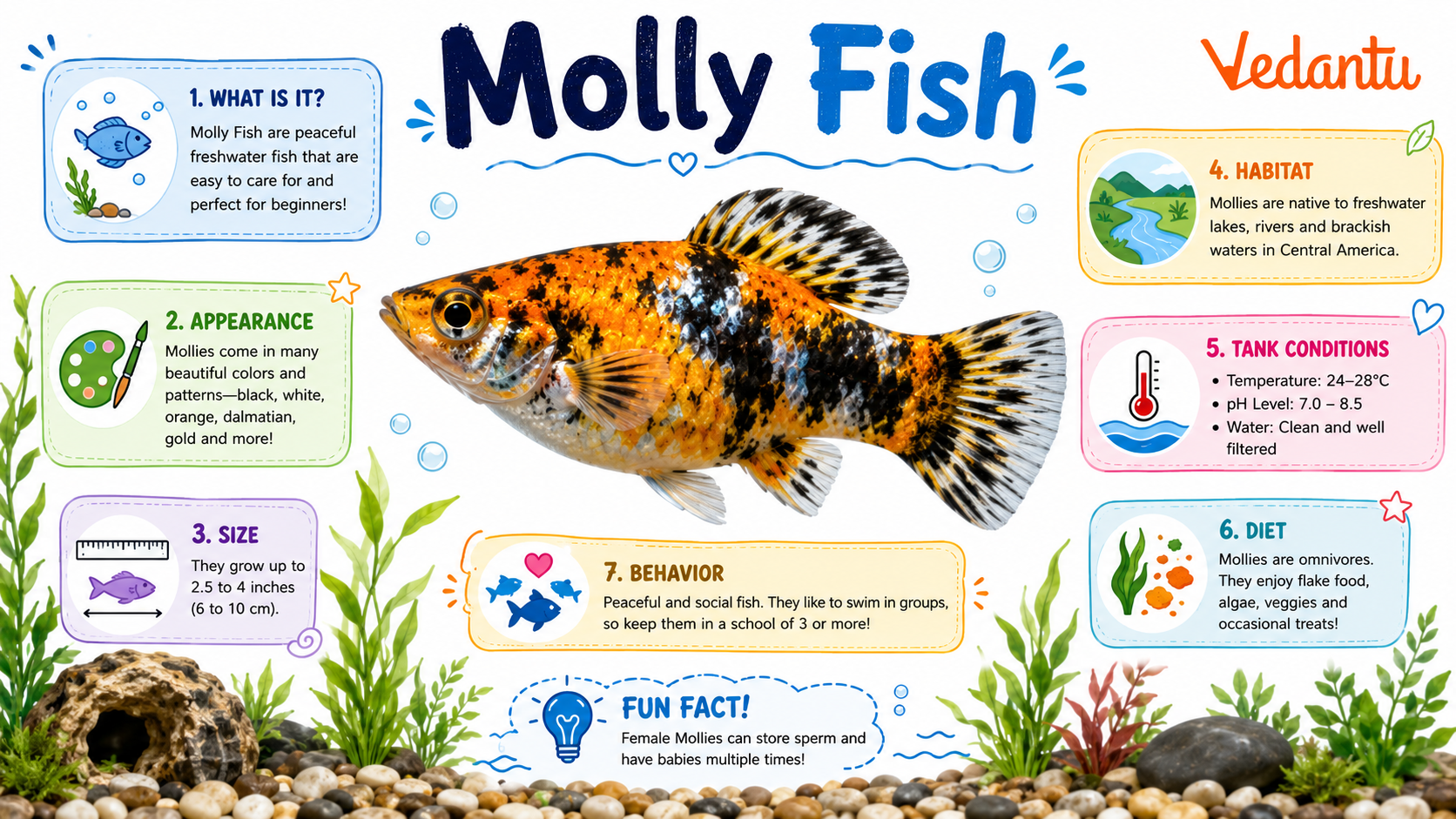
Quick Facts About Molly Fish
| Feature | Details |
|---|---|
| Common Name | Molly Fish |
| Scientific Name | Poecilia species |
| Animal Group | Fish |
| Size | 5–10 cm (2–4 inches) |
| Lifespan | 3–5 years |
| Habitat | Freshwater rivers, streams, and aquariums |
| Diet | Omnivore |
| Young One | Fry (live babies) |
| Special Feature | Gives birth to live young |
Appearance and Physical Characteristics
- Small, slim, and slightly flattened body.
- Available in many colours: black, orange, silver, white, and spotted patterns.
- Rounded or fan-shaped tail fin.
- Large, bright eyes.
- Males are usually smaller and more colourful than females.
Molly Fish Habitat and Distribution
- Originally found in North and Central America.
- Live in freshwater rivers, lakes, and slow-moving streams.
- Can also survive in slightly salty (brackish) water.
- Prefer warm water between 24°C and 28°C.
Today, Molly Fish are commonly found in home aquariums around the world. Their adaptable nature makes them easy to care for in tanks with clean, warm water.
Diet and Feeding Habits
- Molly Fish diet includes plants and small animals.
- They are omnivores.
- Eat algae, small insects, larvae, and fish flakes.
- Help control algae growth in aquariums.
In the wild, they nibble on algae and tiny water organisms. In aquariums, they enjoy flakes, pellets, and vegetable-based food.
Behaviour and Lifestyle
Molly Fish Life Cycle
- Mating: Male fertilises the female internally.
- Pregnancy: Female carries eggs inside her body for about 3–4 weeks.
- Birth: Gives birth to live baby fish called fry.
- Growth: Fry grow quickly and become adults in a few months.
Unlike many fish, Molly Fish do not lay eggs. They are live-bearing fish, which makes their life cycle very interesting.
Types of Molly Fish
What Makes Molly Fish Special?
Importance of Molly Fish
- Popular in the aquarium trade worldwide.
- Help maintain tank cleanliness by eating algae.
- Used in scientific studies on fish breeding and genetics.
- Teach children about aquatic life and responsibility.
Amazing Facts About Molly Fish
Fun Facts for Kids
- Molly Fish love to explore every corner of their tank.
- Baby Mollies are called fry.
- They can recognise feeding time quickly.
- Some Mollies shimmer in light.
- They are social and enjoy company.
FAQs on Molly Fish Care Guide for Beginners
1. What is a Molly Fish?
A Molly Fish is a small, colorful freshwater aquarium fish popular among beginners and kids.
- Scientific name: Poecilia
- Type: livebearer fish (gives birth to live babies)
- Habitat: freshwater and slightly brackish water
- Behavior: Peaceful and social community fish
- Common varieties: Black Molly, Dalmatian Molly, Balloon Molly
2. How big do Molly Fish grow?
Molly Fish usually grow between 3 to 5 inches long depending on the type and care.
- Females are usually larger than males
- Sailfin Mollies can grow up to 5 inches
- Growth depends on tank size, diet, and water quality
- They grow faster in clean, warm water conditions
3. What do Molly Fish eat?
Molly Fish are omnivores, which means they eat both plants and small animals.
- Fish flakes or pellets (main diet)
- Algae and plant matter
- Brine shrimp and bloodworms (as treats)
- Blanched vegetables like spinach or zucchini
4. How long do Molly Fish live?
Molly Fish usually live for about 3 to 5 years with proper care.
- Clean and filtered aquarium water increases lifespan
- Stable water temperature around 72–78°F (22–26°C)
- Healthy diet and low stress environment
- Regular tank cleaning and maintenance
5. Are Molly Fish good for beginners?
Yes, Molly Fish are great for beginners because they are hardy and easy to care for.
- Adapt well to different water conditions
- Peaceful community fish
- Simple feeding requirements
- Breed easily in home aquariums
6. Do Molly Fish need a heater?
Yes, Molly Fish need a heater to keep the water warm and stable.
- Ideal temperature: 72–78°F (22–26°C)
- Sudden temperature changes can cause stress
- Warm water supports healthy digestion and activity
- A thermometer helps monitor tank conditions
7. Can Molly Fish live with other fish?
Yes, Molly Fish can live peacefully with many other community fish.
- Good tank mates: Guppies, Platies, Tetras, Corydoras
- Avoid aggressive fish like large cichlids
- Keep them in groups for social comfort
- Provide enough space in the aquarium
8. How do Molly Fish reproduce?
Molly Fish are livebearers, meaning they give birth to live baby fish called fry.
- Females can give birth every 30–45 days
- One birth may produce 20–100 fry
- Pregnant females have a dark gravid spot
- Baby fry should be separated for safety
9. What size tank do Molly Fish need?
Molly Fish need at least a 10–20 gallon tank depending on how many you keep.
- Minimum 10 gallons for a small group
- Larger tanks provide better swimming space
- Use a filter for clean water
- Add plants and hiding spots
10. Why is my Molly Fish swimming at the top?
If your Molly Fish is swimming at the top, it may be seeking more oxygen or food.
- Low oxygen levels in the aquarium
- Poor water quality
- Normal feeding behavior
- Possible stress or illness
