






What Do Meerkats Eat, Where Do They Live, and How Do They Survive?
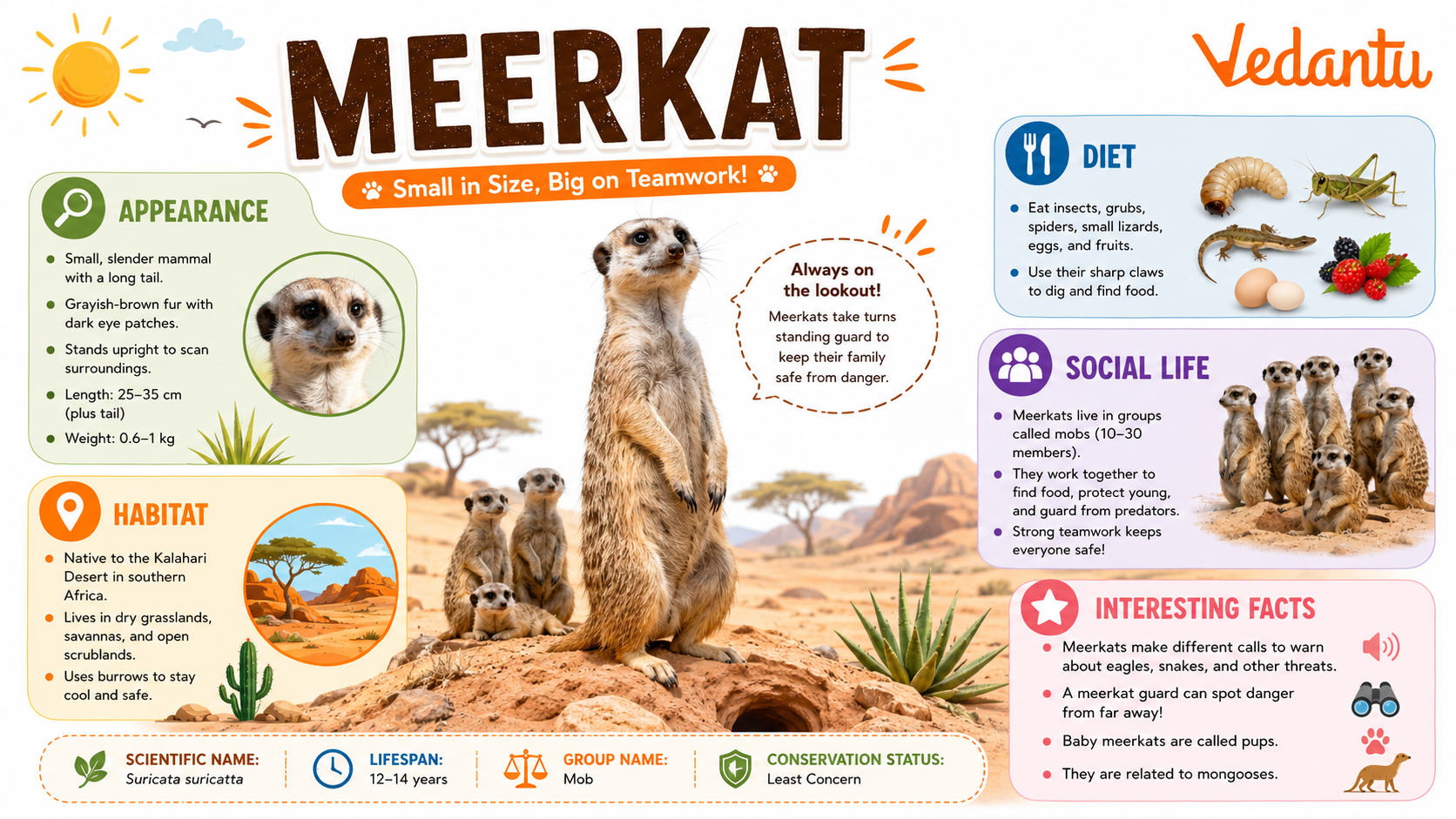
Quick Facts About Meerkat
| Feature | Details |
|---|---|
| Common Name | Meerkat |
| Scientific Name | Suricata suricatta |
| Animal Group | Mammal |
| Size | 25–35 cm (body length) |
| Weight | 0.6–1 kg |
| Lifespan | 10–14 years (in captivity) |
| Habitat | Deserts and grasslands |
| Diet | Insects, small animals, fruits |
| Found In | Southern Africa |
| Young One | Pup |
Appearance and Physical Characteristics
- Small, slender body with a pointed face.
- Short, sandy-brown fur with dark stripes on the back.
- Dark patches around the eyes to reduce sunlight glare.
- Long tail used for balance while standing upright.
- Sharp claws for digging burrows quickly.
Meerkat Habitat and Distribution
- Kalahari Desert
- Namibia
- Botswana
- South Africa
A typical meerkat habitat includes grasslands and deserts with little rainfall. Their burrows protect them from extreme heat during the day and cold temperatures at night.
Diet and Feeding Habits
Meerkats are mainly carnivores but may eat some fruits.
Insects, beetles, spiders, scorpions, and small reptiles.
They dig in the sand using sharp claws to find hidden prey.
They can eat scorpions by carefully removing the venomous sting.
Behaviour and Lifestyle
- Live in groups called mobs or clans (up to 30 members).
- Very social and cooperative animals.
- One meerkat stands guard while others search for food.
- Use different calls to warn about danger.
- Active during the day (diurnal).
Sound or Call
Meerkats make chirps, barks, and growls. Different sounds warn the group about aerial predators like eagles or ground predators like snakes.
Meerkat Life Cycle
- Birth: Female gives birth to 2–5 pups in an underground burrow.
- Baby Stage: Pups are blind at birth and depend fully on adults.
- Learning Stage: Adults teach pups how to find and handle prey.
- Adult Stage: Grow into responsible group members and may become lookouts.
What Makes Meerkat Special?
Importance and Role in Nature
- Controlling insect populations.
- Serving as prey for larger animals.
- Helping maintain balance in desert ecosystems.
Amazing Meerkat Facts
Fun Facts for Kids
- Meerkats look like they are always posing for a photo!
- They love sunbathing in the morning.
- A group of meerkats is called a mob.
- They are related to mongooses.
- They are small but very brave.
FAQs on Meerkat Animal Guide: Facts, Habitat, and Behavior
1. What is a Meerkat?
A meerkat is a small, social mammal that lives in the deserts of southern Africa and is known for standing upright on its hind legs.
- Scientific name: Suricata suricatta
- Belongs to the mongoose family
- Found in South Africa, Botswana, Namibia, and Angola
- Famous for their upright “sentinel” pose
2. Where do meerkats live?
Meerkats live in dry, open areas of southern Africa, especially deserts and grasslands.
- Common in the Kalahari Desert
- Prefer savannas and open plains
- Live in large underground burrows
- Burrows protect them from heat and predators
3. What do meerkats eat?
Meerkats are omnivores that mostly eat insects but also enjoy small animals and plants.
- Main food: insects like beetles and termites
- Also eat spiders and scorpions
- Sometimes hunt small reptiles and rodents
- Occasionally eat fruits and roots
4. Why do meerkats stand on their hind legs?
Meerkats stand upright to watch for danger and protect their group.
- This behavior is called being a sentinel
- They look out for eagles, snakes, and jackals
- Use sharp eyesight to scan the area
- Warn others with a special alarm call
5. Do meerkats live alone or in groups?
Meerkats live in large social groups called mobs or clans.
- Groups can have up to 50 members
- Work together to find food
- Take turns guarding the group
- Help raise each other’s babies
6. How big is a meerkat?
A meerkat is a small animal about the size of a squirrel.
- Length: around 25–35 cm (10–14 inches)
- Tail adds another 17–25 cm
- Weight: about 1–2 pounds
- Have slim bodies and pointed faces
7. What are baby meerkats called?
Baby meerkats are called pups.
- Born in underground burrows
- Usually 2–5 pups in one litter
- Cared for by the whole mob
- Learn hunting skills as they grow
8. Are meerkats dangerous to humans?
Meerkats are generally not dangerous to humans but are still wild animals.
- Usually shy and avoid people
- May bite if they feel threatened
- Have sharp teeth and claws
- Should not be kept as pets
9. How long do meerkats live?
Meerkats live around 6–8 years in the wild and can live longer in captivity.
- Wild lifespan: about 6–8 years
- In zoos: up to 12–14 years
- Main threats: predators and harsh weather
- Group living helps increase survival
10. What are some interesting facts about meerkats?
Meerkats have many unique features that make them fascinating desert animals.
- Have dark patches around eyes to reduce sun glare
- Are immune to some scorpion venom
- Use different calls for different dangers
- Work as a team to survive in harsh desert environments
