






Why Did the Hawaii Mamo Bird Become Extinct?
The Mamo was a beautiful Hawaiian bird known for its shiny black feathers and bright yellow patches. It belonged to a special group of birds called Hawaiian honeycreepers. Sadly, the Mamo is now extinct, but it remains an important part of Hawaii’s natural and cultural history. Learning about Mamo facts, Mamo habitat, and its life story helps us understand why protecting wildlife is so important.
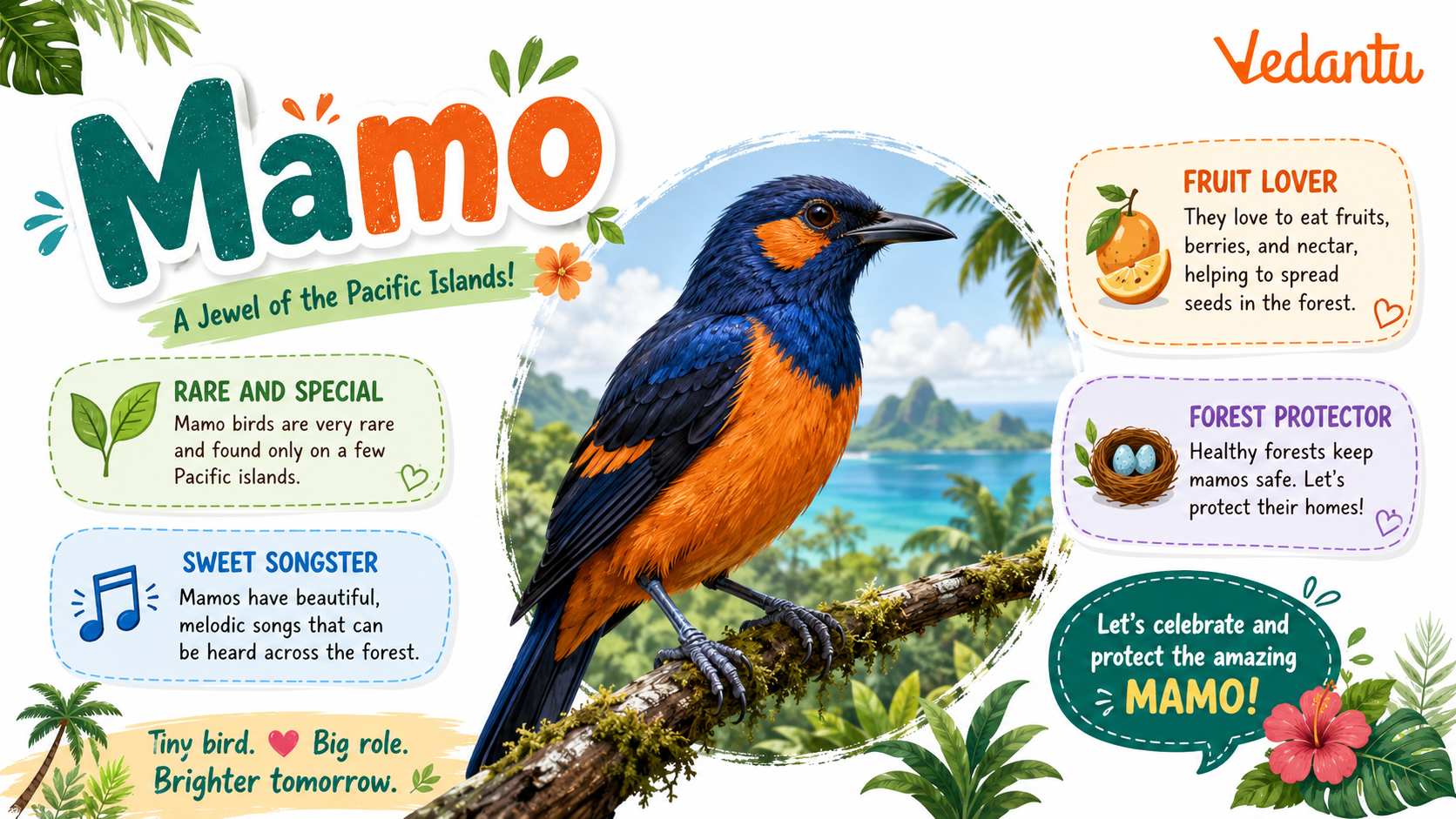
Quick Facts About Mamo
| Feature | Details |
|---|---|
| Common Name | Mamo |
| Scientific Name | Drepanis pacifica |
| Animal Group | Bird |
| Family | Hawaiian Honeycreepers |
| Size | About 20–23 cm long |
| Diet | Nectar and insects |
| Habitat | Forests of Hawaii (Big Island) |
| Conservation Status | Extinct |
Appearance and Physical Characteristics
- Glossy black feathers covering most of the body.
- Bright yellow feathers on the rump and under the wings.
- Long, curved beak specially shaped for drinking nectar.
- Strong legs for perching on tree branches.
- Medium-sized forest bird with a slim body.
Mamo Habitat and Distribution
- Lived only in the forests of the Big Island of Hawaii.
- Preferred tropical mountain forests.
- Often found in areas rich in flowering trees.
- Stayed high in the forest canopy.
The Mamo habitat was limited to a small region. Because it lived only in Hawaii, it was very sensitive to environmental changes.
Mamo Diet and Feeding Habits
Behaviour and Lifestyle
- Active during the day (diurnal bird).
- Likely moved quickly between flowering trees.
- Probably lived alone or in pairs.
- Used calls and songs to communicate.
Life Cycle of the Mamo
- Egg Stage: Female likely laid eggs in a tree nest.
- Chick Stage: Baby birds were fed nectar and insects.
- Young Bird: Grew feathers and learned to fly.
- Adult Stage: Reached full size and reproduced.
Like other birds, the Mamo life cycle included egg, chick, young bird, and adult stages.
What Made the Mamo Special?
Why Did the Mamo Become Extinct?
- Habitat destruction due to human settlement.
- Hunting for its beautiful yellow feathers.
- Diseases spread by introduced mosquitoes.
- Predators like rats and cats brought by humans.
Importance and Role in Nature
Amazing Mamo Facts
- The Mamo was one of the largest Hawaiian honeycreepers.
- It had a long, sickle-shaped beak.
- It lived only on one Hawaiian island.
- Its feathers were brighter than many other honeycreepers.
- The last confirmed sighting was in the late 1800s.
- It is now known only from museum specimens and drawings.
Interesting Facts About Mamo
Fun Facts for Kids
- Mamo was a forest bird with shiny black feathers.
- It loved sweet flower nectar.
- Its yellow feathers were very special.
- It lived high up in trees.
- Today, we learn about it from history books and museums.
FAQs on Mamo Bird: History, Habitat, and Unique Traits
1. What is Mamo?
Mamo is a name that can refer to a person, nickname, or cultural term used in different parts of the world.
- Mamo is often used as a given name or family name.
- In some cultures, it may be a nickname for a loved one.
- The meaning of Mamo depends on the country and language.
2. What does the name Mamo mean?
The meaning of Mamo depends on its cultural background and language.
- In some African regions, Mamo may be connected to family heritage.
- It can sometimes mean beloved or be linked to a respected person.
- The exact definition changes based on local traditions.
3. Where does the name Mamo come from?
Mamo has roots in different parts of the world, especially in African and Latin-based cultures.
- It is commonly found in countries like Ethiopia.
- It may also appear in Spanish or Italian communities.
- The origin depends on family history and regional language.
4. Is Mamo a boy or girl name?
Mamo can be used as both a boy’s name and a girl’s name, depending on culture.
- In some regions, it is more common for boys.
- In others, it may be a unisex name.
- Family traditions often decide how it is used.
5. Is Mamo a common name?
Mamo is not very common worldwide, but it is familiar in certain communities.
- It appears more often in Ethiopian families.
- It may be used as a surname in some countries.
- Its popularity depends on region and culture.
6. Can Mamo be a nickname?
Yes, Mamo can be used as a sweet and friendly nickname.
- Families may call children Mamo as a term of love.
- It can be short for longer names.
- Nicknames like Mamo often show affection and closeness.
7. Are there famous people named Mamo?
Yes, there are notable people with the name Mamo, especially in sports and public life.
- Some athletes and public figures carry the name.
- It may appear as both a first name and a last name.
- Recognition depends on the country.
8. How do you pronounce Mamo?
Mamo is usually pronounced as "MAH-moh".
- The first syllable sounds like “ma” in “mama.”
- The second syllable sounds like “mo” in “more.”
- Pronunciation can change slightly by accent.
9. What makes the name Mamo special?
Mamo is special because it carries cultural meaning and family history.
- It may connect to heritage and traditions.
- It is often a unique and rare name.
- It can show identity and pride.
10. How can kids learn more about the name Mamo?
Kids can learn about Mamo by exploring culture, language, and family stories.
- Ask parents or grandparents about family history.
- Read about world names and their meanings.
- Explore maps to find where Mamo is common.
