






What Do Lorises Eat, Where Do They Live, and Why Are They Unique?
The Loris is a small, tree-living mammal known for its huge round eyes and slow, careful movements. Found mainly in Asia, this shy animal is active at night and spends most of its life in trees. Loris facts show that it is one of the few venomous mammals in the world. With its soft fur and strong grip, the Loris is perfectly adapted to life in forests. Let’s explore its habitat, diet, characteristics, and more.
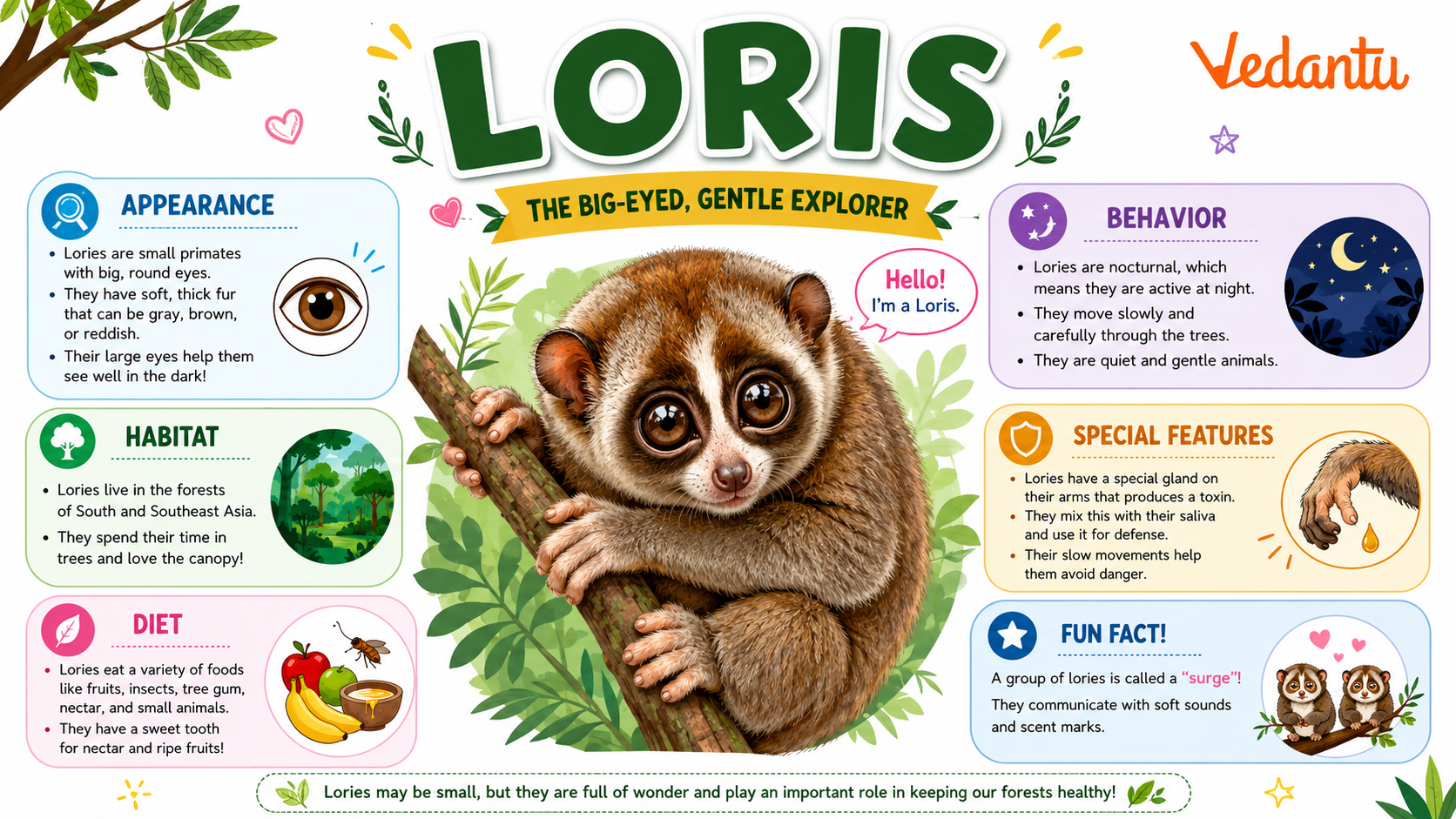
Quick Facts About Loris
| Feature | Details |
|---|---|
| Common Name | Loris |
| Scientific Genus | Loris / Nycticebus (Slow Loris) |
| Animal Group | Mammal |
| Size | 18–38 cm long |
| Weight | 300 g to 2 kg |
| Habitat | Tropical forests and woodlands |
| Diet | Insects, fruits, tree sap |
| Lifespan | 15–20 years (in captivity) |
| Conservation Status | Threatened / Endangered (varies by species) |
Appearance and Physical Characteristics
- Large, round eyes for excellent night vision.
- Small, compact body with soft brown or grey fur.
- Short or almost invisible tail.
- Strong hands and feet with a powerful grip.
- Special gland near the elbow that produces venom.
Loris Habitat and Distribution
- Found in South and Southeast Asia.
- Lives in India, Sri Lanka, Indonesia, Thailand, and nearby regions.
- Prefers tropical rainforests, bamboo forests, and dense woodlands.
- Spends most of its time high in trees.
- Sleeps curled up on branches during the day.
Loris Diet and Feeding Habits
Eats beetles, ants, termites, and other small insects.
Enjoys soft fruits and tree gum or sap.
Sometimes eats small birds or eggs.
Moves quietly and slowly to catch prey without being noticed.
Behaviour and Lifestyle
- Nocturnal – active at night.
- Mostly solitary but may share territory.
- Moves slowly and carefully to avoid predators.
- Communicates using soft calls and scent markings.
- Defends itself using a venomous bite.
Loris Life Cycle
- Birth: Female gives birth to 1–2 babies after about 6 months of pregnancy.
- Baby Stage: Babies cling to the mother’s belly or are parked on branches.
- Growing Up: Young lorises learn climbing and hunting skills.
- Adult Stage: Become independent after several months.
What Makes the Loris Special?
Importance and Role in Nature
- Controls insect populations.
- Helps maintain forest ecosystem balance.
- Part of the food chain in tropical forests.
- Important for biodiversity conservation.
Amazing Loris Facts
Fun Facts for Kids
- Lorises look like they are always surprised because of their big eyes.
- They hug tree branches tightly while climbing.
- They are very quiet and shy animals.
- They sleep during the day and play at night.
- They are protected by wildlife laws in many countries.
FAQs on Loris Animal Guide: Facts, Habitat, and Behavior
1. What is a loris?
A loris is a small, slow-moving primate with big eyes that lives in trees in Asia and Africa.
- Belongs to the primate family, like monkeys and lemurs
- Known for its large round eyes and gentle movements
- Active mostly at night (nocturnal animal)
- Lives in forests and tropical jungles
2. Where do lorises live?
Lorises live in warm forest regions of South Asia and Southeast Asia.
- Found in countries like India, Sri Lanka, Thailand, and Indonesia
- Prefer rainforests, tropical forests, and dense woodlands
- Spend most of their time in trees
3. Why do lorises have big eyes?
Lorises have big eyes to help them see clearly in the dark.
- They are nocturnal animals, active at night
- Large eyes improve night vision
- Help them find food and avoid predators
4. What do lorises eat?
Lorises are omnivores that eat both plants and small animals.
- Fruits and tree sap
- Insects like ants and beetles
- Small animals such as lizards and birds
- Leaves and nectar
5. Are lorises poisonous?
Yes, the slow loris is one of the only venomous primates in the world.
- Has special glands near its elbows
- Mixes toxin with saliva to create venom
- Uses venom for self-defense
6. How do lorises move?
Lorises move very slowly and carefully along tree branches.
- Have a strong grip with hands and feet
- Climb silently to avoid predators
- Rarely jump like other primates
7. Are lorises endangered?
Yes, many species of lorises are endangered due to habitat loss and illegal pet trade.
- Forests are being cut down
- Captured for the exotic pet market
- Protected by wildlife laws in many countries
8. How big is a loris?
A loris is a small primate, usually about the size of a squirrel.
- Length: 7 to 15 inches
- Weight: 1 to 3 pounds
- Has a short or almost invisible tail
9. How long do lorises live?
Lorises can live for many years, especially in safe environments.
- Live about 15 to 20 years in captivity
- May live shorter lives in the wild
- Lifespan depends on food, safety, and habitat
10. Is a loris a good pet?
No, a loris is not a good pet because it is a wild and protected animal.
- Needs special forest habitat
- Has a venomous bite
- Illegal to own in many countries
- Belongs in the wild for conservation
