






What Do Jellyfish Eat, Where Do They Live, and How Do They Survive?
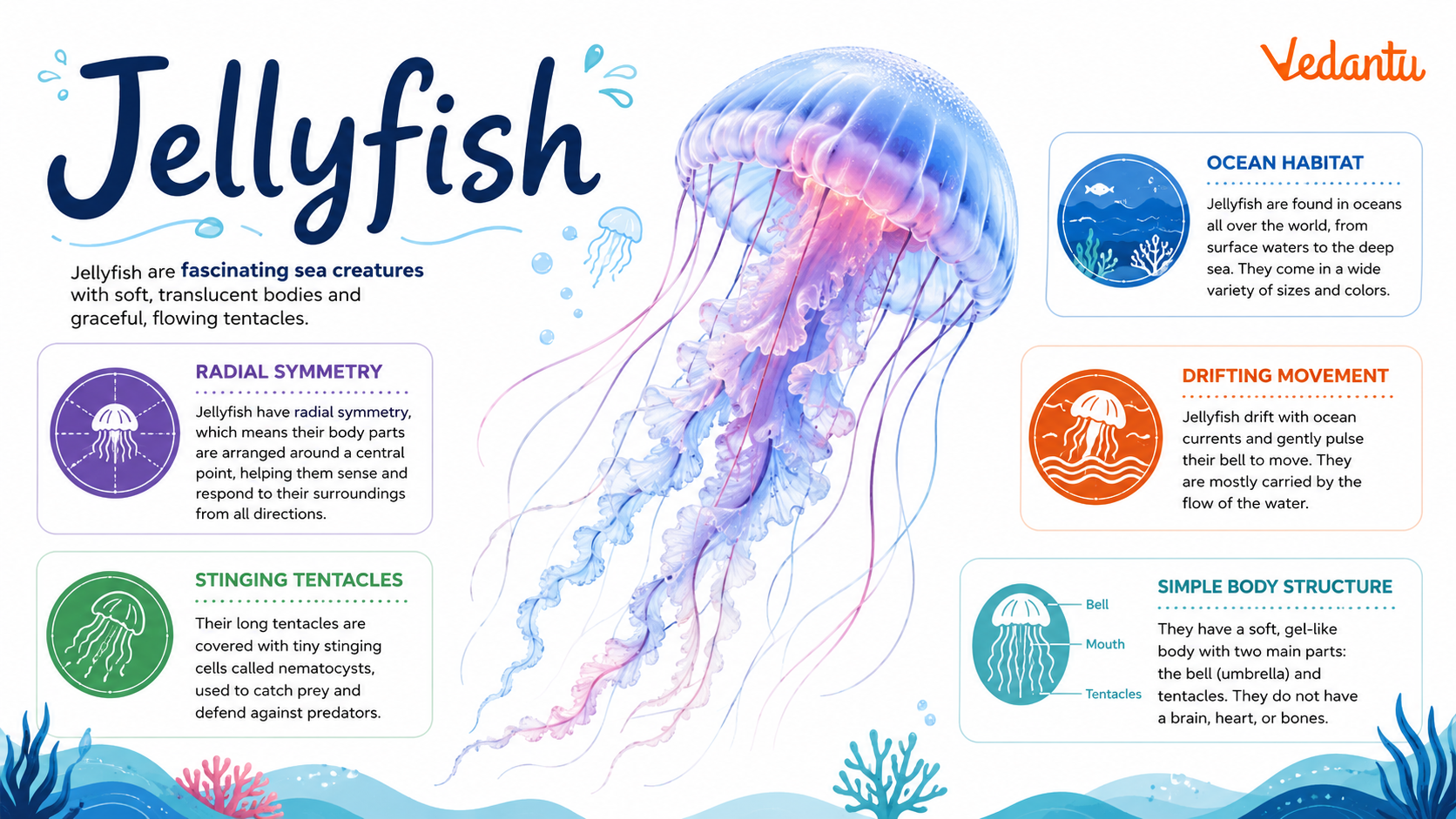
Jellyfish are soft, umbrella-shaped sea animals that float and drift through oceans around the world. Even though they look simple and delicate, they have special stinging cells that help them catch food and protect themselves. Jellyfish have been living on Earth for more than 500 million years, making them older than dinosaurs! Let’s explore fascinating jellyfish facts, their habitat, diet, characteristics, and why they are important in marine ecosystems.
Quick Facts About Jellyfish
| Feature | Details |
|---|---|
| Common Name | Jellyfish |
| Animal Group | Invertebrate (Cnidarian) |
| Body Composition | About 95% water |
| Habitat | Oceans worldwide |
| Diet | Plankton, small fish, shrimp |
| Lifespan | Few months to several years (varies by species) |
| Special Feature | Stinging cells called nematocysts |
Appearance and Physical Characteristics
- Transparent or lightly coloured body (blue, pink, purple, or clear).
- Long tentacles hanging from the bell.
- No brain, no heart, and no bones.
- Single opening used as both mouth and anus.
- Body made mostly of water.
Jellyfish Habitat and Distribution
- Found in all oceans, from warm tropical waters to cold Arctic seas.
- Some species live near the surface, while others stay in deep waters.
- Often seen drifting near coastlines.
- Prefer saltwater, but a few species can live in freshwater.
Jellyfish Diet and Feeding Habits
- Carnivores – they eat other small marine animals.
- Main food: plankton, fish eggs, small fish, and tiny crustaceans.
- Use tentacles with venom to stun prey.
- Bring captured food to their mouth using their arms.
Behaviour and Lifestyle
- Mostly drift with ocean currents.
- Some species gather in large groups called blooms.
- Do not have a central brain but have a simple nerve network.
- Defend themselves using stinging tentacles.
Jellyfish Life Cycle
- Egg Stage: Female releases eggs into water.
- Larva Stage: Tiny larvae float freely.
- Polyp Stage: Attaches to a surface and grows.
- Medusa Stage: Adult jellyfish swims freely.
What Makes Jellyfish Special?
Importance of Jellyfish in Nature
Amazing Jellyfish Facts
- Some jellyfish have tentacles longer than a blue whale.
- The box jellyfish is one of the most venomous animals in the world.
- Jellyfish do not have blood.
- They breathe through their skin.
- Moon jellyfish are one of the most common types.
- Jellyfish can shrink in size when food is scarce.
Fun Facts for Kids
FAQs on Jellyfish: Fascinating Facts About These Ocean Drifters
1. What is a jellyfish?
A jellyfish is a soft-bodied marine animal that lives in oceans around the world.
- It belongs to the group called cnidarians.
- It has a jelly-like umbrella-shaped body called a bell.
- It does not have a brain, heart, or bones.
- It uses tentacles to catch food.
2. Do jellyfish have brains or hearts?
No, jellyfish do not have a brain, heart, or bones.
- They have a simple nerve net instead of a brain.
- They move using muscle contractions in their bell.
- Oxygen moves through their thin body by diffusion.
3. Where do jellyfish live?
Jellyfish live in oceans all over the world, from warm beaches to deep seas.
- They are found in saltwater oceans.
- Some species live near the coast.
- Others live in the deep sea or cold Arctic waters.
4. How do jellyfish sting?
Jellyfish sting using special cells in their tentacles called nematocysts.
- These cells release tiny, sharp barbs.
- The sting helps them catch prey like fish and plankton.
- Some stings can hurt humans, while others are harmless.
5. What do jellyfish eat?
Jellyfish are carnivores that eat small sea animals.
- They feed on plankton.
- They catch small fish and fish eggs.
- Some large species eat other jellyfish.
6. How do jellyfish move in the water?
Jellyfish move by pulsing their bell to push water behind them.
- This movement is called jet propulsion.
- They mostly drift with ocean currents.
- They are not strong swimmers.
7. Are all jellyfish dangerous?
No, not all jellyfish are dangerous to humans.
- Many species have mild or harmless stings.
- The box jellyfish is one of the most dangerous.
- It is important to avoid touching any wild marine life.
8. How long do jellyfish live?
The lifespan of a jellyfish depends on its species.
- Some live for only a few months.
- Others can live for several years.
- The immortal jellyfish (Turritopsis dohrnii) can restart its life cycle.
9. What is the life cycle of a jellyfish?
Jellyfish have a unique life cycle with different stages.
- They begin as a tiny larva.
- They grow into a polyp attached to a surface.
- They later become a free-swimming medusa (adult jellyfish).
10. Why are jellyfish important to the ocean?
Jellyfish play an important role in the marine ecosystem.
- They are both predators and prey.
- They help control plankton populations.
- They provide food for animals like sea turtles and some fish.
