






What Do Jackals Eat, Where Do They Live, and How Do They Survive?
The jackal is a smart and adaptable wild animal known for its sharp senses and survival skills. Found mainly in Africa and parts of Asia, jackals are closely related to dogs, wolves, and foxes. They are famous for their loud howls and clever hunting techniques. Learning about jackal facts, jackal habitat, and jackal characteristics helps us understand how these intelligent mammals survive in different environments.
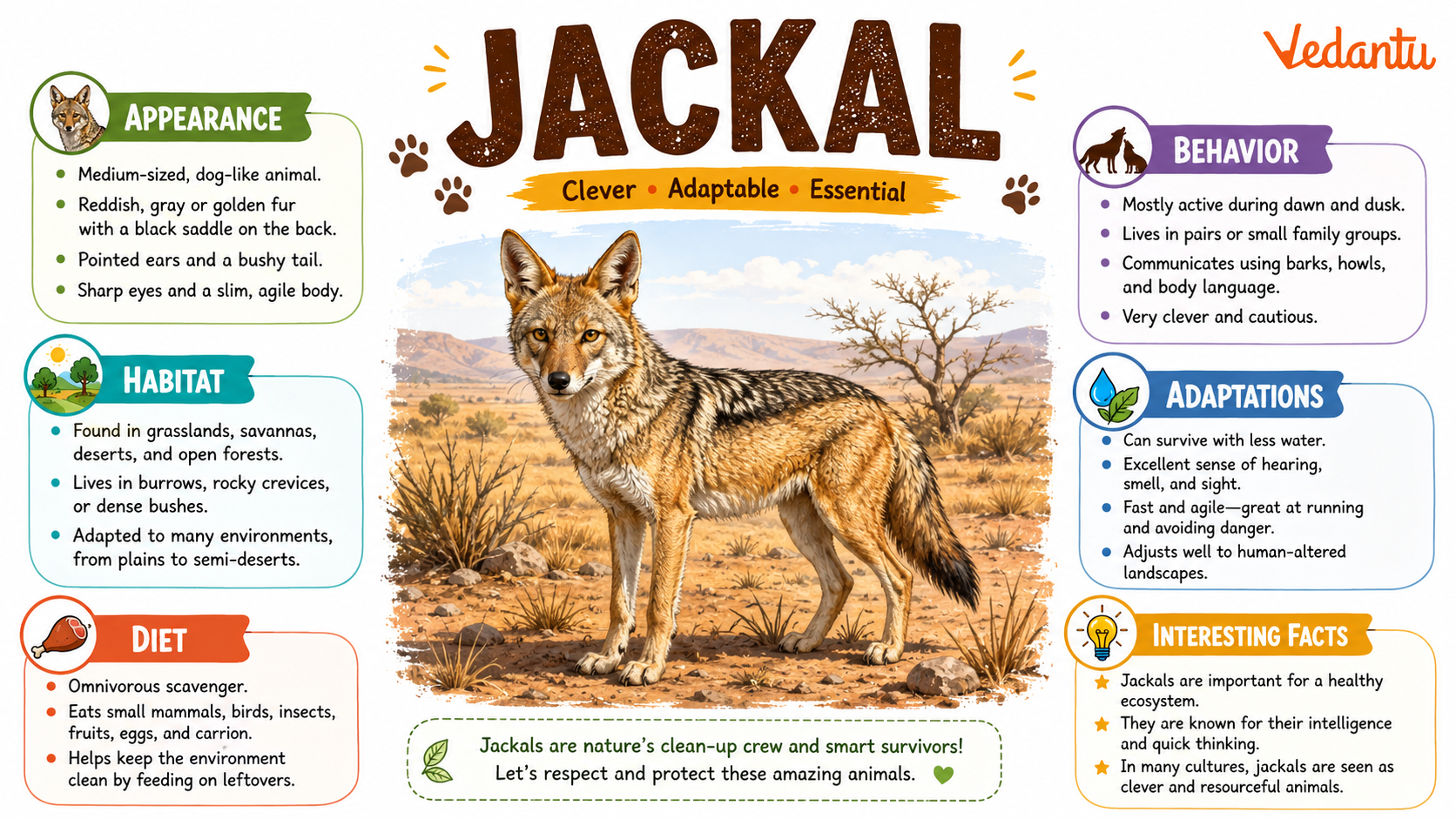
Quick Facts About Jackal
| Feature | Details |
|---|---|
| Common Name | Jackal |
| Scientific Name | Canis species (e.g., Canis aureus) |
| Animal Group | Mammal |
| Family | Canidae (Dog family) |
| Size | 60–105 cm (body length) |
| Weight | 6–15 kg |
| Lifespan | 8–12 years (in the wild) |
| Habitat | Grasslands, deserts, savannas, forests |
| Diet | Omnivore (meat, fruits, insects) |
| Young One | Pup |
Appearance and Physical Characteristics
- Medium-sized body with long legs.
- Pointed ears and sharp muzzle.
- Fur colour ranges from golden-brown to grey.
- Bushy tail with a dark tip.
- Sharp teeth for tearing meat.
Habitat and Distribution
Jackal habitat includes a wide range of environments. They are highly adaptable and can survive in both dry and semi-wet regions.
- Found mainly in Africa, the Middle East, and South Asia.
- Live in grasslands, deserts, savannas, and open woodlands.
- Can adjust to areas near human settlements.
- Make dens in burrows or thick bushes.
Diet and Feeding Habits
The jackal diet is very flexible. Being omnivores, they eat both plants and animals.
Small animals like rodents, birds, rabbits, and reptiles.
Feed on leftovers from larger predators like lions.
Fruits, berries, and roots.
Often hunt alone or in pairs during night.
Behaviour and Lifestyle
- Mostly nocturnal (active at night).
- Live alone, in pairs, or small family groups.
- Communicate using howls, yelps, and barks.
- Very alert and cautious animals.
- Mark territory using scent.
Sound or Call
Jackals are famous for their loud, high-pitched howls. They howl to communicate with family members and to warn others to stay away from their territory.
Life Cycle of a Jackal
- Mating: Usually during specific seasons.
- Birth: Female gives birth to 2–6 pups in a den.
- Pup Stage: Blind at birth, depend on mother’s milk.
- Growing Up: Start eating solid food after a few weeks.
- Adult Stage: Become independent in about 6–11 months.
Types of Jackals
Found in Africa, Europe, and Asia.
Has a black patch on its back, found in Africa.
Has white stripes along its sides.
Earlier considered a jackal, now classified separately.
Importance and Role in Nature
Amazing Jackal Facts
Fun Facts for Kids
- A baby jackal is called a pup.
- Jackals sometimes follow lions to find food.
- They look like a mix of a dog and a fox.
- Jackals can live near villages without being noticed.
- Their howls can be heard from far away!
FAQs on Jackal Animal Guide: Facts, Habitat, and Behavior
1. What is a jackal?
A jackal is a medium-sized wild dog that belongs to the Canidae family, the same family as wolves, foxes, and domestic dogs.
- It is a carnivorous mammal found in Africa, Asia, and parts of Europe.
- Jackals have pointed ears, bushy tails, and sharp teeth.
- They are known for their loud howling and yelping sounds.
- There are three main species: Golden Jackal, Black-backed Jackal, and Side-striped Jackal.
2. Where do jackals live?
Jackals live in warm regions with open land and light forests.
- They are commonly found in African savannas and grasslands.
- The Golden Jackal also lives in Asia and southeastern Europe.
- They prefer deserts, woodlands, and plains.
- Jackals often dig dens in the ground for shelter and raising pups.
3. What do jackals eat?
Jackals are omnivores, meaning they eat both meat and plants.
- They hunt small animals like rabbits, rodents, birds, and reptiles.
- They also eat insects, fruits, and berries.
- Jackals sometimes act as scavengers, feeding on leftovers from larger predators.
- Their flexible diet helps them survive in different habitats.
4. Are jackals dangerous to humans?
Jackals are generally not dangerous to humans and avoid people.
- They are shy and prefer to run away if approached.
- Most jackals hunt small prey, not large animals.
- Rare problems happen when jackals search for food near villages.
- Like all wild animals, they should not be fed or disturbed.
5. How are jackals different from wolves and foxes?
Jackals are smaller than wolves but bigger than most foxes, with features of both animals.
- Wolves are larger and hunt in bigger packs.
- Foxes are usually smaller with bushier tails.
- Jackals often live in pairs or small family groups.
- All three belong to the dog family (Canidae).
6. How do jackals communicate?
Jackals communicate using sounds, body language, and scent marking.
- They make howls, yelps, and high-pitched calls.
- Howling helps them locate family members.
- They use scent markings to protect their territory.
- Body movements show warning or friendliness.
7. How long do jackals live?
Jackals usually live around 8 to 10 years in the wild.
- In protected areas or zoos, they may live up to 12–16 years.
- Their lifespan depends on food supply, predators, and habitat safety.
- Young jackals are called pups.
8. What are the types of jackals?
There are three main types of jackals found in the wild.
- Golden Jackal (Canis aureus) – Found in Africa, Asia, and Europe.
- Black-backed Jackal (Canis mesomelas) – Recognized by its dark back, found in Africa.
- Side-striped Jackal (Canis adustus) – Identified by light stripes on its sides.
9. Do jackals hunt alone or in packs?
Jackals usually hunt in pairs or small family groups.
- They often form monogamous pairs (one male and one female).
- Small groups help them catch larger prey.
- Sometimes they hunt alone for insects or small animals.
- Family teamwork improves survival in the wild.
10. Why are jackals important to the ecosystem?
Jackals play an important role in keeping ecosystems clean and balanced.
- As scavengers, they clean up dead animals.
- As predators, they control populations of rodents and pests.
- They help spread seeds by eating fruits.
- This balance supports healthy wildlife habitats and biodiversity.
