






Where Do Hammerhead Sharks Live, What Do They Eat, and Why Is Their Head Shaped Like a Hammer?
The Hammerhead Shark is one of the most unusual and fascinating ocean predators. Known for its wide, hammer-shaped head, this shark is easy to recognise in the sea. Found in warm oceans around the world, hammerheads are powerful swimmers and skilled hunters. In this page, you will explore Hammerhead Shark facts, habitat, diet, life cycle, characteristics, and importance in marine ecosystems in a simple and exciting way.
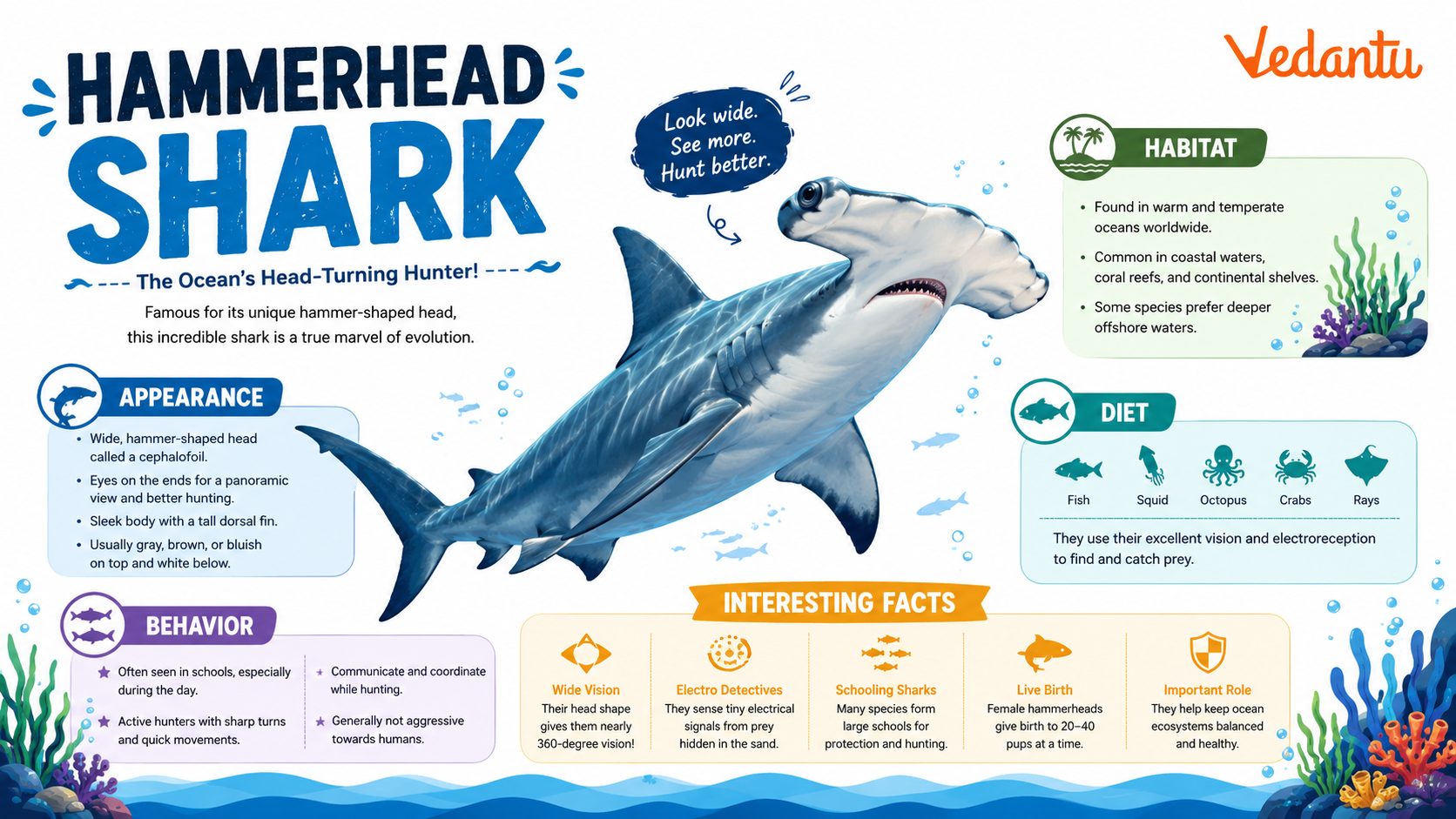
Quick Facts About Hammerhead Shark
| Feature | Details |
|---|---|
| Common Name | Hammerhead Shark |
| Scientific Family | Sphyrnidae |
| Animal Group | Fish (Cartilaginous Fish) |
| Length | Up to 20 feet (depending on species) |
| Weight | Up to 450 kg (Great Hammerhead) |
| Habitat | Warm tropical and temperate oceans |
| Diet | Fish, squid, octopus, stingrays |
| Lifespan | 20–30 years |
| Conservation Status | Some species are Endangered |
Appearance and Physical Characteristics
- Wide, flat head shaped like a hammer (called a cephalofoil).
- Eyes placed at both ends of the head for a wider field of vision.
- Smooth grey or olive-green body with a lighter belly.
- Strong, muscular body built for fast swimming.
- Sharp triangular teeth for catching prey.
Hammerhead Shark Habitat and Distribution
- Found in warm tropical and temperate oceans worldwide.
- Common in the Atlantic, Indian, and Pacific Oceans.
- Often seen near coastlines, coral reefs, and continental shelves.
- Some species migrate long distances in groups.
Diet and Feeding Habits
- Carnivorous predator.
- Eats fish, squid, octopus, and crustaceans.
- Especially known for hunting stingrays.
- Uses its wide head to pin stingrays to the ocean floor.
Behaviour and Lifestyle
- Some species are solitary, while others form large schools.
- Active swimmers and strong hunters.
- Usually hunt at night.
- Use electroreception to sense hidden prey.
Hammerhead Shark Life Cycle
- Mating: Males fertilise females internally.
- Birth: Unlike many fish, they give birth to live young.
- Pups: Babies are called pups and are born fully formed.
- Growth: Young sharks grow quickly and learn to hunt.
- Adult Stage: Reach maturity in several years and live up to 30 years.
What Makes Hammerhead Sharks Special?
Importance and Role in Nature
Amazing Hammerhead Shark Facts
- There are about 9 known species of hammerhead sharks.
- The Great Hammerhead is the largest species.
- They can swim long distances during migration.
- Their head shape improves turning ability in water.
- They are more active at night.
- Some species are threatened due to overfishing.
Fun Facts for Kids
- A baby hammerhead is called a pup.
- Their head looks like a big “T” shape.
- They can find hidden fish under sand.
- Some travel in groups like a fish parade!
- They have skeletons made of cartilage, not bones.
FAQs on Hammerhead Shark: Amazing Facts About This Unique Ocean Predator
1. What is a Hammerhead Shark?
A Hammerhead Shark is a type of shark known for its unique hammer-shaped head called a cephalofoil.
- Belongs to the Sphyrnidae family
- Found in warm and tropical oceans worldwide
- Uses its wide head to detect prey easily
- Is one of the most recognizable marine animals in the ocean
2. Why do Hammerhead Sharks have hammer-shaped heads?
The hammer-shaped head helps Hammerhead Sharks find food and see better.
- Improves 360-degree vision
- Contains special sensors to detect electric signals from prey
- Helps pin down stingrays on the ocean floor
- Enhances better movement and balance in water
3. What do Hammerhead Sharks eat?
Hammerhead Sharks are carnivores that eat a variety of sea animals.
- Stingrays (their favorite food)
- Small fish
- Squid and octopus
- Crustaceans like crabs
4. Are Hammerhead Sharks dangerous to humans?
Hammerhead Sharks are generally not dangerous to humans and rarely attack people.
- Most species are shy and avoid swimmers
- Very few attacks have ever been recorded
- Humans are not part of their natural diet
- They prefer hunting fish and stingrays
5. Where do Hammerhead Sharks live?
Hammerhead Sharks live in warm, tropical, and temperate oceans around the world.
- Near coastlines and continental shelves
- Around coral reefs
- In open ocean waters
- Sometimes in shallow bays
6. How big can a Hammerhead Shark grow?
The size of a Hammerhead Shark depends on the species.
- Most grow between 10 to 14 feet long
- The Great Hammerhead Shark can reach up to 20 feet
- Can weigh over 1,000 pounds
- Females are usually larger than males
7. How many species of Hammerhead Sharks are there?
There are about 9 different species of Hammerhead Sharks.
- Great Hammerhead
- Scalloped Hammerhead
- Smooth Hammerhead
- Bonnethead Shark
8. How do Hammerhead Sharks reproduce?
Hammerhead Sharks give birth to live babies instead of laying eggs.
- They are viviparous sharks
- Babies develop inside the mother
- A mother can give birth to 12–50 pups at once
- Pups are independent right after birth
9. Why are Hammerhead Sharks endangered?
Many Hammerhead Sharks are endangered species due to human activities.
- Overfishing and shark finning
- Accidental capture in fishing nets
- Habitat loss
- Slow reproduction rate
10. What makes Hammerhead Sharks special compared to other sharks?
Hammerhead Sharks are special because of their unusual head shape and strong hunting skills.
- Wide-set eyes for better vision
- Special electroreceptors to sense prey
- Unique social behavior, sometimes swimming in schools
- Highly skilled ocean predators
