






Gar Fish Facts: Habitat, Diet, Species Types, and Unique Adaptations
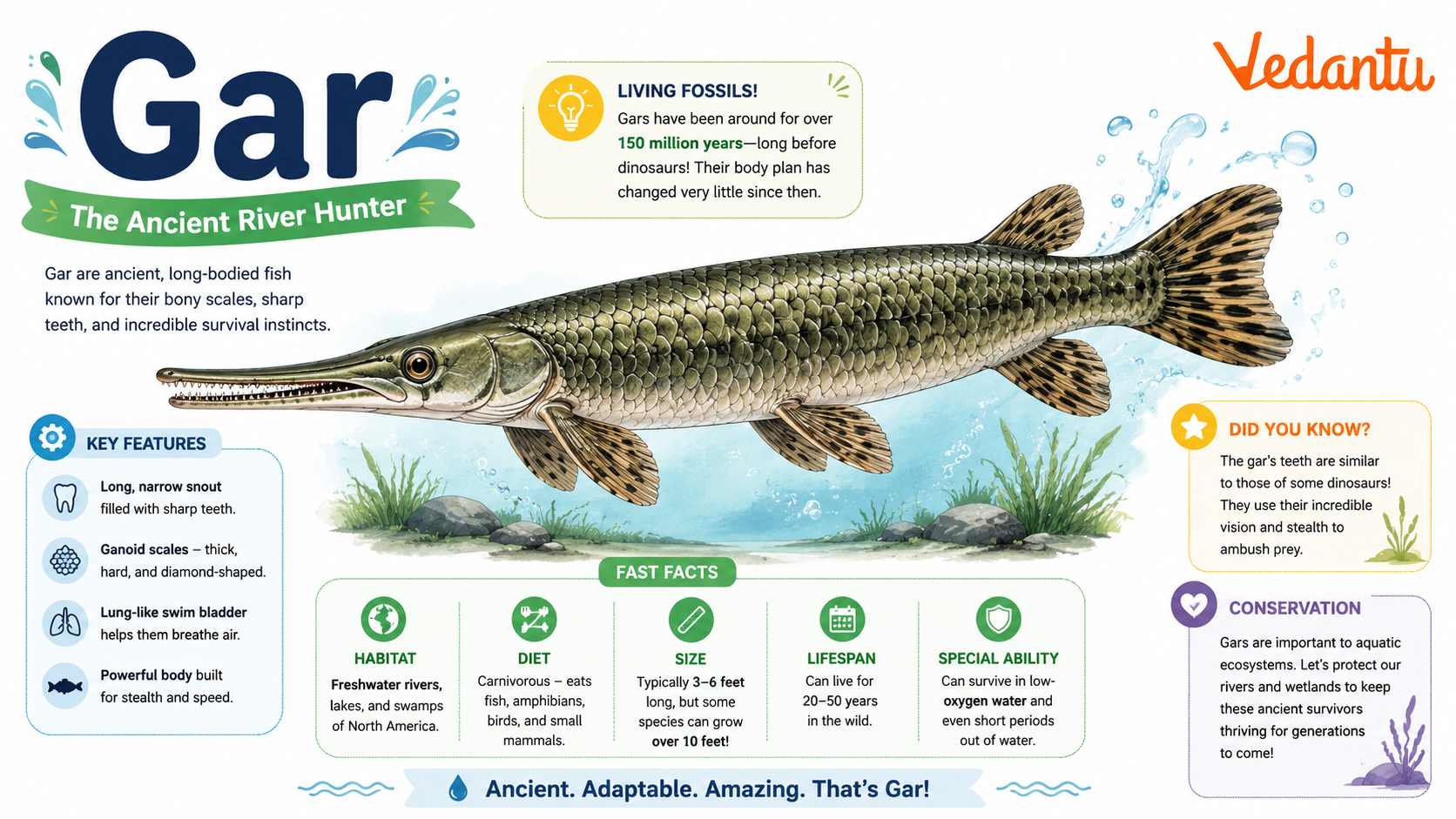
Quick Facts About Gar
| Feature | Details |
|---|---|
| Common Name | Gar |
| Scientific Family | Lepisosteidae |
| Animal Group | Fish |
| Habitat | Rivers, lakes, swamps, and slow-moving freshwater bodies |
| Diet | Carnivore (fish, insects, crustaceans) |
| Length | 2 to 10 feet (depending on species) |
| Lifespan | 10–20 years or more |
| Special Feature | Hard, armor-like scales |
| Found In | North America and parts of Central America |
Appearance and Physical Characteristics
- Long, thin body shaped like a torpedo.
- Long snout filled with sharp, needle-like teeth.
- Covered with hard, diamond-shaped scales called ganoid scales.
- Usually olive-green or brown on top with a lighter belly.
- Strong tail for powerful swimming.
Gar Habitat and Distribution
- Found mostly in freshwater habitats.
- Prefer slow-moving rivers, lakes, swamps, and bayous.
- Some species can survive in slightly salty water.
- Common in the southeastern United States.
Gar fish can also breathe air using a special swim bladder that acts like a lung. This helps them survive in waters with low oxygen levels.
Diet and Feeding Habits
Eats mainly other fish.
The Gar diet makes it an important predator that helps control fish populations and maintain balance in aquatic ecosystems.
Behaviour and Lifestyle
- Mostly solitary but sometimes found in small groups.
- Slow-moving but capable of quick bursts of speed.
- Often seen floating near the water surface.
- Comes up to gulp air when oxygen levels are low.
Gar Life Cycle
- Egg Stage: Females lay eggs in shallow water among plants.
- Hatching: Eggs hatch into small larvae.
- Juvenile Stage: Young gars grow quickly and start hunting tiny prey.
- Adult Stage: Fully grown adults become powerful predators.
Female Gar usually lay thousands of eggs. However, many do not survive due to predators.
Types of Gar
The largest species, can grow over 10 feet long.
Has a very long and narrow snout.
Covered with dark spots on its body and fins.
Smaller species with a shorter snout.
What Makes Gar Special?
Importance of Gar in Nature
- Controls populations of smaller fish.
- Maintains balance in freshwater ecosystems.
- Acts as prey for larger animals like birds and alligators.
- Helps scientists study ancient fish evolution.
Amazing Gar Facts
Fun Facts for Kids
FAQs on Gar Fish: Complete Guide to This Ancient Freshwater Predator
1. What is a Gar fish?
A Gar is a long, ancient freshwater fish known for its sharp teeth and armor-like scales.
- Scientific family: Lepisosteidae
- Found in North America and parts of Central America
- Has a long, narrow body and pointed snout
- Often called a “living fossil” because it has existed for millions of years
2. Where do Gar fish live?
Gar fish mainly live in warm freshwater habitats such as rivers and lakes.
- Slow-moving rivers
- Lakes and ponds
- Swamps and bayous
- Sometimes in brackish water near coastal areas
3. Why are Gar called living fossils?
Gar are called living fossils because they have changed very little in over 100 million years.
- Their body shape is similar to prehistoric fish
- They have hard, diamond-shaped ganoid scales
- They existed during the time of dinosaurs
4. What do Gar fish eat?
Gar are carnivorous fish that mostly eat other animals.
- Small fish
- Crayfish
- Insects
- Sometimes frogs
5. How big can a Gar grow?
Some Gar species can grow very large, especially the Alligator Gar.
- Alligator Gar can reach up to 10 feet long
- They can weigh over 300 pounds
- Smaller species like the Spotted Gar are much shorter
6. Are Gar fish dangerous to humans?
Gar fish are generally not dangerous to humans.
- They do not usually attack people
- Their sharp teeth are used for catching prey
- They prefer to avoid humans
7. How do Gar breathe?
Gar have a special ability to breathe both in water and air.
- They have gills like most fish
- Their swim bladder works like a lung
- They can gulp air at the surface
8. What are the main types of Gar?
There are several species of Gar found in North America.
- Alligator Gar
- Longnose Gar
- Spotted Gar
- Shortnose Gar
- Florida Gar
9. Why are Gar important to the ecosystem?
Gar play an important role in maintaining healthy freshwater ecosystems.
- They control populations of smaller fish
- They are part of the aquatic food chain
- They help balance river and lake biodiversity
10. Do Gar lay eggs?
Yes, Gar reproduce by laying eggs in freshwater environments.
- Females lay thousands of sticky eggs
- Eggs attach to plants and rocks
- Gar eggs are toxic if eaten by humans
