






Why Are Some Birds Flightless? Types, Adaptations, and Natural Habitats Explained
Flightless birds are amazing birds that cannot fly but are perfectly adapted to life on land or water. Instead of flying, they run fast, swim powerfully, or live in isolated habitats where flight is not necessary. From the giant ostrich to the cute penguin, flightless birds show us that wings are not only for flying. Let us explore fascinating flightless bird facts, habitat, diet, characteristics, life cycle, and their importance in nature.
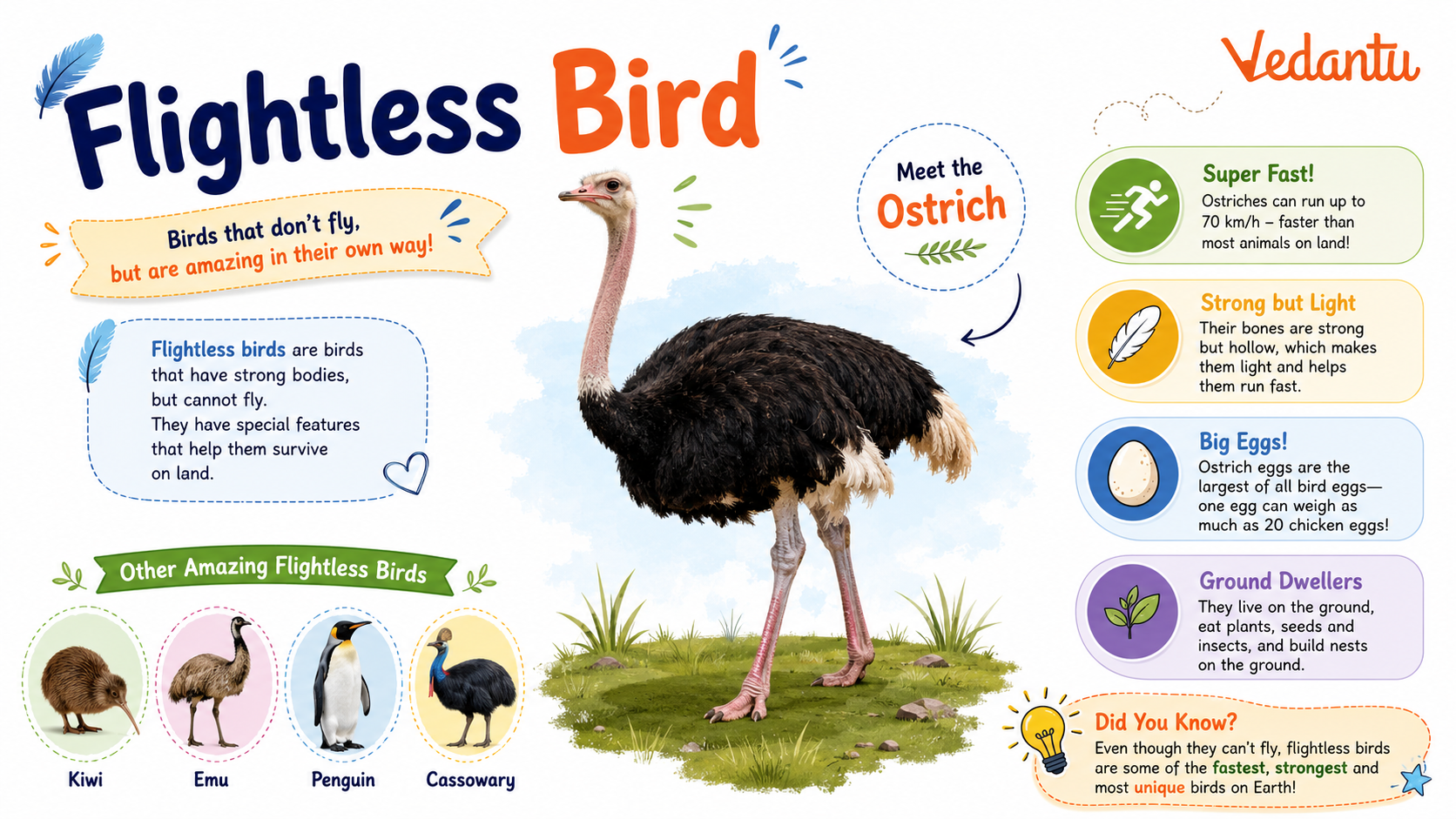
Quick Facts About Flightless Birds
| Feature | Details |
|---|---|
| Animal Group | Birds |
| Number of Species | About 60 living species |
| Main Examples | Ostrich, Emu, Kiwi, Penguin, Cassowary |
| Habitat | Grasslands, forests, islands, polar regions |
| Diet | Herbivore, omnivore, or carnivore (varies by species) |
| Special Feature | Small or modified wings, strong legs |
| Conservation Status | Some species endangered |
Appearance and Physical Characteristics
- Have wings, but they are small or not strong enough for flight.
- Strong and muscular legs for running or swimming.
- Heavy body and dense bones compared to flying birds.
- Feathers may be soft and fluffy (like ostrich) or waterproof (like penguin).
- Flat breastbone without a large keel for flight muscles.
Habitat and Distribution
Flightless bird habitat varies widely depending on the species. They are found in different parts of the world.
- Africa: Ostrich in open grasslands and deserts.
- Australia: Emu and cassowary in forests and plains.
- New Zealand: Kiwi in dense forests.
- Antarctica: Penguins in icy coastal regions.
- Islands: Many species evolved on isolated islands.
Diet and Feeding Habits
Flightless bird diet depends on the species and habitat.
Ostriches and emus eat grass, seeds, leaves, and fruits.
Kiwis eat insects, worms, fruits, and small animals.
Penguins mainly eat fish, squid, and krill.
Some peck on land, while penguins dive deep underwater to catch prey.
Behaviour and Lifestyle
- Some are social (like penguins living in colonies).
- Others are solitary (like kiwi).
- Excellent runners (ostrich, emu).
- Excellent swimmers (penguins).
- Use strong legs for defence and fast escape.
Life Cycle of Flightless Birds
- Egg Stage: Females lay eggs, often large and strong-shelled.
- Incubation: Parents keep eggs warm until hatching.
- Chick Stage: Baby birds hatch with soft feathers.
- Juvenile Stage: Grow quickly and learn to find food.
- Adult Stage: Reach full size and reproduce.
Flightless bird life cycle is similar to other birds, but their chicks often learn running or swimming instead of flying.
What Makes Flightless Birds Special?
Built for speed and strength.
Includes the biggest birds on Earth.
Penguins “fly” underwater using flipper-like wings.
Adapted perfectly to their environment without flight.
Importance and Role in Nature
Spread seeds through droppings.
Act as both predators and prey.
Attract visitors to wildlife parks and polar regions.
Increase ecosystem diversity and balance.
Amazing Flightless Bird Facts
- The ostrich lays the largest eggs of any living bird.
- Penguins can swim up to 15–20 km per hour.
- Kiwis have nostrils at the tip of their beaks.
- Cassowaries are known for their powerful kicks.
- Some extinct flightless birds were over 3 meters tall.
- Penguins spend more time in water than on land.
Interesting Facts About Flightless Birds
Fun Facts for Kids
FAQs on Flightless Bird Guide: Characteristics, Examples, and Survival Secrets
1. What is a flightless bird?
A flightless bird is a bird that cannot fly because its wings are small or not strong enough for flight.
- Flightless birds have heavy bodies and strong legs.
- Their wings may be tiny or adapted for balance instead of flying.
- Examples include the ostrich, penguin, and kiwi.
- They are often found on islands or open lands with fewer predators.
2. Why can’t some birds fly?
Some birds cannot fly because they evolved in places where flying was not necessary for survival.
- Evolution made their bodies larger and heavier.
- Their wing bones are smaller compared to flying birds.
- Strong leg muscles help them run or swim instead.
- Living in safe environments reduced the need to escape predators by flying.
3. What are some examples of flightless birds?
There are many famous flightless birds found around the world.
- Ostrich – the largest living bird from Africa.
- Emu – native to Australia.
- Penguin – excellent swimmers from Antarctica.
- Kiwi – a small bird from New Zealand.
- Cassowary – a strong forest bird.
- Rhea – found in South America.
4. How do flightless birds protect themselves?
Flightless birds use other skills like running, hiding, or swimming to stay safe.
- Ostriches can run very fast to escape danger.
- Penguins swim quickly in water.
- Some birds use camouflage to blend into their surroundings.
- Strong legs and sharp claws help defend against predators.
5. Where do most flightless birds live?
Most flightless birds live in isolated regions like islands or wide open plains.
- New Zealand is home to the kiwi.
- Antarctica has many penguin species.
- Africa is home to the ostrich.
- Australia has emus and cassowaries.
6. Are penguins flightless birds?
Yes, penguins are flightless birds, but they are amazing swimmers.
- Their wings are shaped like flippers.
- They "fly" underwater instead of in the sky.
- Penguins live mostly in the Southern Hemisphere.
- They use swimming to catch fish and escape predators.
7. What is the largest flightless bird?
The ostrich is the largest and heaviest flightless bird in the world.
- It can grow up to 9 feet tall.
- It weighs over 300 pounds.
- Ostriches can run up to 70 km/h (43 mph).
- They lay the largest eggs of any living bird.
8. Did flightless birds ever fly?
Most flightless birds evolved from ancestors that could fly millions of years ago.
- Over time, natural selection changed their bodies.
- Living in safe habitats reduced the need for flight.
- Their wings became smaller while legs became stronger.
- This process is part of bird evolution.
9. What do flightless birds eat?
Flightless birds eat different foods depending on their habitat and species.
- Ostriches eat plants, seeds, and insects.
- Penguins eat fish and squid.
- Kiwis feed on worms and small insects.
- Some species are herbivores, while others are carnivores or omnivores.
10. Are flightless birds endangered?
Some flightless birds are endangered because they cannot easily escape predators or human threats.
- Habitat loss affects many species.
- Introduced animals like cats and rats hunt them.
- Climate change impacts birds like penguins.
- Conservation programs help protect endangered flightless birds.
