






What Is a Feather Star? Habitat, Diet, and Unique Crinoid Features
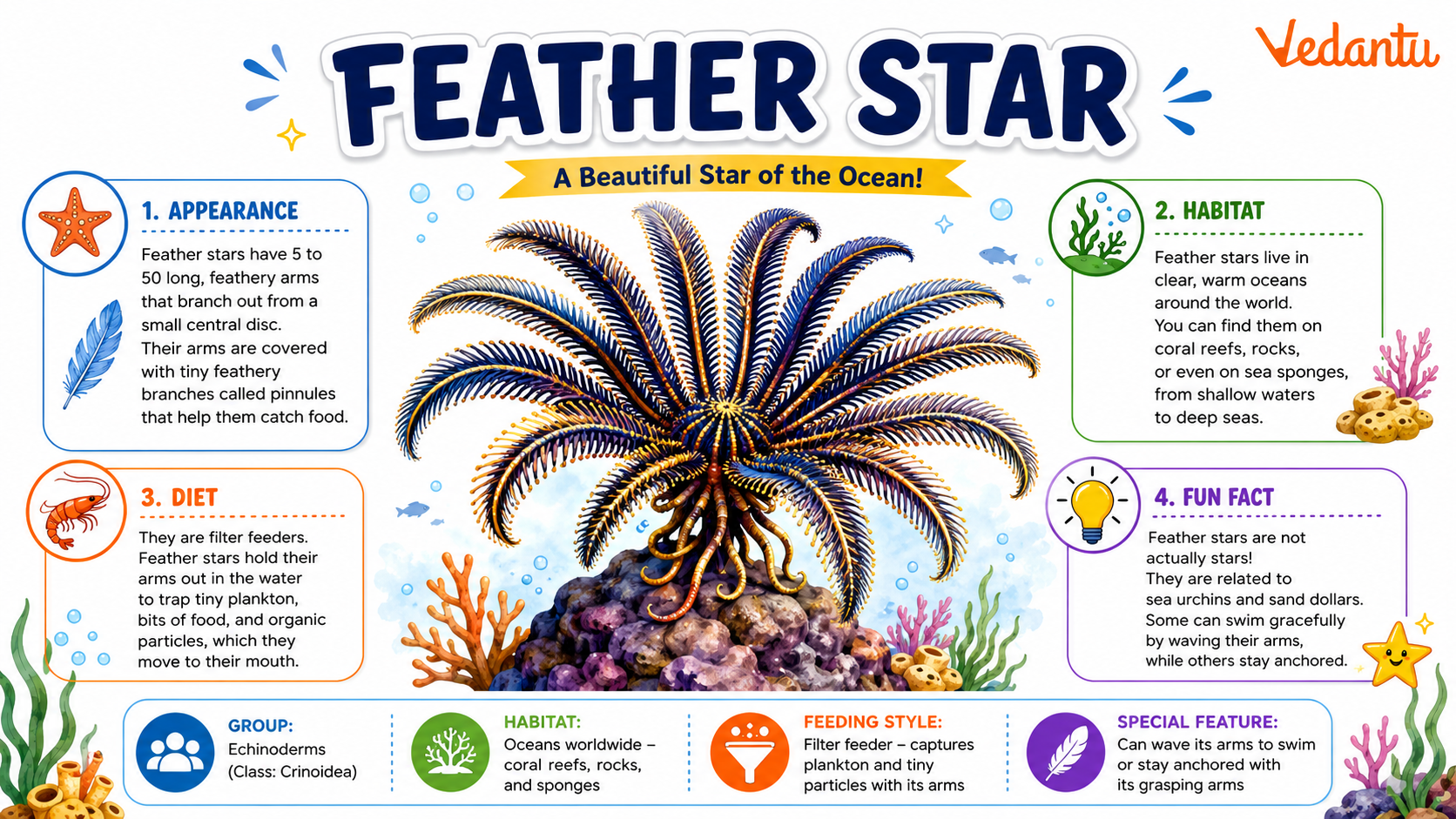
Quick Facts and Statistics
| Feature | Details |
|---|---|
| Common Name | Feather Star |
| Scientific Class | Crinoidea |
| Animal Group | Echinoderm |
| Habitat | Oceans, especially coral reefs |
| Diet | Plankton and tiny organic particles |
| Size | Arms can spread up to 20–40 cm |
| Lifespan | Several years (varies by species) |
| Movement | Crawling, clinging, and slow swimming |
Appearance and Physical Characteristics
- Have 5 main arms that branch into many feathery extensions.
- Arms are covered with tiny tube feet used for catching food.
- Body is small and cup-shaped, located at the centre.
- Bright colours such as red, yellow, orange, green, or purple.
- No brain, but a simple nervous system.
- Hard internal skeleton made of calcium plates.
Habitat and Distribution
- Commonly found in coral reefs.
- Live in shallow coastal waters as well as deeper sea areas.
- Prefer places with strong water currents.
- Found in the Indian Ocean, Pacific Ocean, and parts of the Atlantic Ocean.
Feather Stars usually attach themselves to rocks, corals, or sea plants during the day and may move around at night.
Diet and Feeding Habits
- Feed on plankton and microscopic sea particles.
- Use their feathery arms like nets to trap food.
- Tube feet pass food particles to the mouth located on the upper surface.
- They are filter feeders, meaning they filter food from water.
By feeding on plankton, Feather Stars help maintain balance in marine food chains.
Behaviour and Lifestyle
Many species are more active at night and hide during the day.
They can crawl using small gripping structures called cirri.
Some species can swim by rhythmically moving their arms.
Drop arms to escape predators and grow them back later.
Life Cycle and Reproduction
- Egg Stage: Females release eggs into the water.
- Larval Stage: Free-swimming larvae float in the ocean.
- Attachment Stage: Larvae settle and attach to a surface.
- Juvenile Stage: Develop feathery arms and detach later.
- Adult Stage: Mature Feather Star moves freely.
The Feather Star life cycle shows a transformation from a floating larva to a graceful, multi-armed adult.
What Makes Feather Star Special?
Importance and Role in Nature
- Help control plankton populations.
- Provide shelter for small marine creatures.
- Contribute to coral reef biodiversity.
- Serve as food for fish and other sea animals.
Amazing Feather Star Facts
Fun Facts for Kids
- Feather Stars look like underwater fireworks!
- They are animals, not plants.
- They can “walk” using tiny gripping legs.
- Some glow brightly in coral reefs.
- They wave their arms like they are dancing in water.
FAQs on Feather Star: Amazing Facts About These Colorful Sea Creatures
1. What is a Feather Star?
A Feather Star is a colorful marine animal that looks like a floating feather and lives in the ocean.
- It belongs to the echinoderm family, like starfish and sea urchins.
- It has many feathery arms used for catching food.
- It is also called a crinoid.
- Feather stars live in warm and tropical seas.
2. Where do Feather Stars live?
Feather Stars live in oceans around the world, mostly in warm and shallow waters.
- Common in the Indian Ocean and Pacific Ocean.
- Found near coral reefs and rocky sea floors.
- Some species live in deep-sea habitats.
- They hide in cracks during the daytime.
3. What do Feather Stars eat?
Feather Stars eat tiny floating plants and animals called plankton.
- They use their feathery arms to catch plankton.
- Sticky tube feet help move food to their mouth.
- They are filter feeders in the marine ecosystem.
- They usually feed at night.
4. How do Feather Stars move?
Feather Stars can crawl, swim, or cling to surfaces using special body parts.
- They use small claw-like parts called cirri to grip rocks.
- They can swim by waving their arms gracefully.
- Most movement happens at night.
- Swimming helps them escape predators.
5. Are Feather Stars the same as starfish?
Feather Stars are related to starfish but are not the same species.
- Both belong to the echinoderm group.
- Starfish usually have five thick arms.
- Feather stars have many feathery arms.
- Feather stars can swim, but most starfish cannot.
6. How many arms does a Feather Star have?
A Feather Star can have 10 to 200 feathery arms, depending on the species.
- Arms grow from a central body disk.
- Each arm has tiny side branches called pinnules.
- More arms help catch more food.
- Arms can regrow if damaged.
7. How do Feather Stars protect themselves?
Feather Stars protect themselves by hiding and escaping quickly.
- They hide in coral reefs during the day.
- They swim away from predators like fish.
- Some species can drop an arm to distract predators.
- Their bright colors may warn enemies.
8. What is the life cycle of a Feather Star?
The life cycle of a Feather Star begins as a larva floating in the sea.
- Eggs hatch into tiny free-swimming larvae.
- Larvae attach to a surface and grow a stalk.
- Adults lose the stalk and become free-moving.
- This growth process is part of marine invertebrate development.
9. Why are Feather Stars important in the ocean ecosystem?
Feather Stars help keep the ocean ecosystem balanced by feeding on plankton.
- They control plankton populations.
- They provide food for fish and other sea animals.
- They add beauty and diversity to coral reef habitats.
- They are indicators of healthy marine environments.
10. Are Feather Stars dangerous to humans?
Feather Stars are not dangerous to humans and are safe to observe.
- They do not bite or sting.
- They are gentle marine invertebrates.
- Divers often see them while exploring reefs.
- It is best to avoid touching them to protect marine life.
