






What Is Drosophila? Life Cycle, Habitat, and Role in Genetics Research
Drosophila, commonly known as the fruit fly, is one of the most studied organisms in science. Though it is small in size, it has made a huge impact in understanding genetics, inheritance, and evolution. Scientists around the world use Drosophila in laboratories because it grows quickly and has simple genes. Learning about Drosophila facts, habitat, diet, characteristics, and life cycle helps students understand how living organisms function and reproduce.
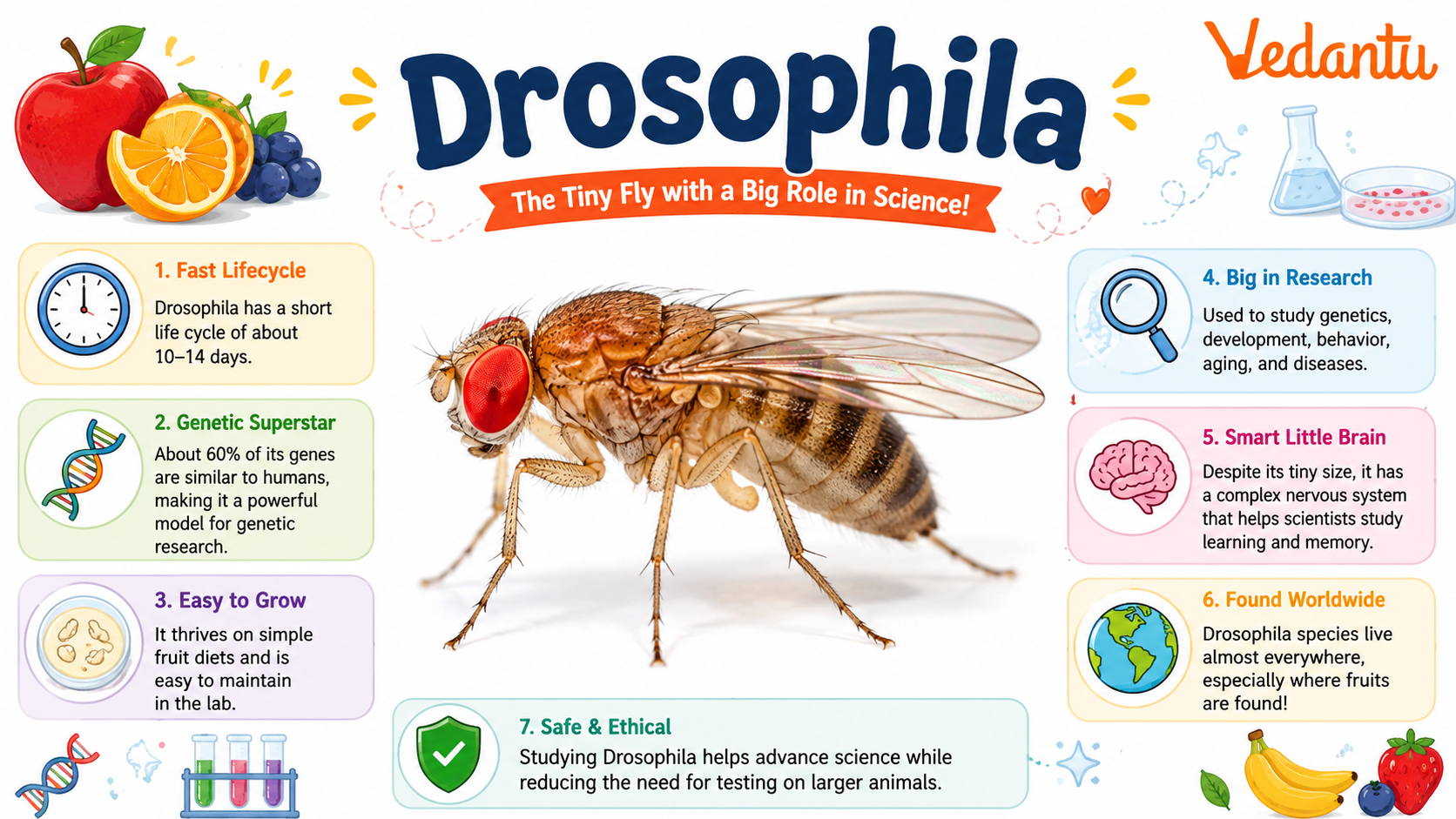
Quick Facts About Drosophila
| Feature | Details |
|---|---|
| Common Name | Fruit Fly |
| Scientific Name | Drosophila melanogaster |
| Animal Group | Insect |
| Size | About 2–4 mm long |
| Lifespan | About 30–50 days |
| Habitat | Near ripe and rotting fruits |
| Diet | Yeast, microorganisms, and fruit sugars |
| Special Feature | Easy to study genes and mutations |
Appearance and Physical Characteristics
- Very small body, usually yellowish-brown in colour.
- Bright red compound eyes.
- Transparent wings with visible veins.
- Three main body parts: head, thorax, and abdomen.
- Six legs and short antennae.
Drosophila Habitat
The natural Drosophila habitat includes places where fruits are fermenting. They are commonly found:
- In kitchens near ripe bananas and fruits.
- In orchards and farms.
- In garbage areas with decaying plant matter.
- In laboratories for scientific research.
Drosophila Diet and Feeding Habits
- Feeds mainly on yeast growing on rotting fruits.
- Consumes fruit sugars and microorganisms.
- Larvae feed directly on decaying fruit pulp.
Behaviour and Lifestyle
- Active during the day.
- Strong attraction to sweet smells.
- Can fly short distances quickly.
- Highly reproductive and lays many eggs.
Drosophila Life Cycle
- Egg: Female lays hundreds of tiny white eggs on fruit.
- Larva: Eggs hatch into worm-like larvae that feed actively.
- Pupa: Larva forms a protective case and undergoes transformation.
- Adult: A fully developed fruit fly emerges in about 8–10 days.
What Makes Drosophila Special?
Importance and Role in Science
Amazing Drosophila Facts
- Completes its life cycle in about 10 days.
- Has been used in research for over 100 years.
- Can produce hundreds of offspring in a short time.
- Has large chromosomes visible under a microscope.
- Was first used in genetics research by Thomas Hunt Morgan.
- Can detect and move toward fermented food quickly.
Fun Facts for Kids
FAQs on Drosophila: Complete Guide to the Fruit Fly and Its Scientific Importance
1. What is Drosophila?
Drosophila is a tiny fruit fly that scientists use to study genetics and biology.
- Also called the fruit fly or Drosophila melanogaster
- Feeds on ripe or rotting fruits
- Common in homes, gardens, and laboratories
- Widely used in genetics research and biology experiments
2. Why is Drosophila important in genetics?
Drosophila is important because it helps scientists understand how genes work.
- Has simple and well-mapped chromosomes
- Shares many genes with humans
- Short life cycle makes experiments quick
- Helped discover key ideas like inheritance and mutation
3. What does Drosophila eat?
Drosophila mainly eats yeast and sugars found in fruits.
- Feeds on ripe bananas, apples, and other fruits
- Attracted to fermenting or rotting food
- Larvae grow in soft fruit pulp
- Common near kitchen fruit bowls
4. What is the life cycle of Drosophila?
The Drosophila life cycle is short and simple, lasting about 10–14 days.
- Egg – Female lays eggs on fruit
- Larva – Worm-like stage that eats and grows
- Pupa – Resting stage where transformation happens
- Adult fly – Fully formed fruit fly
5. Who discovered the importance of Drosophila?
Thomas Hunt Morgan discovered the importance of Drosophila melanogaster in genetics research.
- Worked in the early 1900s
- Studied eye color mutations in fruit flies
- Proved that genes are located on chromosomes
- Won the Nobel Prize in Physiology or Medicine (1933)
6. How long does Drosophila live?
Drosophila lives for about 30 to 50 days under normal conditions.
- Completes development in about 2 weeks
- Reproduces quickly
- Lifespan depends on temperature and environment
- Ideal for short-term scientific studies
7. Why do scientists use Drosophila instead of other animals?
Scientists use Drosophila because it is easy to study and grows quickly.
- Small size and low maintenance
- Produces many offspring
- Simple genetic structure
- Helps study diseases like cancer and Alzheimer’s disease
8. Can Drosophila harm humans?
Drosophila is harmless and does not bite or spread serious diseases.
- Annoying but not dangerous
- Does not sting or bite
- Mostly found around food
- Easy to control by cleaning and covering fruits
9. What are the physical features of Drosophila?
Drosophila melanogaster is a small fly with distinct body features.
- About 3 mm long
- Red eyes (common wild type)
- Light brown or yellow body
- Two transparent wings
10. How does Drosophila help in studying human diseases?
Drosophila helps scientists understand human diseases because many genes are similar to ours.
- Used in research on genetic disorders
- Helps study brain function and behavior
- Important in cancer and aging research
- Model organism in biomedical research
