






How the Draco Lizard Glides and Survives in Rainforests
The Draco Lizard, often called the “flying dragon,” is one of the most fascinating reptiles in the world. It does not truly fly like a bird, but it glides smoothly from tree to tree using special wing-like flaps of skin. Found in tropical forests, this tiny reptile surprises many people with its bright colours and amazing gliding skills. Let’s explore Draco Lizard facts, habitat, diet, characteristics, and life cycle in a fun and simple way.
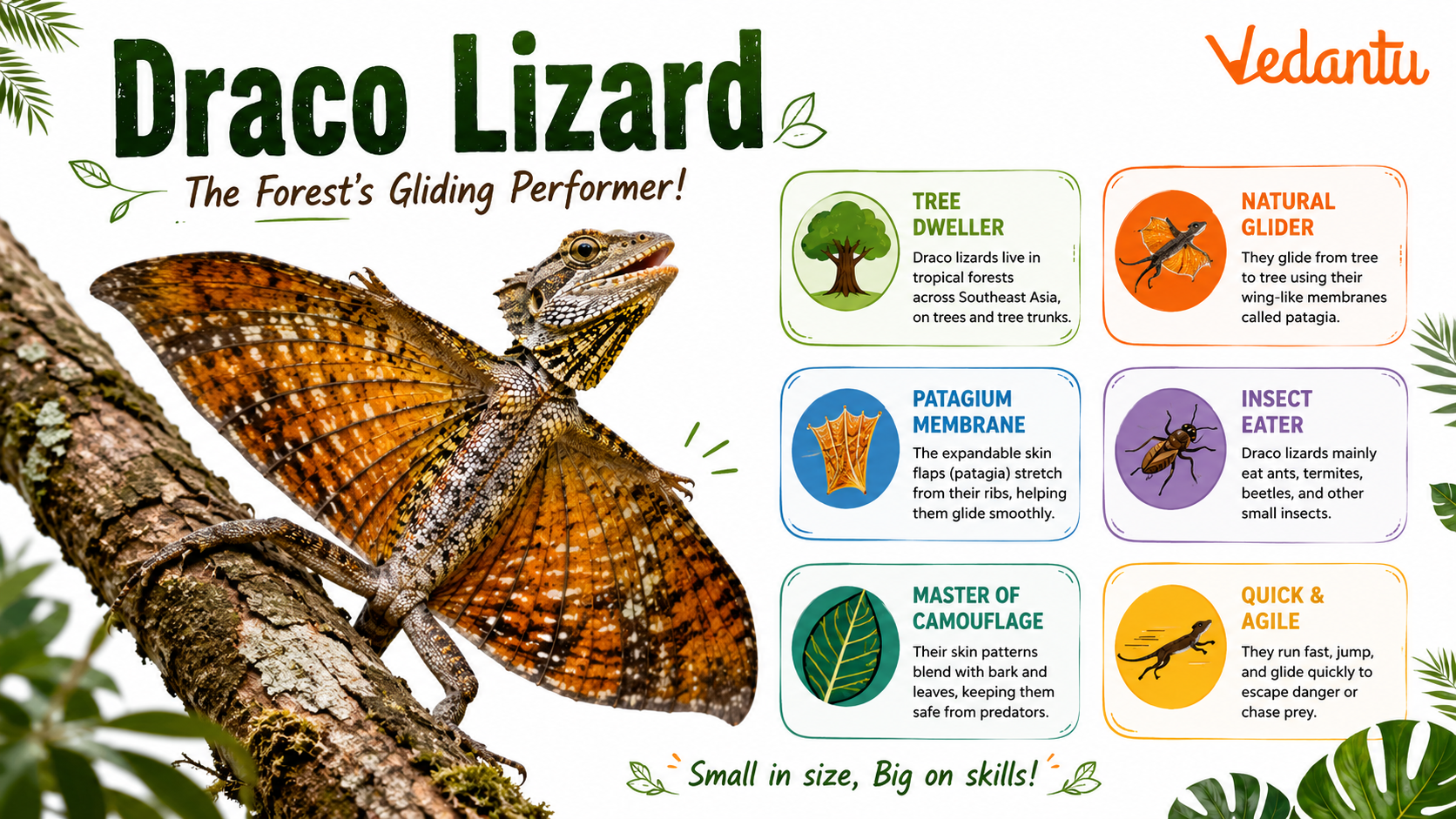
Quick Facts About Draco Lizard
| Feature | Details |
|---|---|
| Common Name | Draco Lizard / Flying Dragon |
| Scientific Genus | Draco |
| Animal Group | Reptile |
| Size | 20–25 cm (including tail) |
| Diet | Insectivore (mainly ants and termites) |
| Habitat | Tropical rainforests |
| Special Feature | Wing-like skin flaps for gliding |
| Found In | Southeast Asia |
Appearance and Physical Characteristics
- Small and slender body with a long tail.
- Loose flaps of skin called patagia on both sides of the body.
- These flaps are supported by long ribs that spread out like wings.
- Bright throat flap (called dewlap) used for display.
- Colours include brown, grey, green, and sometimes orange or yellow.
Habitat and Distribution
The Draco Lizard habitat mainly includes warm and humid tropical forests.
- Lives high in trees.
- Rarely comes down to the ground.
- Found in countries like Indonesia, Malaysia, Thailand, and the Philippines.
- Prefers dense forests with tall trees for easy gliding.
Diet and Feeding Habits
Insectivore – mainly eats small insects.
Ants and termites are its top choice.
Waits quietly on tree trunks and quickly catches prey.
Controls insect population and becomes prey for birds and snakes.
Behaviour and Lifestyle
- Cold-blooded reptile – depends on sunlight to warm its body.
- Spends most of its life on trees.
- Glides to escape predators or move between trees.
- Males use colourful throat flaps to attract females and scare rivals.
- Very alert and quick-moving.
Life Cycle of Draco Lizard
- Egg Stage: Female lays eggs in soil on the forest floor.
- Incubation: Eggs hatch after several weeks.
- Young Lizard: Baby lizards are independent from birth.
- Adult Stage: Develop full gliding membranes and bright colours.
What Makes Draco Lizard Special?
Importance and Role in Nature
- Controls insect populations in forests.
- Serves as prey for birds, snakes, and mammals.
- Indicates a healthy forest ecosystem.
- Adds to biodiversity in tropical regions.
Amazing Draco Lizard Facts
Fun Facts for Kids
- The Draco Lizard is also called the “Flying Dragon.”
- It looks like a tiny dragon from storybooks.
- It spreads its “wings” only when it jumps.
- It loves warm, sunny forests.
- It is harmless to humans.
FAQs on Draco Lizard – Amazing Gliding Reptile Explained
1. What is a Draco lizard?
Draco lizards, also called flying dragons, are small gliding reptiles that can soar between trees using wing-like flaps of skin.
- Belong to the genus Draco
- Live mostly in Southeast Asia
- Have special skin membranes called patagia
- Are known for their amazing gliding ability
2. Can a Draco lizard really fly?
Draco lizards cannot truly fly like birds, but they are expert gliders that move through the air from tree to tree.
- They spread their rib-supported wings
- Glide up to 8–10 meters
- Use their tail for balance and steering
- Land safely on tree trunks
3. Where do Draco lizards live?
Draco lizards live in tropical rainforests across parts of South and Southeast Asia.
- Countries like Indonesia, Malaysia, and the Philippines
- Prefer tall forest trees
- Rarely come down to the ground
- Thrive in warm, humid climates
4. What do Draco lizards eat?
Draco lizards mainly eat insects, making them helpful insect hunters in the forest ecosystem.
- Feed on ants (their favorite food)
- Eat termites and small insects
- Catch prey while staying on trees
- Are classified as insectivores
5. How do Draco lizards glide from tree to tree?
Draco lizards glide by spreading skin flaps supported by long ribs that act like wings.
- They jump off a tree
- Extend their patagium (wing membrane)
- Use their tail to steer
- Land smoothly on another trunk
6. Are Draco lizards dangerous to humans?
Draco lizards are harmless to humans and are shy forest reptiles.
- They do not attack people
- Have no dangerous venom
- Prefer escaping by gliding away
- Are small and non-aggressive
7. Why are they called flying dragons?
Draco lizards are called flying dragons because of their wing-like flaps and dragon-like look.
- The word Draco means dragon in Latin
- Their spread-out ribs look like small wings
- Bright throat flaps add to their dramatic appearance
- They glide like mythical dragons
8. How big is a Draco lizard?
Draco lizards are small reptiles, usually measuring about 8–10 inches including their tail.
- Body length is shorter than the tail
- Lightweight for easy gliding
- Males are often more colorful
- Size helps them move quickly in trees
9. How do Draco lizards protect themselves from predators?
Draco lizards protect themselves mainly by gliding away quickly from danger.
- Leap and glide to another tree
- Camouflage with brown or green skin
- Stay high above ground predators
- Use quick movements to escape birds and snakes
10. Do Draco lizards lay eggs?
Yes, Draco lizards lay eggs like most other reptiles.
- Females come down to the ground to lay eggs
- Lay about 2–5 eggs at a time
- Bury eggs in soil for protection
- Baby lizards hatch fully formed
