






Life Cycle, Habitat, Diet, and Ecological Importance of Daphnia
Daphnia are tiny freshwater crustaceans often called “water fleas” because of their jerky swimming style. Though they are very small, Daphnia play a huge role in lakes and ponds. They help keep water clean by eating algae and serve as food for many fish and aquatic animals. Studying Daphnia helps scientists understand water quality, food chains, and even environmental changes. Let’s explore fascinating Daphnia facts, habitat, diet, life cycle, and importance in nature.
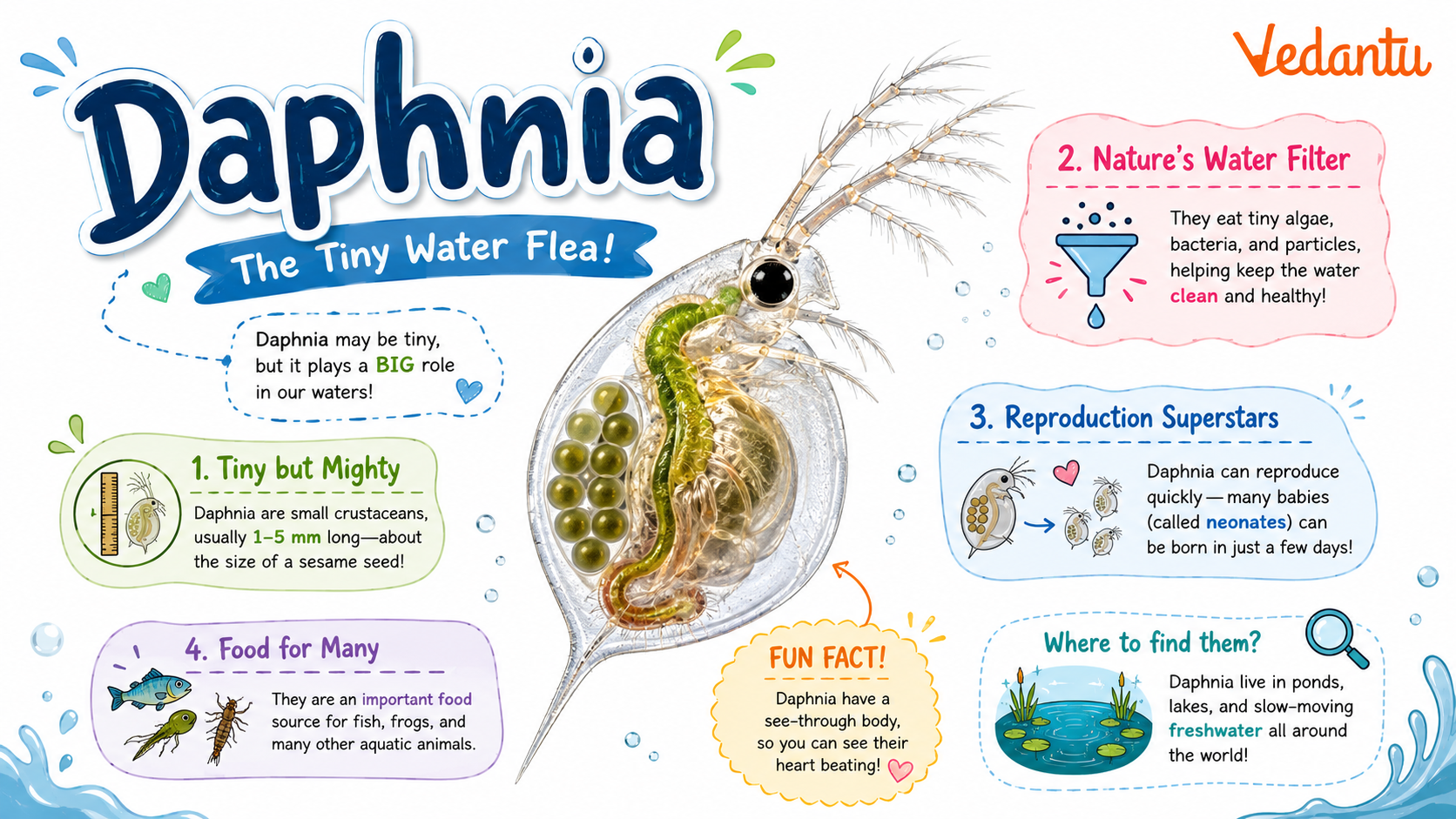
Quick Facts and Statistics
| Feature | Details |
|---|---|
| Common Name | Daphnia (Water Flea) |
| Scientific Genus | Daphnia |
| Animal Group | Crustacean (related to shrimp and crabs) |
| Size | 0.2 mm to 5 mm |
| Habitat | Freshwater ponds, lakes, and slow streams |
| Diet | Algae, bacteria, tiny organic particles |
| Lifespan | Few weeks to a few months |
| Movement | Jerky swimming using antennae |
Appearance and Physical Characteristics
- Very small and usually visible only under a microscope.
- Body is transparent, so you can often see the beating heart inside.
- Protected by a hard outer shell called a carapace.
- Large compound eye located near the head.
- Two large antennae used for swimming.
Daphnia Habitat and Distribution
- Live in freshwater environments like ponds, lakes, and temporary rain pools.
- Found on every continent except Antarctica.
- Prefer still or slow-moving water.
- Often float in the open water rather than staying at the bottom.
The Daphnia habitat is closely linked to clean freshwater ecosystems. They are sensitive to pollution, so their presence often shows that the water is healthy.
Diet and Feeding Habits
What Do Daphnia Eat?
The Daphnia diet makes them very important in the aquatic food chain. They turn tiny plants into energy that fish and other animals can use.
Behaviour and Lifestyle
- Swim in short, jumping movements using their antennae.
- Often move upward at night and downward during the day to avoid predators.
- Form large populations in suitable conditions.
- Respond quickly to changes in temperature and light.
Daphnia Life Cycle
- Egg Stage: Females produce eggs, often without fertilization in good conditions.
- Embryo Development: Eggs develop inside a brood chamber.
- Young Daphnia: Miniature versions hatch and start swimming immediately.
- Adult Stage: Grow quickly and begin reproducing within days.
The Daphnia life cycle is very fast. In warm conditions, they can reproduce quickly, leading to large populations in a short time.
What Makes Daphnia Special?
Importance and Role in Nature
Amazing Daphnia Facts
- Their heart can beat up to 300 times per minute.
- They are closely related to shrimp and crabs.
- They can survive in temporary ponds that dry up seasonally.
- Their eggs can resist freezing and drying.
- They are commonly used in laboratory experiments.
- Fish farmers often use Daphnia as natural fish food.
Fun Facts for Kids
FAQs on Daphnia Explained: Tiny Water Flees of Freshwater
1. What is Daphnia?
Daphnia are tiny freshwater crustaceans often called water fleas because of their jerky swimming movements.
- They live in ponds, lakes, and slow-moving freshwater.
- They belong to a group of small animals called zooplankton.
- They are almost transparent, so you can see their beating heart inside their body.
- They are an important part of the aquatic food chain.
2. Why are Daphnia called water fleas?
Daphnia are called water fleas because they move through water in quick jumps that look like a flea hopping.
- Their large antennae help them swim.
- Their movement is jerky and bouncing.
- They are not real fleas and do not bite humans.
- The name is just a nickname based on their motion.
3. Where do Daphnia live?
Daphnia live in freshwater habitats such as ponds, lakes, and streams.
- They prefer still or slow-moving water.
- They are found all around the world.
- They float in the water as part of the plankton community.
- They cannot survive in salty ocean water.
4. What do Daphnia eat?
Daphnia feed mainly on tiny plants and microorganisms found in water.
- They eat algae and microscopic plants.
- They consume bacteria and organic particles.
- They use special legs to filter food from the water.
- They help keep water clean by controlling algae growth.
5. How do Daphnia reproduce?
Daphnia can reproduce very quickly, often without males in good conditions.
- They use asexual reproduction (parthenogenesis) to produce clones.
- When conditions become harsh, they reproduce sexually.
- They produce special resting eggs that survive cold or dry periods.
- This helps them survive changing environments.
6. Why are Daphnia important in the ecosystem?
Daphnia are important because they connect plants and animals in freshwater ecosystems.
- They eat algae and phytoplankton.
- They are food for fish, tadpoles, and aquatic insects.
- They help balance the aquatic food web.
- They improve water quality by filtering particles.
7. Can you see inside a Daphnia?
Yes, you can see inside a Daphnia because its body is transparent.
- You can observe its beating heart under a microscope.
- You may see food moving through its digestive system.
- This makes Daphnia popular in school science experiments.
- They are often used to study biology and life processes.
8. How big are Daphnia?
Daphnia are very small, usually between 0.2 and 5 millimeters long.
- Most are about the size of a pinhead.
- They can barely be seen with the naked eye.
- A microscope or magnifying glass helps you see details.
- Their small size helps them float easily in water.
9. Are Daphnia used in scientific research?
Yes, Daphnia are widely used in scientific research and environmental testing.
- Scientists study them to test water pollution and toxins.
- They help measure water quality.
- They are model organisms in ecology and toxicology.
- Their fast reproduction makes experiments easier.
10. Do Daphnia have predators?
Yes, many animals eat Daphnia in freshwater habitats.
- Small fish feed on them regularly.
- Insect larvae hunt them underwater.
- Some tadpoles and other plankton also eat them.
- They protect themselves by being transparent and reproducing quickly.
