






What Is a Cyclostome? Characteristics, Examples, and Evolution Explained
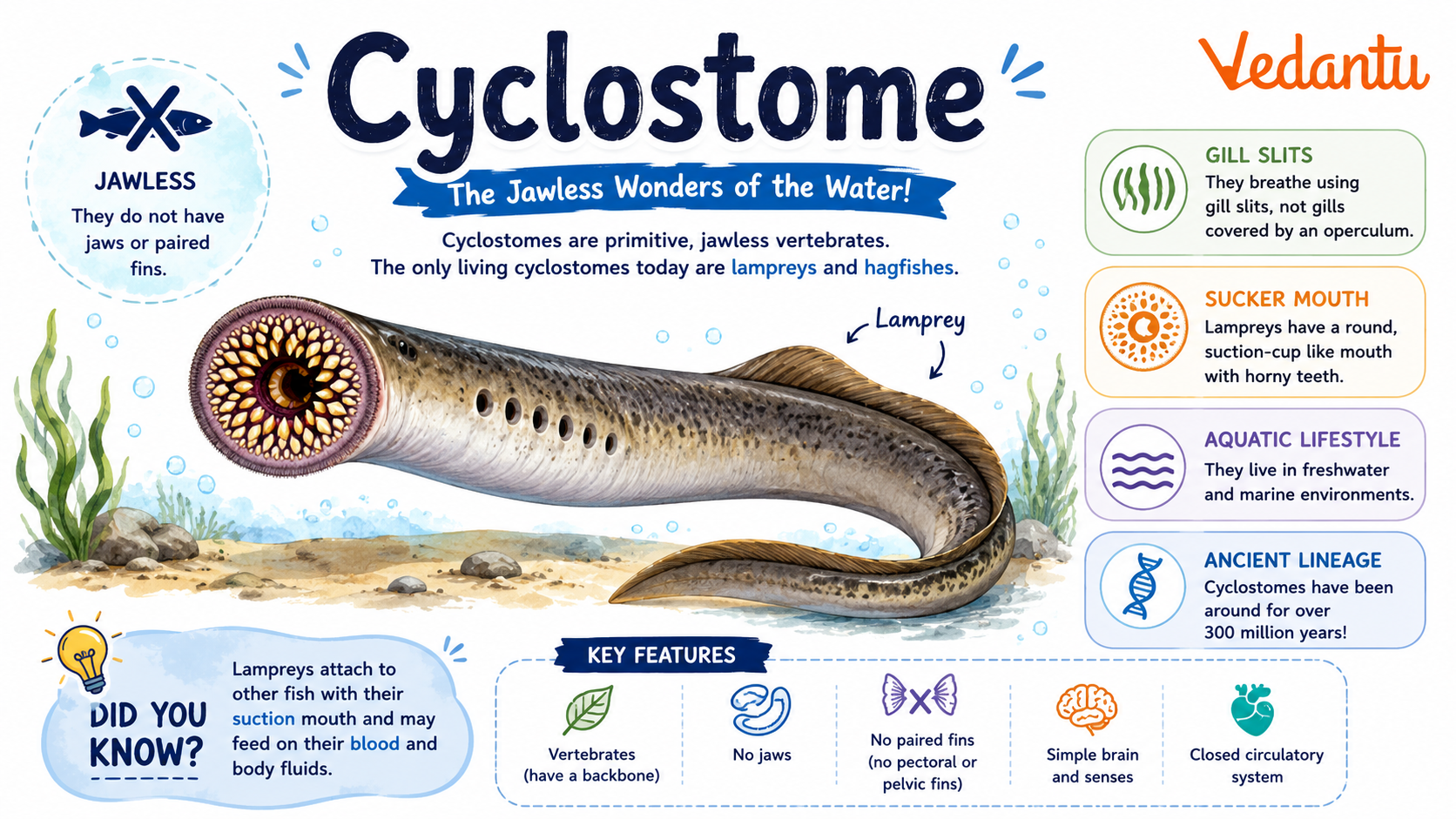
Cyclostomes are primitive, jawless vertebrates that have lived on Earth for over 500 million years. They are among the earliest forms of vertebrate animals and include lampreys and hagfishes. Known for their circular mouths and eel-like bodies, cyclostomes are fascinating examples of early animal evolution. Studying Cyclostome characteristics helps scientists understand how modern fishes and other vertebrates developed over time.
Quick Facts About Cyclostome
| Feature | Details |
|---|---|
| Common Name | Cyclostome (Lampreys & Hagfishes) |
| Scientific Group | Agnatha (Jawless vertebrates) |
| Animal Group | Chordata (Vertebrates) |
| Body Type | Long, cylindrical, eel-like |
| Habitat | Marine and freshwater |
| Diet | Parasitic or scavengers |
| Skeleton | Cartilaginous (no true bones) |
| Special Feature | Round, sucker-like mouth without jaws |
Appearance and Physical Characteristics
- Long, slim, eel-like body
- No jaws and no paired fins
- Round, sucker-like mouth with rows of horny teeth
- Single median nostril
- Cartilaginous skeleton
- Smooth, scaleless skin
- Multiple gill slits for breathing
Habitat and Distribution
Cyclostome habitat varies depending on the species. They are found in both marine and freshwater environments.
Diet and Feeding Habits
Cyclostome diet depends on the type of species.
- Often parasitic
- Attach to fish using suction mouth
- Scrape flesh and suck blood
- Mainly scavengers
- Feed on dead or dying marine animals
- Enter bodies and eat from inside
In the food chain, cyclostomes help control fish populations and clean the ocean by feeding on dead organisms.
Behaviour and Lifestyle
- Mostly solitary animals
- Active mainly at night
- Slow swimmers with snake-like movement
- Hagfishes produce slime as a defence mechanism
- Lampreys attach firmly to hosts using suction
Life Cycle and Reproduction
- Egg Stage: Eggs are laid in water, usually in nests built in riverbeds.
- Larval Stage: Lamprey larvae (ammocoetes) live buried in mud and filter-feed.
- Metamorphosis: Larvae transform into adults with developed mouths and eyes.
- Adult Stage: Adults may become parasitic or non-feeding.
- End of Life: Many lampreys die after reproduction.
Types and Diversity
What Makes Cyclostome Special?
Importance and Role in Nature
- Help in nutrient recycling by feeding on dead animals.
- Maintain ecological balance in aquatic ecosystems.
- Provide important clues about vertebrate evolution.
- Used in scientific research to study early vertebrate development.
Amazing Cyclostome Facts
Fun Facts for Kids
- The word “Cyclostome” means “round mouth.”
- They look like eels but are not true eels.
- They do not have jaws like sharks or other fishes.
- Some can live both in sea and freshwater.
- They are living examples of ancient animal history!
FAQs on Cyclostome: Complete Guide to Jawless Fishes
1. What is a Cyclostome?
Cyclostomes are jawless fish with a circular mouth and a simple body structure. They belong to the group Cyclostomata and are considered the most primitive living vertebrates.
- Have a round, sucker-like mouth
- Lack jaws and paired fins
- Have a cartilaginous skeleton
- Examples include lampreys and hagfish
Cyclostomes are important in understanding the evolution of vertebrates and early fish species.
2. What are examples of Cyclostomes?
Lampreys and hagfish are the main examples of cyclostomes. These jawless fish are found in marine and freshwater habitats.
- Lampreys – Often parasitic and attach to other fish
- Hagfish – Produce slime as a defense mechanism
Both belong to the superclass Cyclostomata and are studied in zoology and biology classes.
3. Why are Cyclostomes called jawless fish?
Cyclostomes are called jawless fish because they do not have true jaws like other fishes. Instead, they have a circular sucking mouth.
- No upper or lower jaw
- Use horny teeth for feeding
- Feed by sucking blood or scavenging
This jawless feature makes them different from bony fish and cartilaginous fish.
4. What are the main characteristics of Cyclostomes?
Cyclostomes have simple and primitive features that make them unique among vertebrates.
- Elongated, eel-like body
- No paired fins
- Cartilaginous skeleton
- Single median nostril
- Multiple gill slits for breathing
These features help scientists classify them under primitive vertebrates.
5. Where do Cyclostomes live?
Cyclostomes live in both marine and freshwater environments, depending on the species.
- Hagfish – Mostly found in deep oceans
- Lampreys – Found in rivers and seas
- Some migrate between freshwater and saltwater
Their habitat plays an important role in their life cycle and reproduction.
6. How do Cyclostomes reproduce?
Cyclostomes reproduce by laying eggs and usually have external fertilization.
- Sexes are generally separate
- Fertilization occurs outside the body
- Lampreys have a larval stage called ammocoetes
Their reproduction method is studied in vertebrate life cycles in biology.
7. How do Cyclostomes breathe?
Cyclostomes breathe through gills that are present in the form of multiple gill slits.
- Water enters through the mouth
- Passes over the gill pouches
- Oxygen is absorbed into the blood
This respiratory system is similar to other aquatic vertebrates but simpler in structure.
8. Are Cyclostomes harmful to other fish?
Some cyclostomes, especially lampreys, can be harmful to fish because they are parasitic.
- Attach to fish using their sucker mouth
- Feed on blood and body fluids
- Can weaken or kill host fish
However, not all cyclostomes are harmful; hagfish are mostly scavengers.
9. Why are Cyclostomes important in evolution?
Cyclostomes are important because they show early stages of vertebrate evolution.
- Represent the most primitive living vertebrates
- Help scientists study the origin of jaws and fins
- Provide clues about ancient fish ancestors
They are often discussed in topics like evolution of chordates and vertebrate history.
10. How are Cyclostomes different from other fishes?
Cyclostomes differ from other fishes mainly because they lack jaws and paired fins.
- No true jaws
- No paired pectoral or pelvic fins
- Have a cartilaginous skeleton
- Possess a circular sucking mouth
Unlike bony fish (Osteichthyes) and cartilaginous fish (Chondrichthyes), cyclostomes are simpler and more primitive.
