






Carnotaurus Facts: Size, Speed, Diet, Habitat, and Unique Horns
Carnotaurus was one of the most unusual meat-eating dinosaurs ever discovered. Famous for the two thick horns above its eyes, this fast-running predator lived during the Late Cretaceous period. Fossils found in South America have helped scientists understand its unique body structure, speed, and hunting style. These Carnotaurus facts show that it was built for quick attacks and powerful bites, making it a fascinating dinosaur for students and researchers alike.
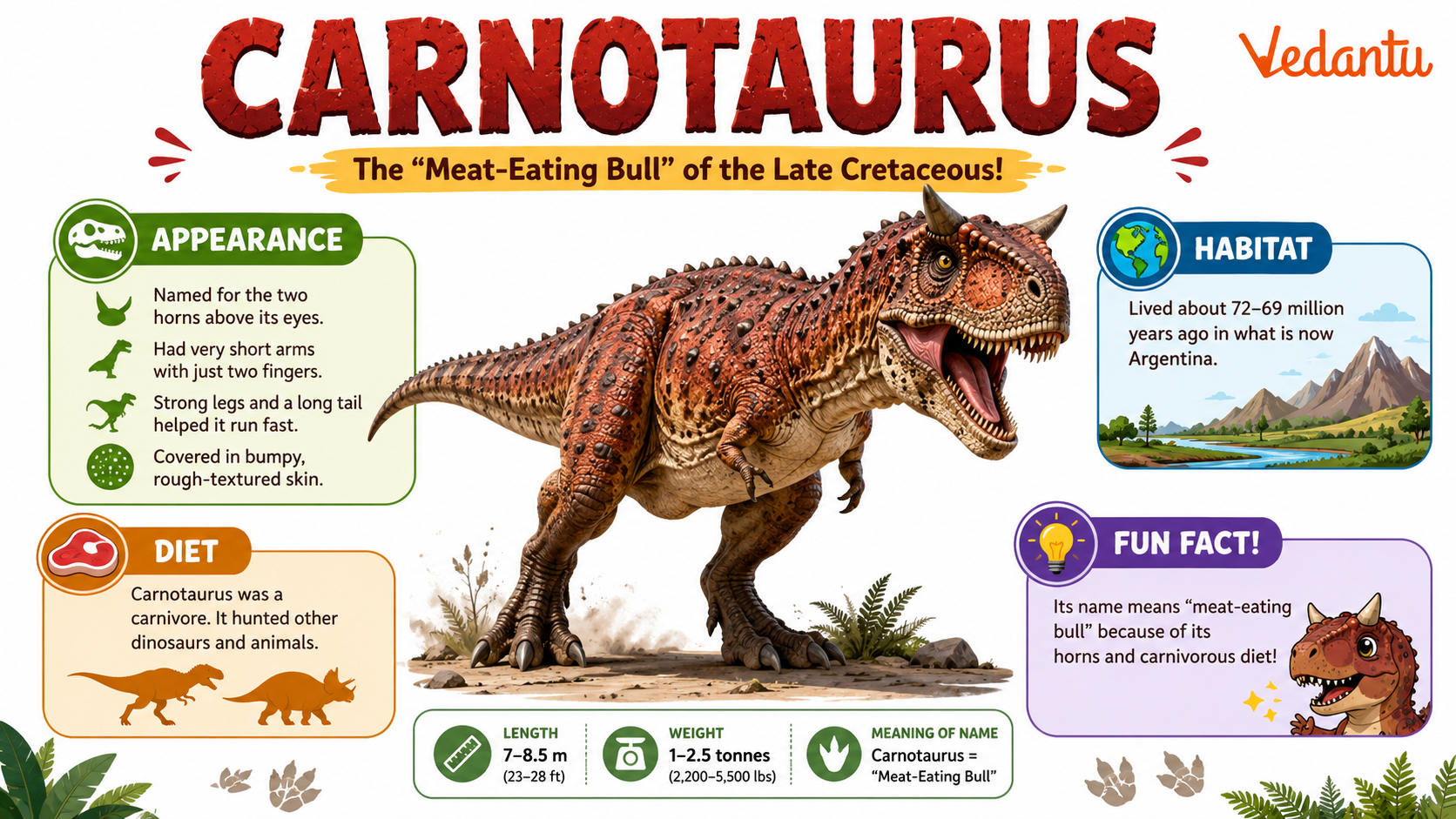
Quick Facts and Statistics
| Feature | Details |
|---|---|
| Common Name | Carnotaurus |
| Scientific Name | Carnotaurus sastrei |
| Meaning of Name | "Meat-eating bull" |
| Animal Group | Theropod Dinosaur |
| Period | Late Cretaceous (about 72–69 million years ago) |
| Length | About 7.5–9 meters |
| Weight | Around 1–2 tonnes |
| Diet | Carnivore (meat-eater) |
| Fossils Found In | Argentina (South America) |
| Conservation Status | Extinct |
Appearance and Physical Characteristics
- Had two thick, curved horns above its eyes.
- Long, slim body with strong back legs.
- Very small arms compared to its body.
- Sharp teeth designed for tearing flesh.
- Long tail to help with balance while running.
Carnotaurus Habitat and Distribution
- Lived in what is now Argentina.
- Preferred warm, semi-arid environments.
- Shared its habitat with other dinosaurs, reptiles, and early birds.
- Lived in plains and open woodland areas.
The Carnotaurus habitat during the Late Cretaceous was very different from today. South America was warmer and had large open spaces where predators like Carnotaurus could move quickly and hunt.
Diet and Feeding Habits
Carnotaurus diet mainly included smaller dinosaurs and possibly reptiles.
Likely used speed to chase and catch prey.
Sharp, blade-like teeth for slicing meat.
Top predator in its ecosystem.
As a carnivore, Carnotaurus played an important role in maintaining balance in its ecosystem by controlling the population of plant-eating dinosaurs.
Behaviour and Lifestyle
- Probably a solitary hunter.
- Active and fast-moving predator.
- Used its tail for balance during quick turns.
- May have used horns for display or fighting.
Though scientists cannot directly observe its behaviour, fossil evidence helps researchers make educated guesses about how Carnotaurus lived and hunted.
Carnotaurus Life Cycle
- Egg Stage: Hatched from eggs laid in nests.
- Hatchling: Small and vulnerable after birth.
- Juvenile: Grew rapidly, developing strong legs.
- Adult: Fully grown predator ready to hunt.
Like other dinosaurs, the Carnotaurus life cycle began with eggs. It likely grew quickly to avoid predators and reach adult size.
What Makes Carnotaurus Special?
Amazing Carnotaurus Facts
- The name Carnotaurus means "meat-eating bull."
- It is one of the best-preserved theropod fossils found in South America.
- Its horns are rare among large carnivorous dinosaurs.
- It lived just a few million years before the mass extinction.
- Its legs were longer than many other similar dinosaurs.
- Scientists found detailed skin impressions with the skeleton.
- It belonged to a group called Abelisauridae.
Interesting Facts About Carnotaurus
- Carnotaurus may have had strong neck muscles to support its horns.
- It likely relied more on speed than strength.
- Its arms were even smaller than those of Tyrannosaurus rex.
- Only one species of Carnotaurus has been discovered so far.
Fun Facts for Kids
Importance and Role in Nature
- Helped control herbivore populations.
- Part of the Late Cretaceous food chain.
- Provides important fossil evidence for scientists.
- Helps researchers understand dinosaur evolution in South America.
The importance of Carnotaurus today lies in the study of fossils. These discoveries teach us about prehistoric life, climate changes, and how dinosaurs evolved before extinction.
FAQs on Carnotaurus: The Fast Horned Predator of the Cretaceous
1. What is Carnotaurus?
Carnotaurus was a fast, meat-eating dinosaur that lived during the Late Cretaceous period.
- Its name means "meat-eating bull" because of the horns above its eyes.
- It was a type of theropod dinosaur, like Tyrannosaurus rex.
- It lived about 70 million years ago.
- Fossils were found in Argentina, South America.
2. How big was Carnotaurus?
Carnotaurus was a medium-to-large carnivorous dinosaur with a slim body built for speed.
- Length: about 25–30 feet (7.5–9 meters).
- Height: around 10 feet tall at the hips.
- Weight: nearly 1.5 tons.
- It had a lightweight skull compared to other large theropods.
3. What did Carnotaurus eat?
Carnotaurus was a carnivore, meaning it ate other animals.
- It hunted smaller dinosaurs.
- It may have eaten lizards and small reptiles.
- Its sharp teeth were perfect for tearing meat.
- As a predator dinosaur, it likely chased fast-moving prey.
4. Why did Carnotaurus have horns?
Carnotaurus had two thick horns above its eyes that made it unique among theropods.
- The horns may have been used for fighting rivals.
- They could help with display or attracting mates.
- Some scientists think they helped with head-butting behavior.
- Very few large carnivorous dinosaurs had horns like this.
5. How fast could Carnotaurus run?
Carnotaurus is believed to have been one of the fastest large theropods.
- It had long, powerful hind legs.
- Its slim body helped it move quickly.
- Scientists estimate speeds of up to 30–35 miles per hour.
- Its speed made it an effective Cretaceous predator.
6. What makes Carnotaurus different from T. rex?
Carnotaurus and Tyrannosaurus rex were different types of meat-eating dinosaurs.
- Carnotaurus had horns; T. rex did not.
- Carnotaurus had extremely tiny arms, even smaller than T. rex.
- T. rex was much bigger and heavier.
- Carnotaurus was likely faster and more slender.
7. Where were Carnotaurus fossils found?
Carnotaurus fossils were discovered in Argentina in South America.
- Found in Patagonia.
- First discovered in 1984.
- It is one of the most complete theropod skeletons ever found.
- The fossil even showed impressions of its skin texture.
8. Did Carnotaurus have tiny arms?
Yes, Carnotaurus had extremely small arms compared to its body size.
- Its arms were smaller than those of Tyrannosaurus rex.
- They had only four tiny fingers.
- Scientists believe the arms were not very useful for hunting.
- Its powerful legs and jaws did most of the work.
9. What did Carnotaurus look like?
Carnotaurus had a fierce and unique appearance among carnivorous dinosaurs.
- Two thick horns above its eyes.
- A narrow skull with sharp serrated teeth.
- A long, strong tail for balance.
- Scaly skin with possible bumps and rough texture.
10. When did Carnotaurus live and become extinct?
Carnotaurus lived during the Late Cretaceous period and became extinct about 66 million years ago.
- It lived around 70–66 million years ago.
- It existed shortly before the mass extinction event.
- The extinction was likely caused by a large asteroid impact.
- This event wiped out all non-avian dinosaurs.
