






Where Do Boa Constrictors Live and What Do They Eat?
The Boa Constrictor is one of the most powerful and fascinating snakes in the world. Known for its incredible strength and calm nature, this large non-venomous snake captures its prey by squeezing it tightly. Found mainly in Central and South America, the boa constrictor is an expert hunter and an important part of its ecosystem. Let’s explore amazing Boa Constrictor facts, habitat, diet, characteristics, and life cycle in a fun and easy way!
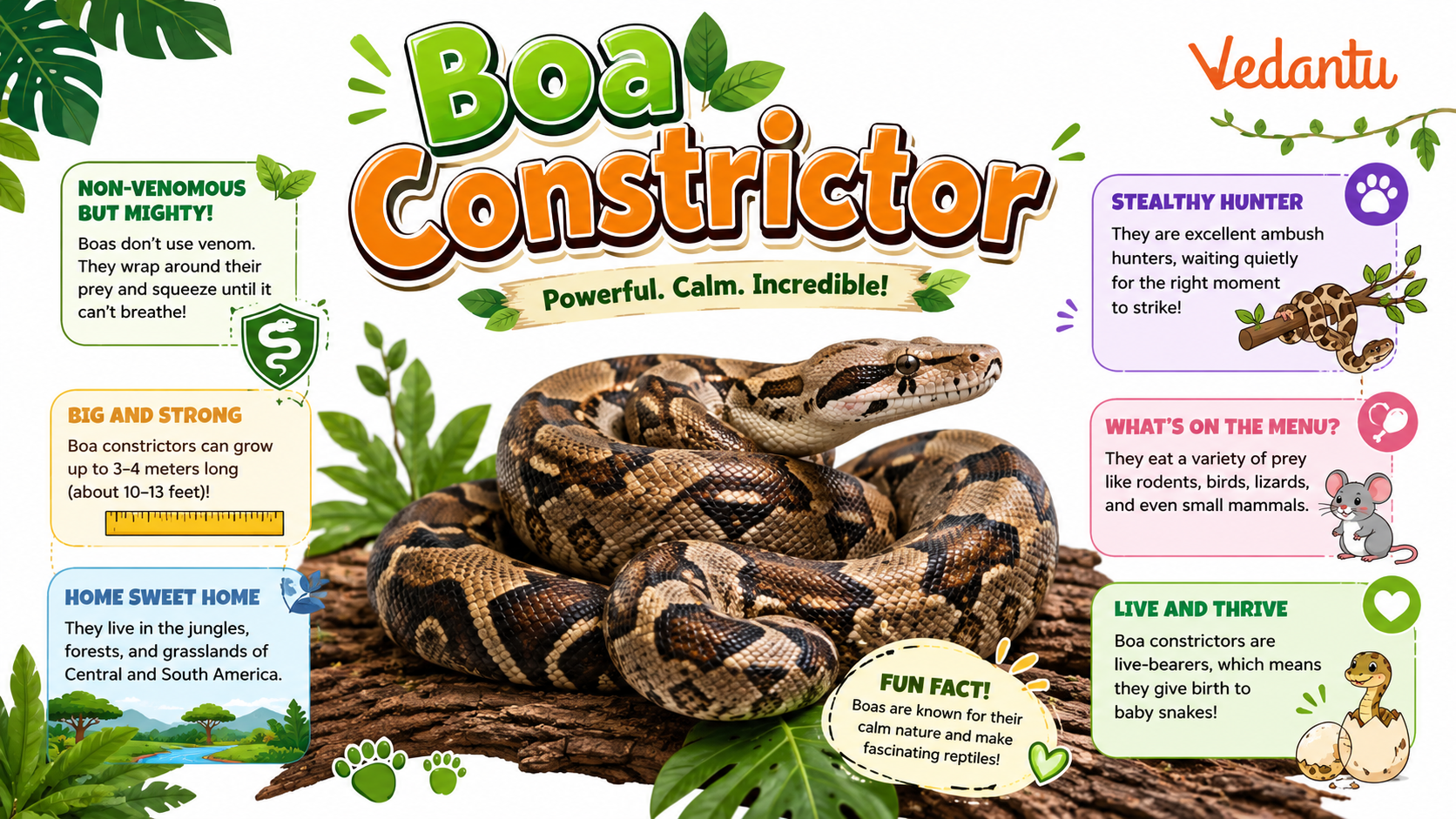
Quick Facts About Boa Constrictor
| Feature | Details |
|---|---|
| Common Name | Boa Constrictor |
| Scientific Name | Boa constrictor |
| Animal Group | Reptile |
| Size | 6–13 feet long |
| Weight | Up to 27 kg (60 lbs) |
| Lifespan | 20–30 years |
| Habitat | Rainforests, grasslands, forests |
| Diet | Carnivore |
| Movement | Slithering |
| Conservation Status | Least Concern |
Appearance and Physical Characteristics
- Long, thick, and muscular body
- Covered with smooth scales
- Brown, grey, or cream colour with dark saddle-shaped patterns
- Triangular head with sharp backward-curved teeth
- Strong tail for gripping branches
Habitat and Distribution
The natural Boa Constrictor habitat includes warm tropical regions.
- Found in Central and South America
- Lives in rainforests, savannas, and semi-desert areas
- Can climb trees and also live on the ground
- Prefers warm and humid climates
They often hide in hollow logs, animal burrows, or thick vegetation during the day.
Diet and Feeding Habits
- Rats and mice
- Birds
- Lizards
- Bats
- Small monkeys (large boas)
- Ambush predator – waits quietly for prey
- Strikes quickly and grabs with sharp teeth
- Wraps around prey and squeezes tightly
- Swallows food whole
Behaviour and Lifestyle
Life Cycle and Reproduction
- Mating: Happens during the breeding season.
- Live Birth: Female gives birth to 10–65 live babies (no eggs laid).
- Baby Boas: Independent from birth and can hunt small prey.
- Adult Stage: Reach full size in 3–4 years.
What Makes the Boa Constrictor Special?
Importance and Role in Nature
- Controls rodent populations
- Maintains balance in the food chain
- Prevents crop damage by reducing pests
Amazing Facts About Boa Constrictor
Interesting Facts About Boa Constrictor
- Boa constrictors are often kept as exotic pets.
- They can stay still for hours waiting for prey.
- Their patterns help them blend into forest floors.
- They are not naturally aggressive towards humans.
Fun Facts for Kids
FAQs on Boa Constrictor: Size, Habitat, Behavior & Care Insights
1. What is a Boa Constrictor?
A Boa Constrictor is a large, non-venomous snake that kills its prey by squeezing it.
- It belongs to the Boidae family.
- It is known for constriction, not venom.
- It lives mainly in Central and South America.
- It is often searched as giant snake, boa snake, or rainforest snake.
2. How does a Boa Constrictor kill its prey?
A Boa Constrictor kills by wrapping around its prey and squeezing tightly.
- This method is called constriction.
- It stops blood flow, not breathing.
- It swallows prey whole after it dies.
- Common prey includes rodents, birds, and small mammals.
3. Are Boa Constrictors poisonous or venomous?
A Boa Constrictor is not poisonous or venomous.
- It does not have venom glands or fangs.
- It relies on strong muscles to capture prey.
- It is considered a non-venomous snake.
- People often confuse boas with venomous snakes like vipers.
4. Where do Boa Constrictors live?
Boa Constrictors live in warm regions of the Americas.
- Found in Central America and South America.
- Live in rainforests, grasslands, and tropical forests.
- Prefer warm, humid habitats.
- Sometimes found near rivers and swamps.
5. How big can a Boa Constrictor grow?
A Boa Constrictor can grow very long and heavy.
- Average length: 6 to 10 feet.
- Some can reach up to 13 feet.
- They can weigh over 60 pounds.
- Females are usually larger than males.
6. What do Boa Constrictors eat?
Boa Constrictors are carnivores that eat other animals.
- They eat rats, mice, birds, bats, and lizards.
- Larger boas may eat monkeys or wild pigs.
- They swallow food whole.
- They can survive weeks without eating.
7. Are Boa Constrictors dangerous to humans?
Boa Constrictors are generally not dangerous to humans unless threatened.
- They are usually shy and avoid people.
- Bites are rare and mostly defensive.
- Large boas can be risky if handled improperly.
- They are sometimes kept as exotic pets.
8. How long do Boa Constrictors live?
Boa Constrictors can live a long time, especially in captivity.
- In the wild: about 20 to 30 years.
- In captivity: up to 40 years with proper care.
- They need warm temperatures and good nutrition.
9. How do Boa Constrictors reproduce?
Boa Constrictors give birth to live young instead of laying eggs.
- They are ovoviviparous (eggs hatch inside the mother).
- A female can have 10 to 60 baby snakes.
- Baby boas are independent at birth.
10. Why are Boa Constrictors important to the ecosystem?
Boa Constrictors help keep ecosystems balanced by controlling animal populations.
- They reduce numbers of rodents and pests.
- They are part of the food chain.
- They support healthy rainforest ecosystems.
- They are studied in wildlife conservation and biodiversity research.
