






What Do Bluefish Eat and Where Do They Live?
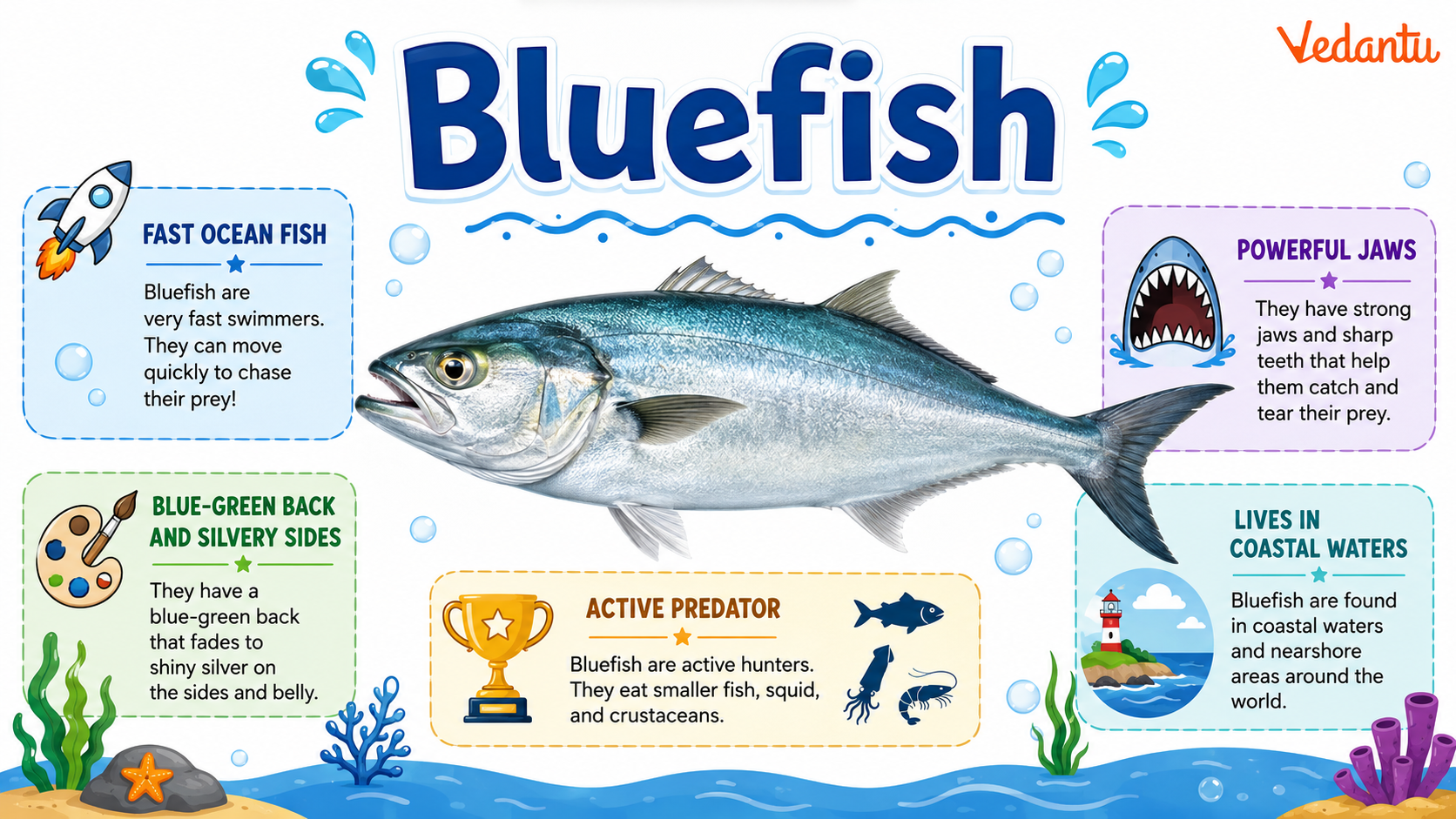
Quick Facts About Bluefish
| Feature | Details |
|---|---|
| Common Name | Bluefish |
| Scientific Name | Pomatomus saltatrix |
| Animal Group | Fish (Marine) |
| Size | Up to 120 cm long |
| Weight | Up to 14 kg |
| Lifespan | About 9–12 years |
| Habitat | Coastal oceans and temperate seas |
| Diet | Fish, squid, shrimp |
| Movement | Strong and fast swimmer |
| Conservation Status | Least Concern |
Appearance and Physical Characteristics
- Long, streamlined body perfect for fast swimming.
- Blue-green back with shiny silver sides.
- Sharp, triangular teeth arranged in a single row.
- Large mouth and strong jaws.
- Forked tail that helps in quick bursts of speed.
Bluefish Habitat and Distribution
- Found in the Atlantic Ocean, Indian Ocean, and Pacific Ocean.
- Common along the eastern coast of the United States.
- Prefer coastal waters, bays, and estuaries.
- Usually swim near the surface but can dive deeper.
- Migrate seasonally to follow warm water and food sources.
Bluefish Diet and Feeding Habits
- Eat smaller fish like sardines, anchovies, and mackerel.
- Also feed on squid and crustaceans.
- Hunt in schools to trap prey.
- Often attack prey in a feeding frenzy.
Bluefish are mid-level predators. They control smaller fish populations and are also eaten by larger sharks and marine mammals.
Behaviour and Lifestyle
- Travel in large schools.
- Very active and energetic swimmers.
- Known for aggressive feeding behaviour.
- Migrate long distances during different seasons.
- Highly sensitive to changes in water temperature.
Bluefish Life Cycle
- Spawning: Females release thousands of eggs in open water.
- Egg Stage: Eggs float freely in the ocean.
- Larva Stage: Tiny larvae hatch and drift with currents.
- Juvenile Stage: Young fish grow quickly and begin hunting.
- Adult Stage: Fully grown Bluefish become powerful predators.
What Makes Bluefish Special?
Built for rapid swimming with a strong tail and streamlined body.
Razor-sharp teeth help them tear apart prey easily.
Work together in groups to surround and attack prey.
Popular in sport fishing because they fight hard when caught.
Importance and Role in Nature
Control populations of smaller fish.
Important prey for sharks and larger marine animals.
Support fishing industries in many countries.
Their migration reflects ocean temperature changes.
Amazing Bluefish Facts
Interesting Facts About Bluefish
- Bluefish have only one species in their family.
- Their silver colour helps them blend into the ocean.
- They are more active during warmer months.
- Large Bluefish are sometimes called “choppers.”
Fun Facts for Kids
FAQs on Bluefish: Complete Guide to Habitat, Diet, and Behavior
1. What is a bluefish?
A bluefish is a fast-swimming, ocean predator known for its sharp teeth and strong body.
- The scientific name is Pomatomus saltatrix.
- It lives in warm and temperate parts of the Atlantic Ocean and other seas.
- Bluefish are famous for being aggressive hunters.
- They are sometimes called tailor or elf in different countries.
- People often search: "What kind of fish is bluefish?" and "Is bluefish a saltwater fish?"
2. Where do bluefish live?
Bluefish live in warm coastal and offshore ocean waters around the world.
- Found in the Atlantic Ocean, Indian Ocean, and parts of the Pacific Ocean.
- Common along the U.S. East Coast and in the Mediterranean Sea.
- Prefer saltwater habitats like bays, beaches, and open sea.
- They migrate seasonally to find warmer water and food.
- People also ask: "Where can you catch bluefish?"
3. What do bluefish eat?
Bluefish are carnivores that eat smaller fish and sea creatures.
- They hunt baitfish like menhaden and sardines.
- They also eat squid and small crustaceans.
- Bluefish hunt in groups called schools.
- Known for their strong jaws and very sharp teeth.
- Common search: "What does a bluefish feed on?"
4. How big can a bluefish grow?
Bluefish can grow quite large compared to many other coastal fish.
- Average size is 20–30 inches long.
- Large bluefish can reach over 40 inches.
- They can weigh up to 30–40 pounds.
- Bigger bluefish are sometimes called "gator blues".
- People also search: "How heavy is a bluefish?"
5. Why are bluefish important?
Bluefish are important because they help balance the ocean ecosystem and support fishing industries.
- They control populations of smaller fish.
- They are popular in recreational fishing.
- They are part of the marine food chain.
- They support coastal economies through sport fishing.
- Common question: "Why are bluefish valuable?"
6. Are bluefish good to eat?
Bluefish are edible and have a strong, rich flavor.
- The meat is oily and high in omega-3 fatty acids.
- Best eaten fresh because it spoils quickly.
- Often grilled, baked, or smoked.
- Some people find the taste strong compared to mild fish.
- People also ask: "Is bluefish healthy?"
7. How fast can a bluefish swim?
Bluefish are very fast swimmers built for chasing prey.
- They have a streamlined, torpedo-shaped body.
- Strong tail fin helps them move quickly.
- They can rapidly attack schools of baitfish.
- Speed helps them survive as ocean predators.
- Common search: "Are bluefish fast?"
8. Do bluefish travel in groups?
Yes, bluefish often travel and hunt in large groups called schools.
- Schooling helps them catch more prey.
- Groups can include hundreds of fish.
- This behavior makes them easier for anglers to spot.
- Young bluefish especially stay in tight schools.
- People also search: "Do bluefish swim alone?"
9. What are baby bluefish called?
Baby bluefish are commonly called "snappers."
- Snappers are small, young juvenile bluefish.
- They are usually under 12 inches long.
- They grow quickly in their first year.
- Found in bays and near the shore.
- Common question: "What is a snapper bluefish?"
10. Are bluefish endangered?
Bluefish are not currently endangered, but their populations are carefully managed.
- Managed by fisheries regulations.
- Catch limits help protect the species.
- Scientists monitor bluefish populations yearly.
- Sustainable fishing keeps numbers stable.
- People also ask: "Is bluefish overfished?"
