






Where Do Blue Sheep Live and What Do They Eat?
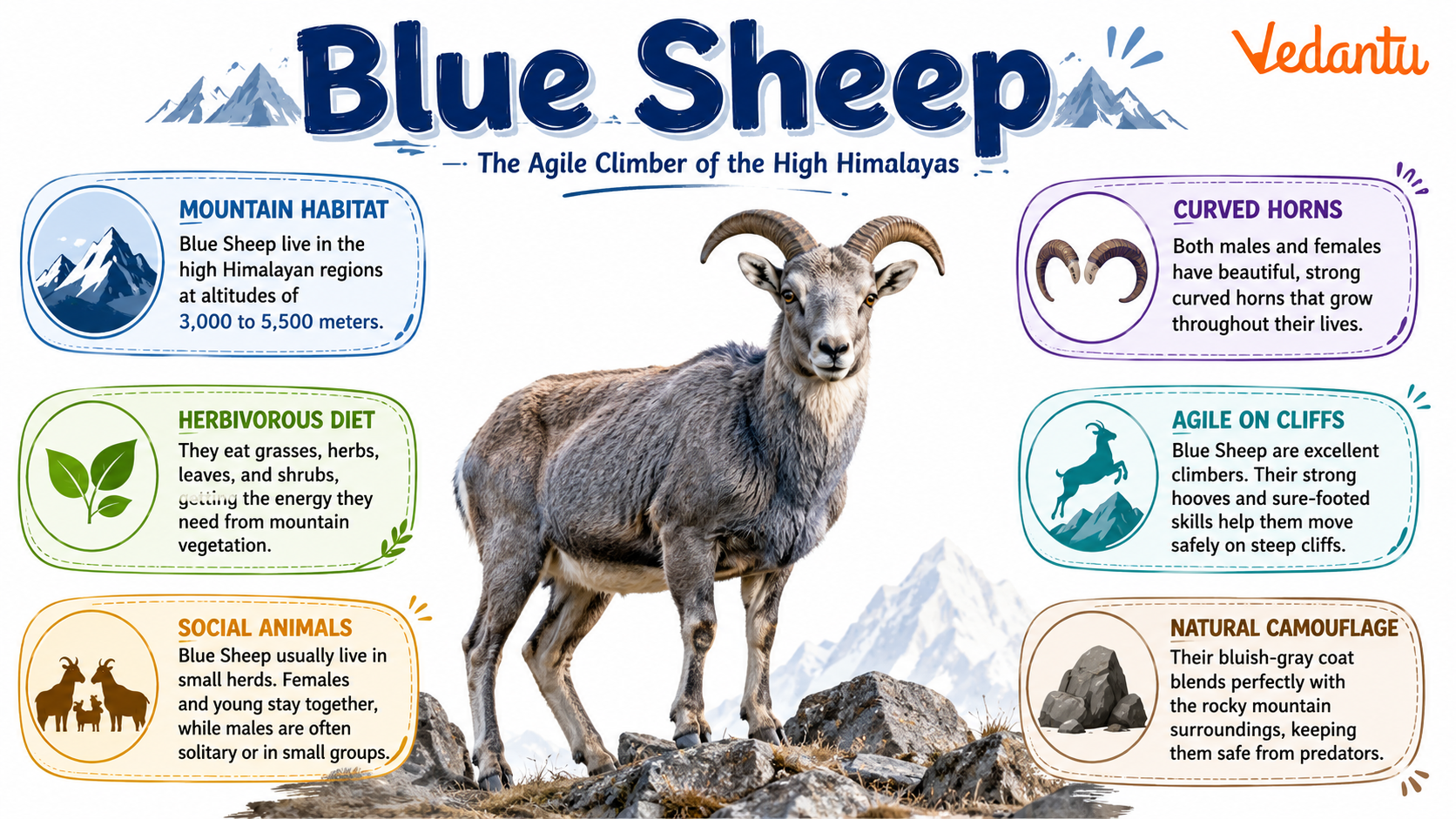
The Blue Sheep, also known as Bharal, is a wild mountain animal found high in the Himalayas. Despite its name, it is not truly a sheep but a goat-like animal. Known for its amazing climbing skills, strong legs, and thick coat, the Blue Sheep survives in rocky, cold environments where very few animals can live. Let’s explore interesting Blue Sheep facts, habitat, diet, characteristics, life cycle, and why it is important in nature.
Quick Facts and Statistics
| Feature | Details |
|---|---|
| Common Name | Blue Sheep (Bharal) |
| Scientific Name | Pseudois nayaur |
| Animal Group | Mammal |
| Height | 80–90 cm at shoulder |
| Weight | 35–75 kg |
| Lifespan | 10–15 years |
| Habitat | High mountains, rocky slopes |
| Diet | Grass, shrubs, herbs |
| Found In | India, Nepal, Bhutan, China, Pakistan |
| Conservation Status | Least Concern (IUCN) |
Appearance and Physical Characteristics
- Greyish-blue coat that blends with rocks.
- White belly and inner legs.
- Strong, curved horns (larger in males).
- Short tail and sturdy body.
- Sharp hooves with rubbery pads for gripping rocks.
Blue Sheep Habitat and Distribution
- Lives at heights of 3,000 to 5,500 meters.
- Prefers open grassy slopes and rocky cliffs.
- Avoids dense forests.
- Often seen near steep terrain for protection from predators.
Diet and Feeding Habits
Eats only plant-based food.
Grass, alpine herbs, shrubs.
Early morning and late afternoon.
Important prey for snow leopards.
Behaviour and Lifestyle
- Usually found in herds of 5–20 members.
- Males and females may live separately except during breeding season.
- Very alert and quick to escape danger.
- Excellent climbers and jumpers.
- Rest during midday to save energy.
Blue Sheep Life Cycle
- Breeding Season: Usually in late autumn.
- Gestation: Around 160 days.
- Birth: One lamb is usually born in spring.
- Young Stage: Lamb can stand and walk within hours.
- Adult Stage: Reaches maturity at about 2–3 years.
What Makes Blue Sheep Special?
Importance and Role in Nature
- Main prey of the endangered Snow Leopard.
- Helps control grass growth in alpine regions.
- Supports biodiversity in mountain ecosystems.
Amazing Facts About Blue Sheep
Interesting Facts About Blue Sheep
- They are active mostly during the day.
- Their eyesight is very sharp.
- They prefer open land so they can spot predators easily.
- They stay in large groups during winter for safety.
Fun Facts for Kids
FAQs on Blue Sheep: Complete Guide to the Himalayan Bharal
1. What is a Blue Sheep?
A Blue Sheep is a wild mountain animal that lives in the high Himalayas of Asia.
- Its scientific name is Pseudois nayaur
- Also called Bharal
- Found in Himalayan mountains, Tibet, Nepal, India, and Bhutan
- It is not a true sheep but closely related to wild goats and sheep
- Known for its amazing climbing skills on rocky cliffs
2. Why is it called a Blue Sheep?
The Blue Sheep gets its name from the bluish shade of its fur.
- Its coat looks grayish-blue from a distance
- This color helps with camouflage on rocky mountains
- The shade protects it from predators like snow leopards
- The name does not mean it is bright blue
3. Where do Blue Sheep live?
Blue Sheep live in high mountain regions of Central and South Asia.
- Found in the Himalayas and Tibetan Plateau
- Prefer heights of 3,000–5,500 meters
- Live on steep cliffs and rocky slopes
- Choose open areas to spot predators easily
4. What do Blue Sheep eat?
Blue Sheep are plant-eating animals that survive on mountain vegetation.
- They are herbivores
- Eat grass, shrubs, herbs, and moss
- Graze during early morning and evening
- Adapted to eat tough plants in cold climates
5. Are Blue Sheep really sheep or goats?
Blue Sheep are a mix of goat and sheep features but are classified closer to wild sheep.
- Scientific name: Pseudois nayaur
- Have horns like sheep
- Body shape similar to mountain goats
- Belong to the Caprinae subfamily
6. Who are the main predators of Blue Sheep?
The biggest predator of the Blue Sheep is the snow leopard.
- Main enemy: Snow Leopard
- Also hunted by wolves and lynxes
- Their camouflage helps them hide from predators
- They escape by climbing steep rocky cliffs
7. How do Blue Sheep protect themselves?
Blue Sheep protect themselves by using their speed and climbing ability.
- Excellent rock climbers
- Use natural camouflage
- Live in groups (herds) for safety
- Stay alert in open mountain areas
8. How big do Blue Sheep grow?
Blue Sheep are medium-sized mountain animals with strong bodies.
- Length: about 115–165 cm
- Weight: 35–75 kg
- Males are bigger than females
- Males have large curved horns
9. Are Blue Sheep endangered?
Blue Sheep are currently listed as Least Concern but still face threats.
- Status: Least Concern (IUCN Red List)
- Threats include habitat loss and hunting
- Affected by climate change in mountain ecosystems
- Protected in many national parks
10. Why are Blue Sheep important to the ecosystem?
Blue Sheep play an important role in the Himalayan mountain ecosystem.
- Main prey of the Snow Leopard
- Help maintain grassland balance by grazing
- Support the food chain in high-altitude regions
- Important species in Himalayan wildlife
