






Where Do Blue Sharks Live and What Do They Eat?
The Blue Shark is one of the most elegant and widely travelled sharks in the world’s oceans. Known for its slim body and beautiful deep-blue colour, this fast swimmer glides through open waters with amazing speed and control. In this page, you will explore important Blue Shark facts, its habitat, diet, characteristics, life cycle, and importance in the marine ecosystem — all explained in a simple and student-friendly way.
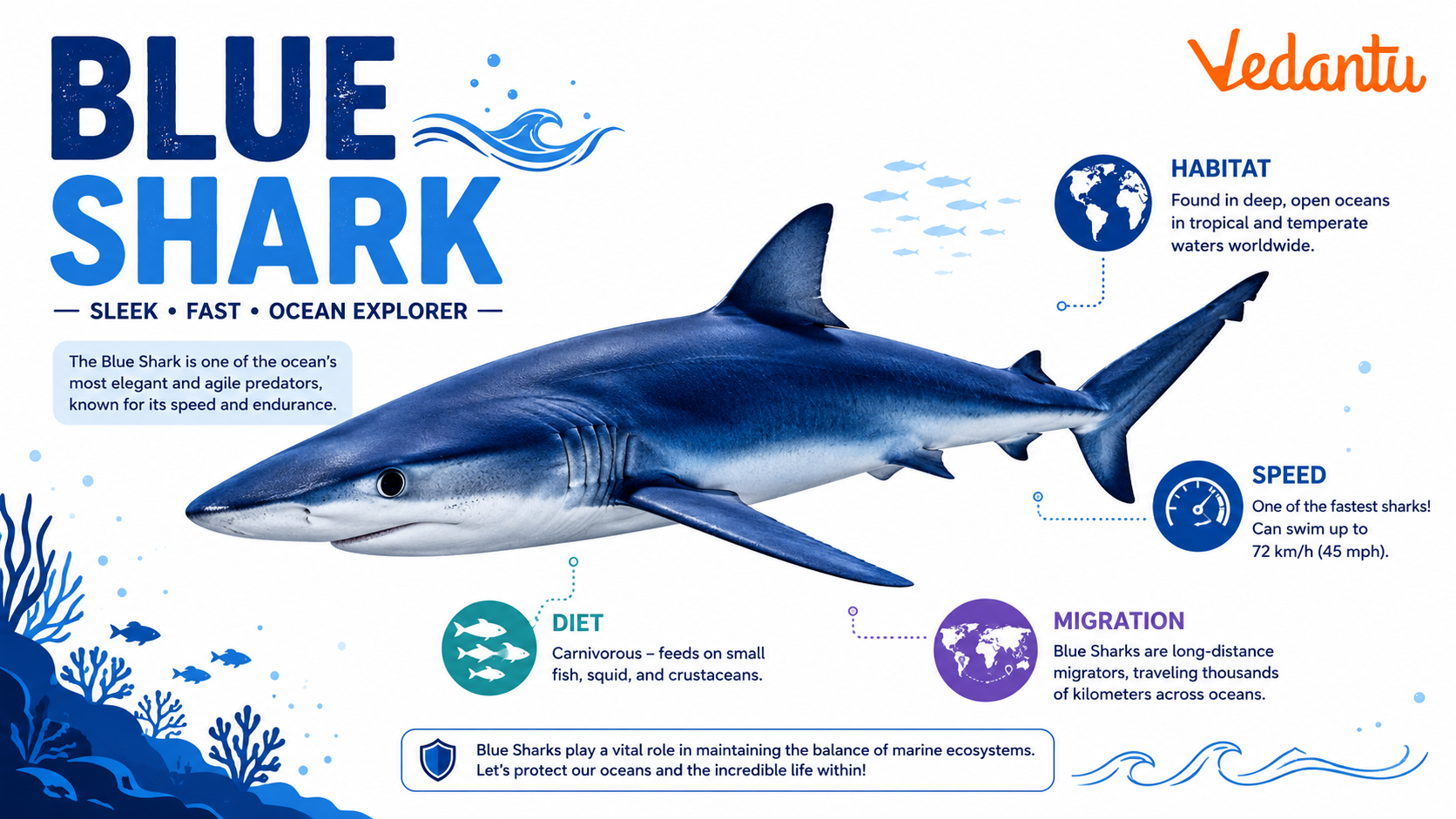
Quick Facts About Blue Shark
| Feature | Details |
|---|---|
| Common Name | Blue Shark |
| Scientific Name | Prionace glauca |
| Animal Group | Fish (Cartilaginous Fish) |
| Size | Up to 3.8 metres long |
| Weight | Up to 200 kg |
| Lifespan | 15–20 years |
| Habitat | Open oceans worldwide |
| Diet | Fish, squid, small sharks |
| Conservation Status | Near Threatened |
Appearance and Physical Characteristics
- Long, slim and torpedo-shaped body built for speed.
- Bright blue colour on top and white belly underneath.
- Very long and pointed pectoral fins.
- Sharp, triangular teeth with serrated edges.
- Large black eyes adapted for open ocean vision.
Blue Shark Habitat and Distribution
- Lives in temperate and tropical oceans around the world.
- Common in the Atlantic, Pacific, and Indian Oceans.
- Prefers open sea rather than coastal areas.
- Usually found at depths of 0–350 metres.
- Migrates long distances following food and water temperature.
The Blue Shark habitat mainly includes deep offshore waters. It is one of the most widely distributed shark species on Earth, travelling thousands of kilometres each year.
Diet and Feeding Habits
Behaviour and Lifestyle
- Usually solitary but sometimes seen in small groups.
- Highly migratory species.
- Active both during day and night.
- Excellent swimmers with smooth, graceful movement.
- Curious but generally not aggressive toward humans.
Blue Shark Life Cycle
- Internal Fertilisation: Mating happens in open water.
- Live Birth: Females give birth to live pups (viviparous).
- Litter Size: 25 to over 100 pups at a time.
- Growing Stage: Young sharks grow quickly in open waters.
- Adult Stage: Reach maturity in 4–6 years.
What Makes the Blue Shark Special?
Importance and Role in Nature
- Maintains balance in marine ecosystems.
- Controls populations of squid and fish.
- Important indicator of ocean health.
- Supports biodiversity in open sea environments.
Amazing Blue Shark Facts
Interesting Facts About Blue Shark
- Blue Sharks are known for their elegant and smooth swimming style.
- They sometimes form loose groups separated by size and gender.
- Their long fins help them glide efficiently.
- They are sensitive to changes in ocean temperature.
Fun Facts for Kids
FAQs on Blue Shark: Complete Guide to Behavior and Ocean Life
1. What is a Blue Shark?
The Blue Shark is a fast, deep-blue ocean shark known for its slim body and long fins.
- Scientific name: Prionace glauca
- Belongs to the requiem shark family
- Recognized for its bright blue color on top and white belly
- Lives in open oceans around the world
- One of the most widespread shark species
2. Where do Blue Sharks live?
Blue Sharks live in warm and temperate ocean waters across the globe.
- Found in the Atlantic, Pacific, and Indian Oceans
- Prefer deep offshore waters rather than coastal areas
- Migrate long distances in search of food
- Often swim near the surface at night
- Common in tropical and subtropical seas
3. What do Blue Sharks eat?
Blue Sharks are carnivores that hunt small sea animals.
- Main diet includes squid
- Also eat small fish like sardines and mackerel
- Sometimes feed on crustaceans
- Use sharp teeth to catch slippery prey
- Hunt mostly at night in the open ocean
4. How big can a Blue Shark grow?
A full-grown Blue Shark can reach impressive lengths in the ocean.
- Average length: 6 to 7 feet (1.8–2.1 meters)
- Some grow up to 12 feet (3.8 meters)
- Weigh around 200–400 pounds
- Females are usually larger than males
- Long, pointed fins make them look even bigger
5. Are Blue Sharks dangerous to humans?
Blue Sharks are generally not dangerous to people and rarely attack humans.
- Very few recorded shark attacks
- Prefer deep ocean instead of beaches
- Curious but usually shy around divers
- Most human encounters are accidental
- Considered a low-risk shark species
6. Why are Blue Sharks blue?
The Blue Shark’s blue color helps it hide in the ocean.
- Top side is deep indigo blue
- Belly is white for camouflage
- Blends with dark water when seen from above
- Matches bright surface light when seen from below
- This coloring is called countershading
7. How long do Blue Sharks live?
Blue Sharks can live for many years in the wild ocean.
- Average lifespan is about 15–20 years
- Grow quickly compared to some other sharks
- Reach maturity around 4–6 years
- Females mature slightly later than males
- Lifespan depends on food and ocean conditions
8. How do Blue Sharks reproduce?
Blue Sharks give birth to live babies instead of laying eggs.
- They are viviparous (live-bearing sharks)
- Pregnancy lasts about 9–12 months
- Can have large litters of 25–50 pups
- Baby sharks are independent at birth
- Pups measure about 14–16 inches long
9. Are Blue Sharks endangered?
Blue Sharks are considered near threatened due to fishing pressure.
- Listed as Near Threatened by conservation groups
- Often caught in commercial fishing nets
- Hunted for fins, meat, and liver oil
- Large numbers are caught as bycatch
- Conservation efforts aim to protect shark populations
10. What are some interesting facts about Blue Sharks?
Blue Sharks have many fascinating features that make them unique ocean predators.
- Among the most migratory sharks in the world
- Can travel thousands of miles each year
- Have very long, slender pectoral fins
- Excellent sense of smell to detect prey
- Play an important role in the marine ecosystem
