






What Is a Blow Fly? Meaning, Habitat, Diet, and Role in Forensics
The blow fly is a shiny, fast-flying insect often seen around garbage, dead animals, or even open wounds. Though it may seem unpleasant, this tiny insect plays a very important role in nature. Blow fly facts reveal that these insects help recycle nutrients, clean up decaying matter, and even assist scientists in solving crimes. Let’s explore the blow fly habitat, diet, life cycle, and why it matters more than you might think!
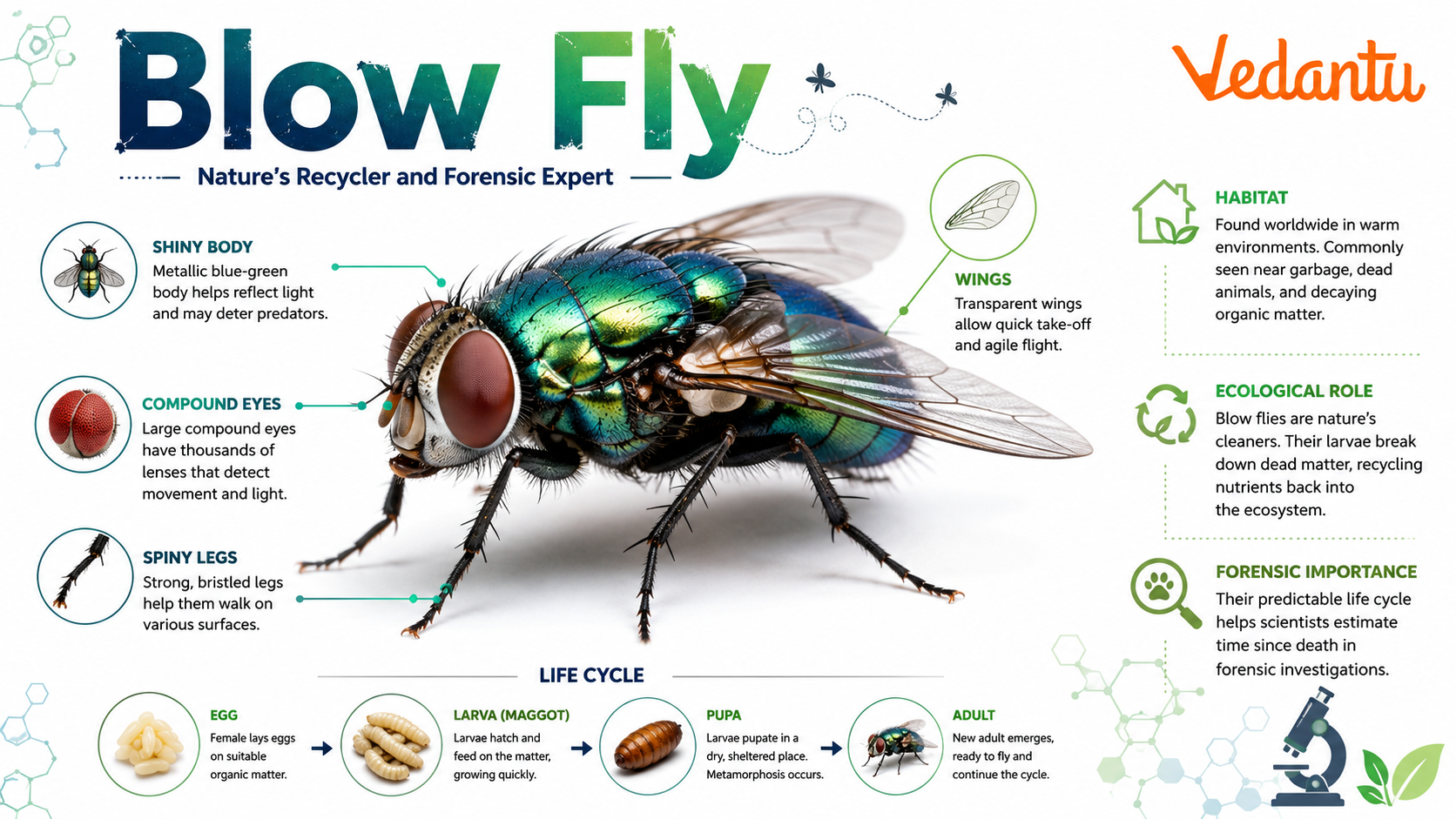
Quick Facts About Blow Fly
| Feature | Details |
|---|---|
| Common Name | Blow Fly |
| Scientific Family | Calliphoridae |
| Animal Group | Insect |
| Size | 6–14 mm long |
| Lifespan | 2–4 weeks (adult stage) |
| Diet | Decaying meat, garbage, wounds, nectar |
| Habitat | Urban areas, farms, forests, near waste |
| Special Feature | Shiny metallic body |
Appearance and Physical Characteristics
- Small to medium-sized insect.
- Bright metallic colours like blue, green, or bronze.
- Large red or dark compound eyes.
- One pair of transparent wings.
- Short antennae for sensing smells.
Habitat and Distribution
- Found all over the world except Antarctica.
- Common in cities, villages, forests, and farms.
- Prefer warm and moist environments.
- Often seen near garbage bins or animal carcasses.
Diet and Feeding Habits
- Adults feed on nectar, garbage, and decaying material.
- Larvae (maggots) eat dead animals or rotting meat.
- Some species feed on open wounds of animals.
Behaviour and Lifestyle
- Active during the day.
- Strong and fast fliers.
- Attracted to strong smells.
- Lay eggs quickly after finding food.
Blow flies are usually not social insects, but many can gather in one place if there is a strong food source.
Blow Fly Life Cycle
The blow fly life cycle shows complete metamorphosis with four stages:
- Egg: Laid on decaying matter or wounds.
- Larva (Maggot): Feeds actively and grows fast.
- Pupa: Develops inside a hard case.
- Adult: Emerges as a shiny flying insect.
What Makes Blow Fly Special?
Scientists use blow fly development stages to estimate time of death in criminal investigations.
Maggots grow very quickly and can double in size in a short time.
They can detect dead animals from long distances.
Help clean the environment by removing dead organic matter.
Sound or Buzz
Blow flies produce a buzzing sound when flying. This sound is created by the rapid movement of their wings. The buzzing helps warn predators and is commonly heard near garbage or waste areas.
Importance and Role in Nature
Break down dead animals and organic waste.
Return important nutrients back to the soil.
Serve as food for birds, reptiles, and other insects.
Maggots are sometimes used in medicine to clean infected wounds.
Amazing Blow Fly Facts
- Blow flies are often the first insects to reach a dead animal.
- Their metallic body helps reflect sunlight.
- Some species can lay hundreds of eggs at once.
- Maggots can clean wounds by eating only dead tissue.
- They can fly at speeds up to 11 km per hour.
- Their development depends on temperature.
Fun Facts for Kids
FAQs on Blow Fly: Identification, Life Cycle, and Fascinating Facts
1. What is a blow fly?
A blow fly is a shiny fly known for its bright metallic color and its attraction to decaying matter.
- Also called bottle flies or bluebottles
- Belong to the family Calliphoridae
- Often metallic blue, green, or black in color
- Commonly found near garbage, animal waste, or dead animals
- Important in forensic science and nature’s recycling process
2. Why are blow flies attracted to dead animals?
Blow flies are attracted to dead animals because they lay their eggs on decaying flesh for their young to eat.
- Smell of decaying meat draws them quickly
- Females lay eggs on carcasses or rotting food
- Larvae (maggots) feed on decomposing tissue
- This helps break down and recycle nutrients in nature
3. What do blow fly maggots eat?
Blow fly maggots eat soft, decaying organic matter as their main food source.
- Feed on dead animals and rotting meat
- Sometimes found in garbage or compost
- Help speed up the decomposition process
- Play a role in cleaning up the environment
4. Are blow flies harmful to humans?
Blow flies can spread germs but are usually not directly dangerous to healthy people.
- May carry bacteria from waste to food
- Can contaminate uncovered meals
- Rarely cause infections called myiasis
- Good hygiene and food covering prevent problems
5. How long is the life cycle of a blow fly?
The blow fly life cycle can be completed in as little as 2 to 3 weeks in warm weather.
- Stage 1: Egg (hatches within 24 hours)
- Stage 2: Larva (maggot)
- Stage 3: Pupa
- Stage 4: Adult fly
- Warmer temperatures speed up development
6. Why are blow flies important in forensic science?
Blow flies help forensic scientists estimate the time of death in investigations.
- They are often the first insects on a dead body
- Their life cycle stages show how long a body has been present
- Used in forensic entomology
- Provide important clues in crime cases
7. Where do blow flies live?
Blow flies live almost everywhere in the world, especially in warm areas.
- Found in gardens, farms, and cities
- Common near garbage bins and animal waste
- Prefer warm and moist environments
- Active mostly during daytime
8. How can you tell a blow fly apart from a housefly?
Blow flies are usually larger and shinier than common houseflies.
- Have bright metallic blue or green bodies
- Make a loud buzzing sound
- Often appear quickly around dead animals
- Houseflies are dull gray and smaller
9. What role do blow flies play in the ecosystem?
Blow flies play an important role as natural recyclers in the ecosystem.
- Break down dead plants and animals
- Return nutrients to the soil
- Serve as food for birds and other insects
- Support the natural food chain
10. How can you prevent blow flies in your home?
You can prevent blow flies by keeping your surroundings clean and food covered.
- Seal garbage bins tightly
- Clean up pet waste quickly
- Store food in closed containers
- Install window screens to block flies
- Maintain proper sanitation and hygiene
