






Blind Snake Habitat, Diet, Behavior, and Fascinating Adaptations
The Blind Snake is one of the smallest and most mysterious snakes in the world. Because of its tiny eyes and worm-like body, it is often mistaken for an earthworm. These secretive reptiles spend most of their lives underground, quietly helping nature by eating insects and their eggs. In this page, explore fascinating Blind Snake facts, its habitat, diet, life cycle, characteristics, and why this tiny reptile is important for our ecosystem.
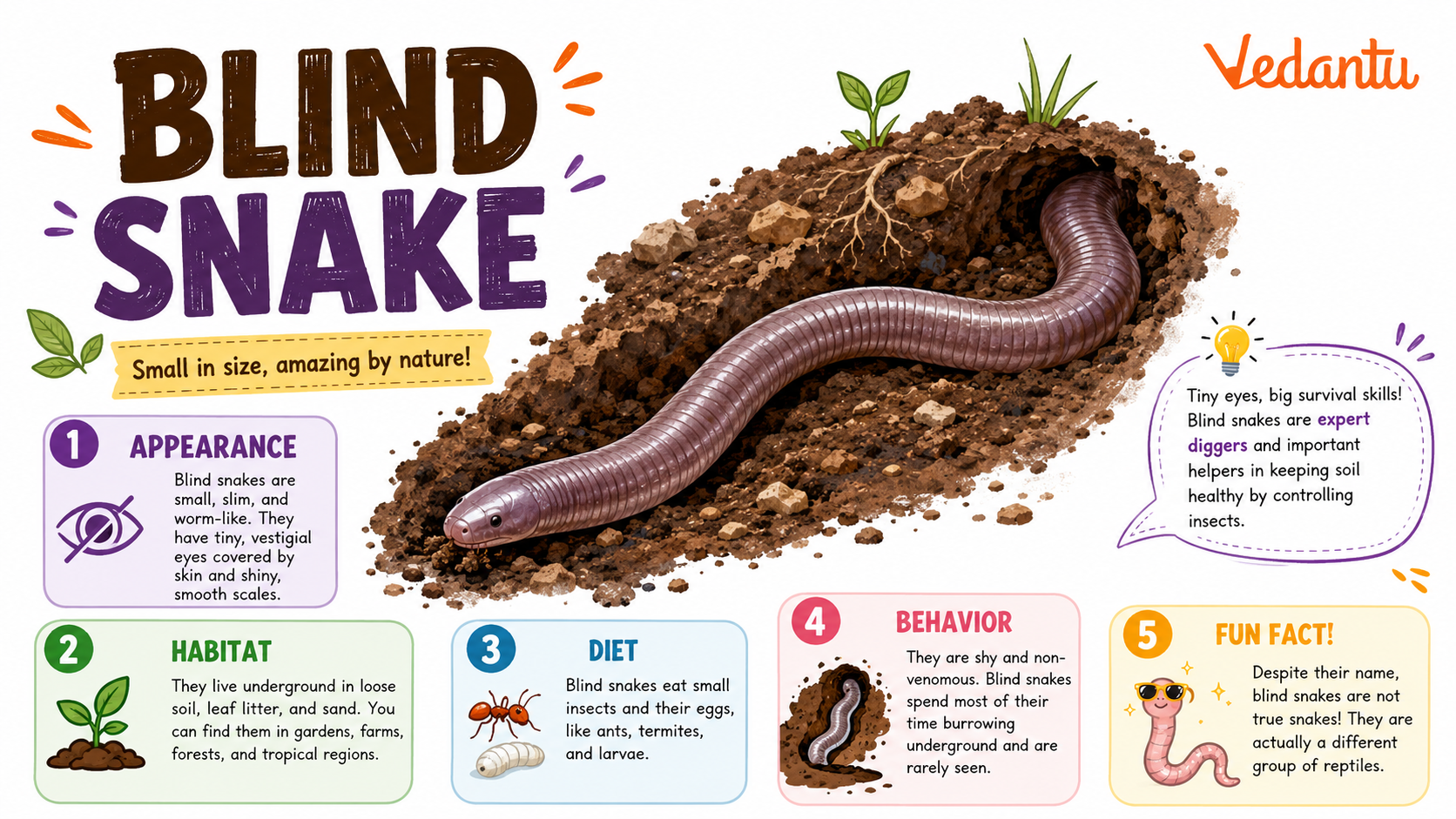
Quick Facts About Blind Snake
| Feature | Details |
|---|---|
| Common Name | Blind Snake |
| Scientific Family | Typhlopidae |
| Animal Group | Reptile |
| Size | 10–30 cm (varies by species) |
| Diet | Ants, termites, insect eggs |
| Habitat | Soil, gardens, forests, grasslands |
| Movement | Burrowing and slithering underground |
| Venom | Non-venomous |
Appearance and Physical Characteristics
- Very small, thin, and cylindrical body.
- Looks similar to an earthworm.
- Smooth, shiny scales.
- Colours include brown, pink, grey, or black.
- Tiny eyes covered with scales, so vision is very weak.
- Short, pointed tail that helps in digging.
Blind Snake Habitat and Distribution
The Blind Snake habitat mainly includes underground areas. These snakes prefer warm regions and loose soil where they can easily burrow.
- Found in Asia, Africa, Australia, and the Americas.
- Lives in gardens, forests, grasslands, and farmlands.
- Often hides under stones, logs, or leaf litter.
- Active mostly during rainy seasons.
Diet and Feeding Habits
The Blind Snake diet mainly consists of small insects and their eggs. It plays an important role in controlling insect populations.
Behaviour and Lifestyle
- Solitary and secretive in nature.
- Spends most of its life underground.
- Comes to the surface after heavy rain.
- Non-aggressive and harmless to humans.
- If disturbed, it may wiggle like an earthworm.
Blind Snake Life Cycle
- Female lays small eggs in moist soil.
- Eggs hatch into tiny snakelets.
- Young snakes are independent from birth.
- Grow slowly and live for several years.
What Makes Blind Snake Special?
Importance and Role in Nature
- Controls ant and termite populations.
- Improves soil health by burrowing.
- Acts as prey for birds and larger reptiles.
- Maintains balance in underground ecosystems.
Amazing Blind Snake Facts
Fun Facts for Kids
FAQs on Blind Snake: Complete Guide to This Secretive Burrowing Reptile
1. What is a Blind Snake?
A Blind Snake is a small, worm-like snake that spends most of its life underground.
- It belongs to the family Typhlopidae
- Also called worm snake or thread snake
- Has very tiny eyes covered by scales
- Lives in soil, gardens, forests, and sandy areas
- Feeds mostly on ants and termites
2. Why is it called a Blind Snake?
A Blind Snake is called "blind" because its eyes are very small and cannot see clearly.
- Eyes are covered with protective scales
- Can only sense light and dark
- Relies on smell and touch instead of vision
- Uses its tongue to detect food and surroundings
3. Are Blind Snakes really blind?
Blind Snakes are not completely blind, but they have very poor eyesight.
- Can detect changes in light
- Cannot see clear shapes or colors
- Spend most time underground where vision is less important
- Depend on senses and vibrations to survive
4. Where do Blind Snakes live?
Blind Snakes live in warm regions around the world, mostly underground.
- Found in Asia, Africa, Australia, and the Americas
- Prefer tropical and subtropical climates
- Hide under rocks, soil, and leaf litter
- Common in gardens and farms
5. What do Blind Snakes eat?
Blind Snakes mainly eat tiny insects found in soil.
- Love eating ant eggs and larvae
- Also feed on termites
- Use their narrow mouths to enter insect nests
- Help control pest populations naturally
6. Are Blind Snakes dangerous to humans?
Blind Snakes are harmless and not dangerous to humans.
- They are non-venomous snakes
- Do not bite unless handled roughly
- Too small to harm people
- Helpful for gardens because they eat pests
7. How big does a Blind Snake grow?
Most Blind Snakes are very small and thin like an earthworm.
- Usually grow between 10 to 30 cm long
- Body is shiny and smooth
- Thin, cylindrical shape
- Color ranges from brown to gray or pink
8. How do Blind Snakes move underground?
Blind Snakes move by wriggling their bodies through loose soil.
- Have a strong, pointed head for digging
- Smooth scales help slide through dirt
- Burrow like worms
- Spend most of their time hidden below ground
9. How do Blind Snakes reproduce?
Blind Snakes reproduce by laying eggs, and some species can reproduce without males.
- Most species are oviparous (egg-laying)
- Lay small clutches of eggs in soil
- The Brahminy Blind Snake is all-female and reproduces by parthenogenesis
- Baby snakes hatch fully formed
10. How is a Blind Snake different from an earthworm?
A Blind Snake looks like an earthworm but is actually a real snake with reptile features.
- Has scales, while earthworms do not
- Has a backbone (vertebrate)
- Flicks a forked tongue like other snakes
- Lays eggs, unlike earthworms
- Belongs to the reptile family, not insects or worms
