






Why Beluga Whales Are Called the Sea Canaries of the Ocean
The Beluga Whale is one of the most fascinating marine mammals in the world. Known for its white colour and “smiling” face, this Arctic whale is highly intelligent and social. Beluga whales are famous for their sounds and are often called the “canaries of the sea.” In this page, explore exciting Beluga Whale facts, their habitat, diet, characteristics, life cycle, and why they are important in the marine ecosystem.
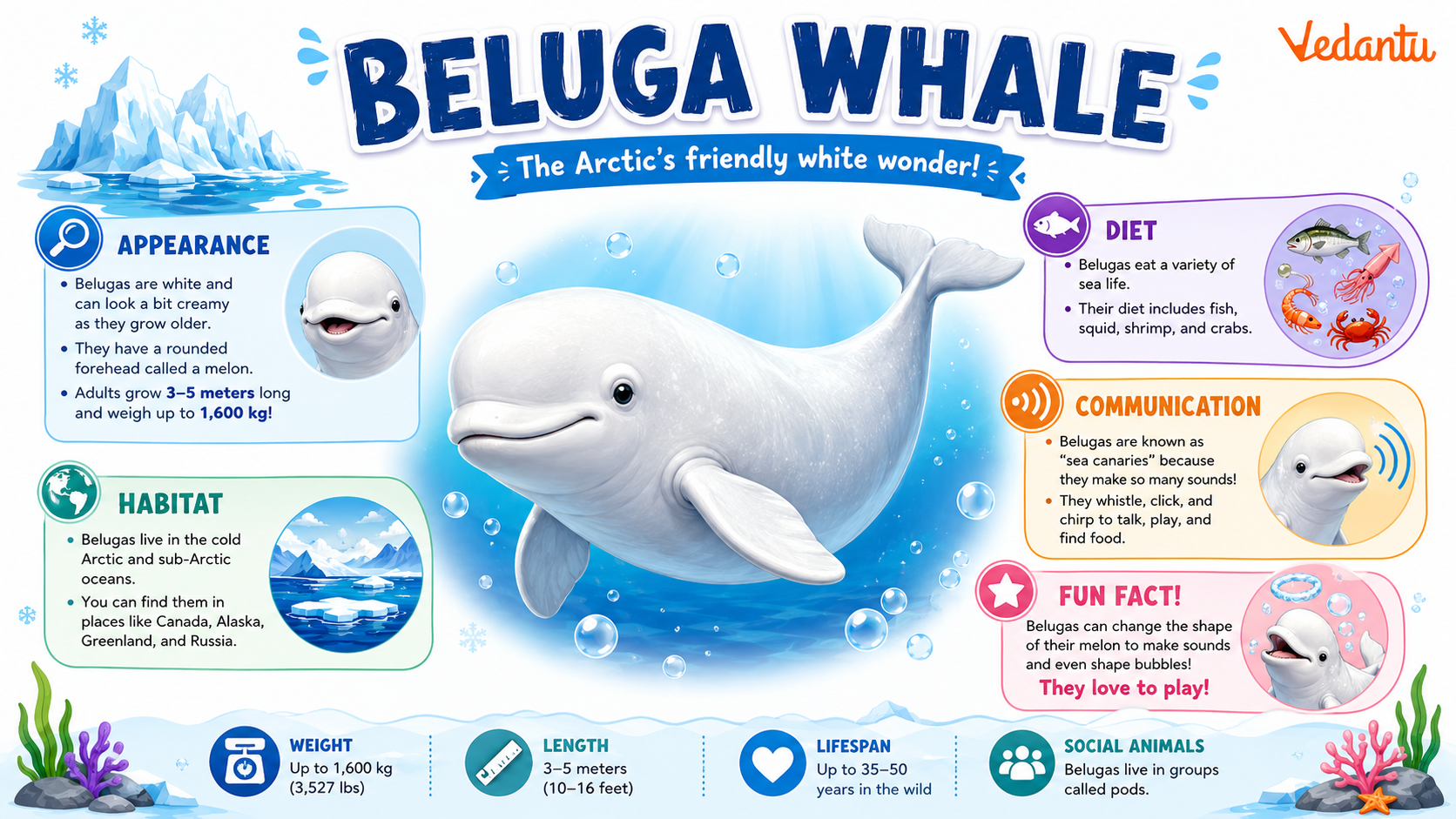
Quick Facts About Beluga Whale
| Feature | Details |
|---|---|
| Common Name | Beluga Whale |
| Scientific Name | Delphinapterus leucas |
| Animal Group | Mammal (Toothed Whale) |
| Size | 3–5 meters long |
| Weight | Up to 1,500 kg |
| Lifespan | 35–50 years |
| Habitat | Arctic and sub-Arctic oceans |
| Diet | Fish, squid, crustaceans |
| Conservation Status | Near Threatened |
Appearance and Physical Characteristics
- Completely white body (adults)
- Rounded forehead called a melon
- No dorsal fin (helps them swim under ice)
- Flexible neck – can move head side to side
- Smooth, thick skin with a layer of fat (blubber)
Beluga Whale Habitat and Distribution
- Found in the Arctic Ocean
- Also seen near Alaska, Canada, Russia, and Greenland
- Prefer icy, shallow coastal waters
- Migrate seasonally depending on ice conditions
Diet and Feeding Habits
What Do Beluga Whales Eat?
- Fish such as salmon and cod
- Squid
- Crabs and shrimp
- Other small sea creatures
Behaviour and Lifestyle
Sound or Call
Beluga whales are known as the “canaries of the sea” because of their wide range of sounds. These sounds help them communicate, find food, and stay connected with their group.
Beluga Whale Life Cycle
- Birth: Female gives birth to one calf after about 14–15 months of pregnancy.
- Calf Stage: Calves stay close to their mother and drink milk.
- Growing Up: Young belugas learn hunting and communication skills.
- Adult Stage: Become fully white and join social groups.
What Makes Beluga Whales Special?
Importance and Role in Nature
- Help maintain balance in the marine food chain
- Serve as indicators of ocean health
- Part of Arctic indigenous cultures
- Support marine biodiversity
Amazing Beluga Whale Facts
- Belugas can mimic human-made sounds.
- They shed their outer skin layer every year.
- Their melon changes shape when making sounds.
- They can dive up to 700 meters deep.
- They can swim backward.
- They are one of the few whales without a dorsal fin.
Interesting Facts About Beluga Whale
Fun Facts for Kids
- Belugas look like they are always smiling.
- Baby belugas are not white at birth.
- They love to swim together in groups.
- They live in icy Arctic waters.
- They are called the singers of the sea.
FAQs on Beluga Whale: Complete Guide to Its Life in the Arctic
1. What is a Beluga Whale?
Beluga whales are small, white Arctic whales known for their friendly appearance and wide range of sounds.
- Scientific name: Delphinapterus leucas
- Also called the "sea canary" because of their vocal sounds
- Belong to the toothed whale family (Odontoceti)
- Found mainly in the Arctic Ocean and nearby cold waters
- Known for their rounded forehead called a melon
2. Why are Beluga Whales white?
Beluga whales are white to help them blend into icy Arctic waters.
- Their white color provides camouflage against snow and sea ice
- Young belugas are born gray or brown and turn white as they grow
- The color change helps them adapt to the Arctic environment
- This protection helps them avoid predators like polar bears and orcas
3. Where do Beluga Whales live?
Beluga whales live in cold Arctic and sub-Arctic waters.
- Common in the Arctic Ocean
- Found near Canada, Greenland, Russia, and Alaska
- Prefer shallow coastal waters in summer
- Migrate to deeper waters during winter
- Travel in groups called pods
4. What do Beluga Whales eat?
Beluga whales are carnivores that eat fish and marine animals.
- Main diet includes fish, shrimp, crabs, and squid
- Use echolocation to find food underwater
- Do not chew food; they swallow it whole
- Feed near the ocean floor or in open water
5. How big do Beluga Whales grow?
Beluga whales are medium-sized whales that grow up to 20 feet long.
- Average length: 13–20 feet (4–6 meters)
- Average weight: 1–1.5 tons
- Males are usually larger than females
- Have thick blubber to stay warm in icy water
6. Why are Beluga Whales called the "sea canary"?
Beluga whales are called the "sea canary" because they make many different sounds.
- Produce clicks, whistles, chirps, and squeals
- Use sounds for communication within pods
- Rely on echolocation to navigate icy waters
- Are among the most vocal marine mammals
7. How long do Beluga Whales live?
Beluga whales can live for several decades in the wild.
- Average lifespan: 35–50 years
- Females often live slightly longer than males
- Age can be estimated by studying their teeth layers
- Healthy Arctic habitats support longer lifespans
8. Are Beluga Whales endangered?
Some populations of beluga whales are endangered, while others are considered near threatened.
- Main threats include climate change and melting sea ice
- Also affected by pollution and oil spills
- Hunted in some regions for traditional purposes
- Protected under marine conservation laws
9. How do Beluga Whales communicate?
Beluga whales communicate using sounds and body movements.
- Use whistles and clicks to talk to each other
- Depend on echolocation to detect objects
- Can change the shape of their melon to control sounds
- Often travel and communicate in social pods
10. What makes Beluga Whales unique?
Beluga whales are unique because of their white color, flexible neck, and expressive face.
- Have a flexible neck unlike most whales
- Can move their head side to side
- Lack a dorsal fin, which helps them swim under sea ice
- Known for their friendly look and social behavior
- Adapted perfectly to the Arctic marine ecosystem
