






What Do Barbet Birds Eat, Where Do They Live, and How Do They Nest?
The Barbet Bird is a bright, chubby forest bird known for its loud, repetitive calls and colourful feathers. Found mainly in Asia, Africa, and the Americas, barbets are famous for sitting quietly on tree branches and suddenly bursting into song. These birds play an important role in forests by spreading seeds. Learning about Barbet Bird facts, habitat, diet, characteristics, and life cycle helps us understand how special these tree-dwelling birds really are.
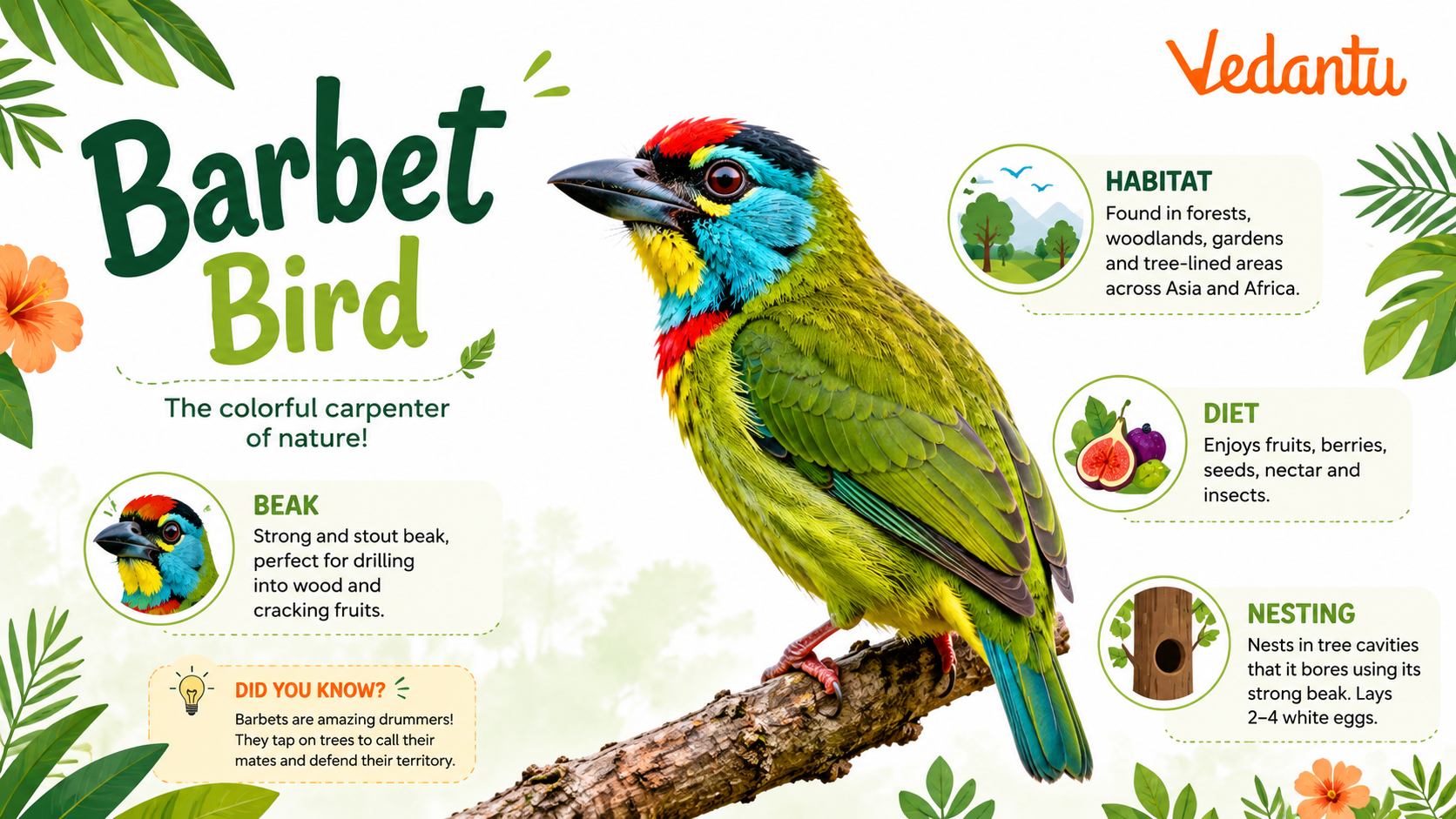
Quick Facts About Barbet Bird
| Feature | Details |
|---|---|
| Common Name | Barbet Bird |
| Scientific Family | Megalaimidae (Asian Barbets) |
| Animal Group | Bird |
| Size | 15–30 cm (varies by species) |
| Weight | 40–200 grams |
| Diet | Mainly fruits, also insects |
| Habitat | Forests, gardens, orchards |
| Lifespan | 8–12 years (approx.) |
| Special Feature | Strong beak for drilling tree holes |
Appearance and Physical Characteristics
- Small to medium-sized bird with a strong, thick body.
- Bright green feathers with red, yellow, or blue patches.
- Large head and short neck.
- Strong, sharp beak for cutting fruits and drilling wood.
- Short tail and sturdy legs for gripping branches.
Habitat and Distribution
- Common in tropical and subtropical forests.
- Also seen in parks, gardens, and fruit orchards.
- Found in Asia (especially India and Southeast Asia), Africa, and Central & South America.
- Prefer warm climates with lots of trees.
The Barbet Bird habitat mostly includes tall trees because they nest inside tree trunks. They rarely come to the ground and feel safest among branches.
Diet and Feeding Habits
Eats figs, berries, mangoes, and other soft fruits.
Also feeds on insects like beetles and ants.
Uses its thick beak to break fruit skin and catch insects.
Spreads seeds through droppings, helping forests grow.
The Barbet Bird diet makes it an important part of the forest ecosystem because it supports plant growth.
Behaviour and Lifestyle
- Mostly active during the day (diurnal).
- Often seen sitting still for long periods.
- Known for loud, repeated calls.
- Usually found alone or in pairs.
- Territorial during breeding season.
Sound or Call
Barbets make a loud, repetitive “tuk-tuk-tuk” or “kutroo-kutroo” sound. Their call can continue for several minutes without stopping and is often heard during hot afternoons.
Life Cycle of Barbet Bird
- Nest Building: Both male and female drill a hole in a tree trunk.
- Egg Laying: Female lays 2–4 white eggs inside the tree cavity.
- Incubation: Eggs hatch after about 2 weeks.
- Chicks: Parents feed chicks fruits and insects.
- Fledging: Young birds leave the nest in 4–5 weeks.
The Barbet Bird life cycle shows strong parental care, as both parents protect and feed their young.
Flight Adaptations
- Short, rounded wings for quick movement between trees.
- Lightweight body for easy flight.
- Strong chest muscles for flapping.
- Excellent grip to land safely on branches.
What Makes Barbet Bird Special?
Importance and Role in Nature
- Help in seed dispersal and forest regeneration.
- Control insect populations.
- Provide nesting holes later used by other birds.
Amazing Barbet Bird Facts
Fun Facts for Kids
- Barbets love eating juicy fruits.
- They build their homes inside tree trunks.
- Their call can be heard even in noisy cities.
- They look small but have very strong beaks.
- Some barbets have bright red or yellow faces!
FAQs on Barbet Bird: A Complete Guide to This Colorful Forest Species
1. What is a Barbet bird?
Barbet birds are colorful, medium-sized birds known for their strong beaks and loud calls.
- They belong to the family Megalaimidae (Asian barbets) and Lybiidae (African barbets).
- They are named after the bristles (“barbs”) around their beaks.
- They are often seen sitting quietly on tree branches.
- They are famous for their repetitive, ringing bird calls.
2. Where do Barbet birds live?
Barbet birds live in forests and woodlands across Asia, Africa, and parts of the Americas.
- They prefer tropical and subtropical forests.
- Many species are found in India, Sri Lanka, Thailand, and Africa.
- They live in tree holes in gardens, parks, and jungles.
- They rarely come down to the ground.
3. What do Barbet birds eat?
Barbet birds mainly eat fruits but also enjoy insects.
- Their favorite foods include figs, berries, and wild fruits.
- They sometimes eat insects, termites, and small bugs.
- Their strong beak helps them break tough fruit skins.
- They help spread seeds, which supports forest growth.
4. Why are Barbet birds called Barbets?
Barbet birds are named after the bristle-like hairs around their beaks.
- The word “barbet” comes from the French word “barbe”, meaning beard.
- These bristles protect their eyes while pecking wood.
- The bristles help them catch insects.
- This feature makes them different from many other birds.
5. Are Barbet birds related to woodpeckers?
Yes, Barbet birds are closely related to woodpeckers.
- Both belong to the order Piciformes.
- They have strong beaks for drilling into wood.
- Unlike woodpeckers, barbets do not tap rapidly on trees.
- They use tree holes mainly for nesting.
6. How do Barbet birds build their nests?
Barbet birds make their nests by digging holes in tree trunks.
- They use their powerful beaks to carve out cavities.
- Nests are usually built in dead or soft wood.
- The female lays eggs inside the tree hole.
- Both parents help care for the chicks.
7. What do Barbet birds look like?
Barbet birds are small, plump birds with bright colors and large heads.
- They often have green bodies with red, yellow, or blue markings.
- They have a thick, strong beak.
- Some species have colorful patches on the throat and face.
- Their bright feathers help them blend into leafy trees.
8. Why do Barbet birds make loud calls?
Barbet birds make loud, repetitive calls to communicate.
- They use calls to mark their territory.
- They call to attract mates during breeding season.
- Their sound is often described as a “tuk-tuk” or ringing note.
- They may call for many minutes without stopping.
9. How many types of Barbet birds are there?
There are over 80 species of Barbet birds worldwide.
- Some common species include the Coppersmith Barbet and Blue-throated Barbet.
- Asian barbets are mostly green.
- African barbets often have bold black, red, and yellow colors.
- Each species has unique markings and calls.
10. Are Barbet birds endangered?
Most Barbet birds are not endangered, but habitat loss can affect them.
- Deforestation reduces their nesting trees.
- Some species are listed as Least Concern by conservation groups.
- Protecting forests helps keep barbet populations safe.
- Planting fruit trees can attract them to gardens.
