






Where Do Bandicoots Live? Habitat, Diet, and Behavior Explained
A bandicoot is a small mammal known for its pointed snout, strong claws, and fast digging skills. These animals are mostly active at night and are famous for living in burrows underground. Bandicoots are found in different parts of Asia and Australia, depending on the species. Learning about bandicoot facts, habitat, diet, and characteristics helps us understand how these tiny creatures survive in forests, grasslands, and even near human settlements.
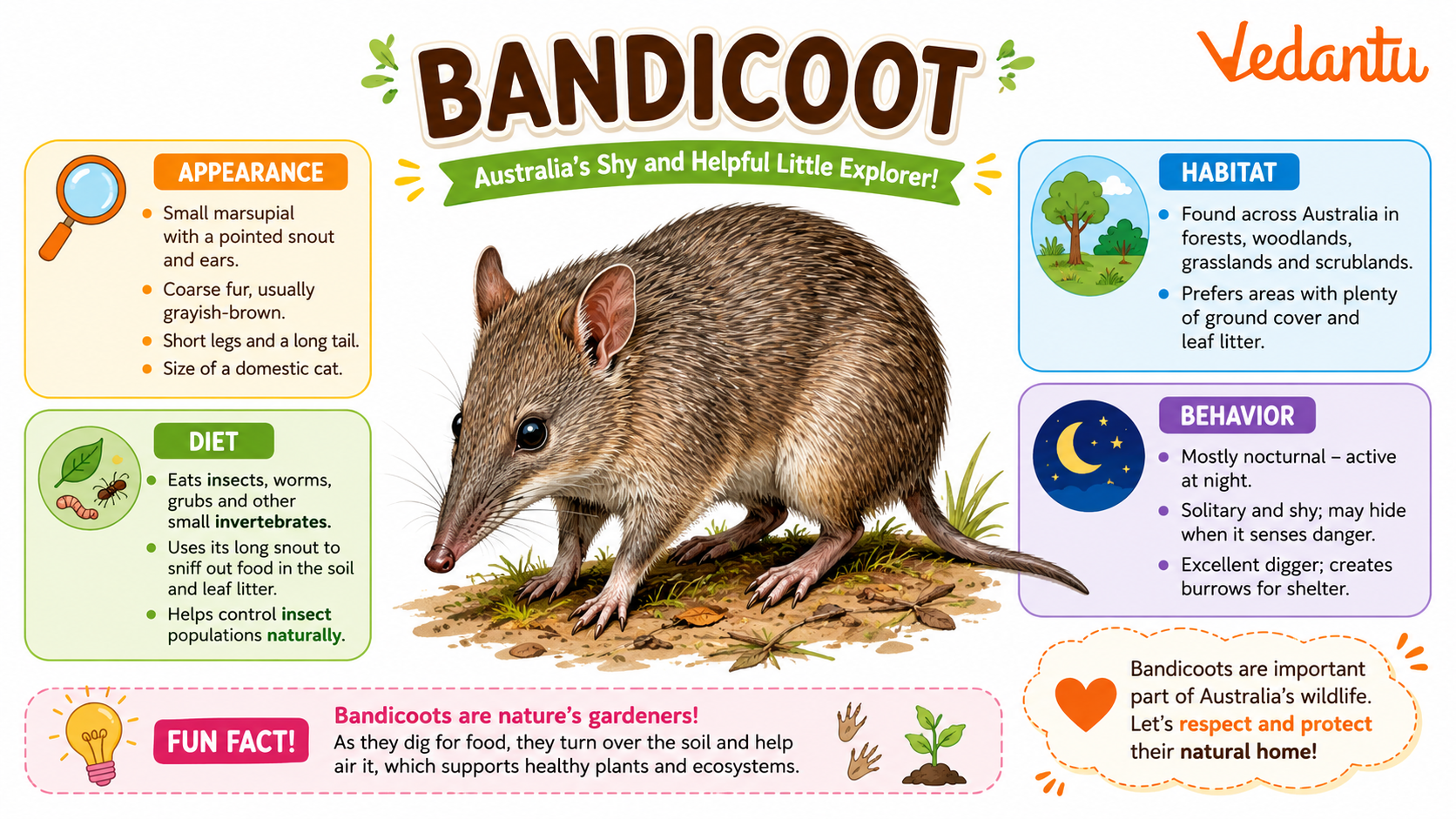
Quick Facts and Statistics
| Feature | Details |
|---|---|
| Common Name | Bandicoot |
| Animal Group | Mammal |
| Size | 20–60 cm (depending on species) |
| Weight | 0.2–5 kg |
| Lifespan | 2–5 years (in the wild) |
| Diet | Omnivore (plants and small animals) |
| Habitat | Forests, grasslands, farms, urban areas |
| Activity | Nocturnal (active at night) |
Appearance and Physical Characteristics
- Small to medium-sized body with a rounded back.
- Long, pointed snout used for sniffing and digging.
- Sharp front teeth for gnawing food.
- Strong front claws for digging burrows.
- Fur usually brown, grey, or black.
- Small eyes and rounded ears.
Bandicoot Habitat and Distribution
- Found in India, Sri Lanka, Southeast Asia, and Australia.
- Live in forests, grasslands, farmlands, and sometimes cities.
- Prefer areas with loose soil for digging.
- Build underground burrows for shelter and safety.
Diet and Feeding Habits
- Bandicoot diet includes roots, seeds, fruits, and grains.
- They also eat insects, worms, and small animals.
- Use their long snout to smell food underground.
- Dig quickly with sharp claws to find hidden prey.
Behaviour and Lifestyle
- Mostly solitary animals.
- Active at night (nocturnal).
- Very alert and quick runners.
- Hide in burrows during the day.
- Use smell and hearing to detect danger.
Bandicoot Life Cycle
Female gives birth to small babies. In marsupial species, babies stay in the pouch.
Young ones grow quickly and start exploring outside the burrow.
After a few weeks, they become independent and find their own territory.
Adults reproduce and continue the life cycle.
What Makes Bandicoots Special?
Importance and Role in Nature
Amazing Bandicoot Facts
- Some bandicoots can run very fast to escape predators.
- They have sharp incisors that grow continuously.
- Australian bandicoots are different from Indian bandicoot rats.
- They are very good at adapting to human environments.
- Bandicoots can squeeze into small spaces.
- Their burrows can have multiple tunnels and exits.
Fun Facts for Kids
FAQs on Bandicoot: Fascinating Facts About This Unique Marsupial
1. What is a bandicoot?
A bandicoot is a small, rat-like marsupial that carries its babies in a pouch and lives mainly in Australia and New Guinea.
- Belongs to the Peramelemorphia order
- Has a long snout and sharp claws
- Active mostly at night (nocturnal animal)
- Eats insects, worms, roots, and small plants
2. Where do bandicoots live?
Bandicoots live in forests, grasslands, and bush areas mainly in Australia, Tasmania, and New Guinea.
- Rainforests and woodlands
- Coastal heathlands
- Scrublands and grassy plains
- Sometimes near farms or gardens
3. What do bandicoots eat?
Bandicoots are omnivores, which means they eat both plants and animals.
- Insects and beetles
- Earthworms and larvae
- Roots and bulbs
- Fruits and seeds
4. Are bandicoots rodents?
No, bandicoots are not rodents; they are marsupials with pouches for carrying babies.
- Rodents include rats and mice
- Bandicoots belong to the marsupial group
- They give birth to tiny babies that grow in a pouch
5. How do bandicoots reproduce?
Bandicoots reproduce by giving birth to very tiny young that continue growing in the mother’s pouch.
- Very short pregnancy (about 12 days in some species)
- Babies crawl into the pouch after birth
- Stay in the pouch until strong enough to leave
6. Are bandicoots endangered?
Some bandicoot species are endangered due to habitat loss and predators.
- Threats from foxes and cats
- Land clearing and urban development
- Climate change effects
7. What are the main types of bandicoots?
There are several species of bandicoots found in Australia and nearby regions.
- Eastern Barred Bandicoot
- Long-nosed Bandicoot
- Northern Brown Bandicoot
- Southern Brown Bandicoot
8. Why are bandicoots important to the ecosystem?
Bandicoots play an important role in keeping soil and forests healthy.
- Digging helps aerate the soil
- Spreads seeds while foraging
- Controls insect populations
9. Are bandicoots dangerous to humans?
Bandicoots are generally harmless and shy animals that avoid humans.
- Do not attack people
- May dig small holes in gardens
- Prefer to run away if scared
10. How long do bandicoots live?
Bandicoots usually live for about 2 to 5 years in the wild.
- Life span depends on species
- Predators can shorten their lifespan
- Protected environments may help them live longer
