






What Did Apatosaurus Eat, How Big Was It, and Where Did It Live?
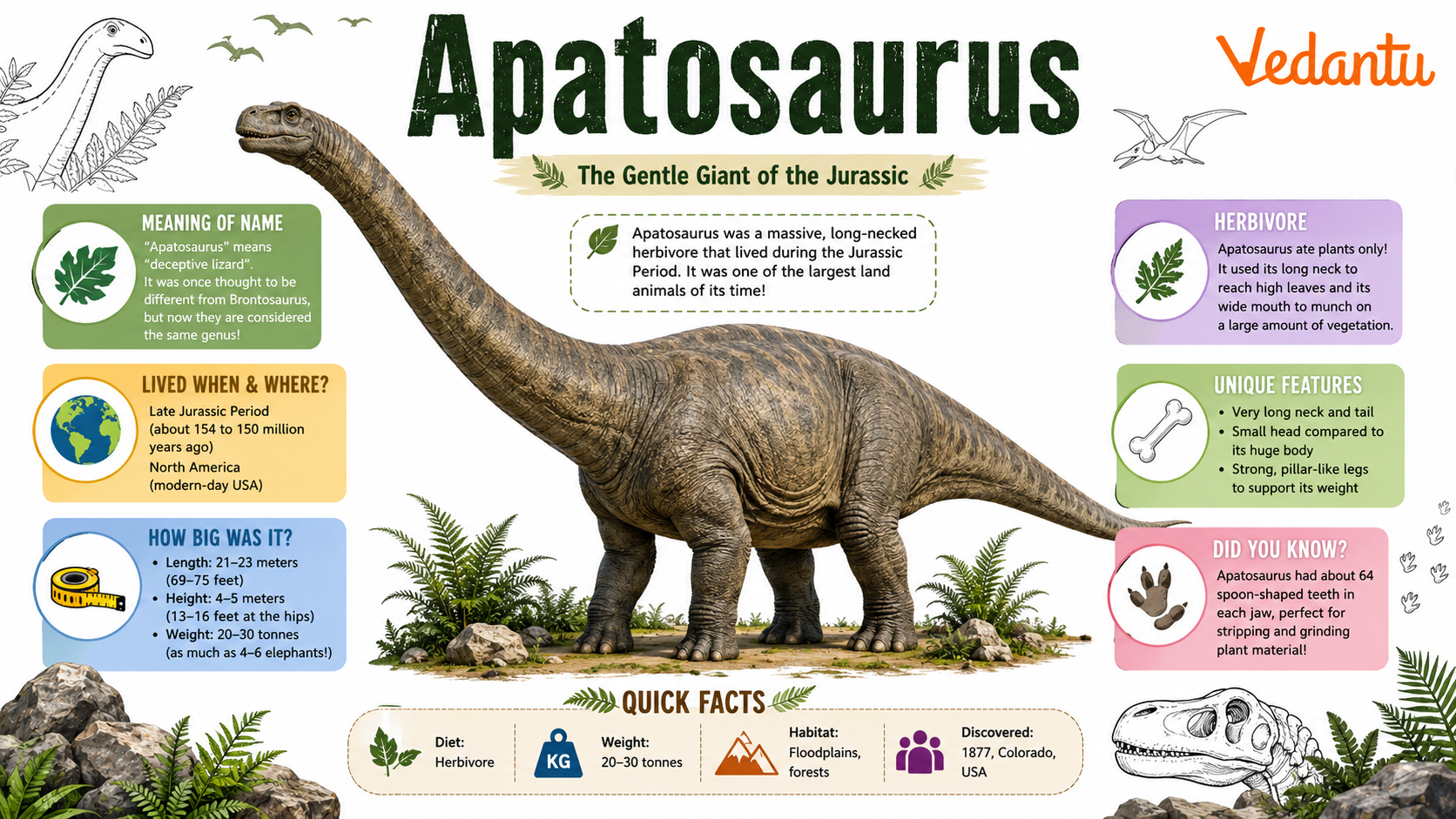
Quick Facts and Statistics
| Feature | Details |
|---|---|
| Common Name | Apatosaurus |
| Scientific Meaning | "Deceptive Lizard" |
| Animal Group | Dinosaur (Sauropod) |
| Period | Late Jurassic (about 154–150 million years ago) |
| Length | About 21–23 metres |
| Weight | Up to 20–23 tonnes |
| Diet | Herbivore (plants) |
| Habitat | Forests, river plains, and open land |
| Fossils Found In | North America (USA) |
Appearance and Physical Characteristics
- Very long neck to reach tall trees and plants.
- Small head compared to its huge body.
- Long, strong tail that worked like a whip.
- Thick, pillar-like legs to support heavy weight.
- Massive barrel-shaped body.
Apatosaurus belonged to a group called sauropods, known for their long necks, long tails, and enormous bodies. Its bones were strong but designed to reduce weight, helping it move despite its giant size.
Apatosaurus Habitat and Distribution
- Lived in North America.
- Fossils mostly found in Colorado, Utah, and Wyoming (USA).
- Preferred warm, semi-dry climates.
- Stayed near rivers and lakes where plants grew in large amounts.
Diet and Feeding Habits
- Strict herbivore (plant-eater).
- Ate leaves, ferns, shrubs, and soft plants.
- Used its long neck to reach vegetation at different heights.
- Did not chew food; swallowed it whole.
Like many dinosaurs, Apatosaurus may have swallowed small stones (called gastroliths). These stones helped grind food inside its stomach.
Behaviour and Lifestyle
- Likely lived in herds for safety.
- Moved slowly due to its heavy body.
- Used its long tail for defence against predators.
- Spent most of its day eating to maintain energy.
Apatosaurus Life Cycle
- Egg Stage: Hatched from large eggs laid in nests.
- Baby Dinosaur: Small compared to adults but grew quickly.
- Juvenile Stage: Continued rapid growth to avoid predators.
- Adult Stage: Reached full giant size and reproduced.
What Makes Apatosaurus Special?
Importance and Role in Nature
Amazing Apatosaurus Facts
- Apatosaurus could grow longer than a school bus.
- Its tail may have produced a loud cracking sound like a whip.
- It lived about 150 million years ago.
- It was once wrongly called Brontosaurus.
- It had one of the longest necks among dinosaurs.
- Its bones were first discovered in the 1870s.
Interesting Facts About Apatosaurus
Fun Facts for Kids
FAQs on Apatosaurus: Amazing Facts About This Giant Long-Neck Dinosaur
1. What is an Apatosaurus?
Apatosaurus was a giant plant-eating dinosaur that lived millions of years ago during the Late Jurassic period.
- It was a type of sauropod dinosaur (long-necked dinosaur).
- Lived about 154–150 million years ago.
- Its name means "deceptive lizard".
- Often confused with Brontosaurus.
- Known for its very long neck and tail.
2. How big was an Apatosaurus?
Apatosaurus was one of the largest land animals of its time.
- Length: About 70–75 feet (21–23 meters).
- Weight: Around 20–30 tons.
- Height: As tall as a 2–3 story building.
- Had a long neck to reach high plants.
3. What did Apatosaurus eat?
Apatosaurus was a strict herbivore, meaning it only ate plants.
- Ate ferns, cycads, and conifer leaves.
- Used its long neck to reach tall trees.
- Did not chew food; swallowed plants whole.
- May have used stones in its stomach to help digestion.
4. Where did Apatosaurus live?
Apatosaurus lived in what is now North America during the Jurassic period.
- Fossils found in Colorado, Utah, Wyoming, and Oklahoma.
- Lived in warm, semi-dry environments.
- Shared habitat with dinosaurs like Allosaurus and Stegosaurus.
5. Is Apatosaurus the same as Brontosaurus?
Apatosaurus and Brontosaurus are closely related but not exactly the same dinosaur.
- Brontosaurus was once considered the same as Apatosaurus.
- Scientists debated this for many years.
- Recent studies suggest Brontosaurus may be its own genus.
- Both are large sauropod dinosaurs.
6. How did Apatosaurus defend itself?
Apatosaurus likely used its size and tail to protect itself from predators.
- Its massive body scared away many attackers.
- Had a strong, whip-like long tail.
- May have traveled in groups for safety.
- Main predator was Allosaurus.
7. When was Apatosaurus discovered?
Apatosaurus was first discovered in the 19th century.
- Named in 1877 by paleontologist Othniel Charles Marsh.
- Fossils found during the famous Bone Wars.
- Early skeletons had skull mix-ups with other dinosaurs.
8. What did Apatosaurus look like?
Apatosaurus had a classic long-neck dinosaur appearance.
- Small head compared to its body.
- Very long neck and long tail.
- Thick, pillar-like legs.
- Large, bulky body.
9. How fast could Apatosaurus move?
Apatosaurus was not very fast due to its huge size.
- Estimated speed: About 5–10 miles per hour.
- Walked on four strong legs.
- Energy used mostly for eating and growing.
10. Why is Apatosaurus important in paleontology?
Apatosaurus is important because it helped scientists understand giant sauropod dinosaurs.
- One of the first large dinosaurs mounted in museums.
- Helped study dinosaur growth and bone structure.
- Played a key role in the Bone Wars history.
- Popular in books, museums, and dinosaur studies.
