




Which of the subsequent polymers doesn't have vinylic monomer units?
(A) Acrilan
(B) Nylon
(C) Polystyrene
(D) Neoprene
Answer
 Verified
233.1k+ views
Hint: Polymers are materials product of long, repeating chains of molecules. The materials have unique properties, betting on the kind of molecules that are bonded and the way bonded they're. It is done due to their broad spectrum of properties, both synthetic and natural polymers play essential and ubiquitous roles.
Complete step by step answer:
Vinyl polymers are polymers made of vinyl monomers; that's, small molecules containing carbon-carbon double bonds. They create the largest family of polymers. Let's examine how we get from a vinyl monomer to a polyvinyl resin using for example the best vinyl resin, polyethylene. Polyethylene is formed from the monomer ethylene, which is additionally called ethene. When polymerized, the ethylene molecules are joined along the axes of their double bonds to create a protracted chain of many thousands of carbon atoms containing only single bonds between atoms.
Now let us see Vinylic monomer, they’re basically a monomer containing a carbon-carbon covalent bond in them.
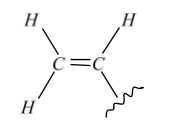
Acrilan
${{\left( -C{{H}_{2}}=CHCN- \right)}_{n}}$
Polystyrene
${{\left( -{{C}_{6}}{{H}_{5}}-C{{H}_{2}}=C{{H}_{2}}- \right)}_{n}}$
Neoprene
${{\left( -C{{H}_{2}}=CHCl- \right)}_{n}}$
Nylon
$\begin{array}{*{35}{l}}
~{{\left( Hexamethylene\,diamine+adipicacid \right)}_{n}} \\
\end{array}$
Only nylon does not have vinylic monomer units.
So, the correct option is (B).
Note:
Vinyl polymers are made up of monomers within which one or more of the hydrogen atoms of ethylene has been replaced by another atom or groups of atoms. Not many monomers during which hydrogen atoms have been replaced on both carbon atoms will polymerize.
Complete step by step answer:
Vinyl polymers are polymers made of vinyl monomers; that's, small molecules containing carbon-carbon double bonds. They create the largest family of polymers. Let's examine how we get from a vinyl monomer to a polyvinyl resin using for example the best vinyl resin, polyethylene. Polyethylene is formed from the monomer ethylene, which is additionally called ethene. When polymerized, the ethylene molecules are joined along the axes of their double bonds to create a protracted chain of many thousands of carbon atoms containing only single bonds between atoms.
Now let us see Vinylic monomer, they’re basically a monomer containing a carbon-carbon covalent bond in them.
Acrilan
${{\left( -C{{H}_{2}}=CHCN- \right)}_{n}}$
Polystyrene
${{\left( -{{C}_{6}}{{H}_{5}}-C{{H}_{2}}=C{{H}_{2}}- \right)}_{n}}$
Neoprene
${{\left( -C{{H}_{2}}=CHCl- \right)}_{n}}$
Nylon
$\begin{array}{*{35}{l}}
~{{\left( Hexamethylene\,diamine+adipicacid \right)}_{n}} \\
\end{array}$
Only nylon does not have vinylic monomer units.
So, the correct option is (B).
Note:
Vinyl polymers are made up of monomers within which one or more of the hydrogen atoms of ethylene has been replaced by another atom or groups of atoms. Not many monomers during which hydrogen atoms have been replaced on both carbon atoms will polymerize.
Recently Updated Pages
JEE Main 2023 April 6 Shift 1 Question Paper with Answer Key

JEE Main 2023 April 6 Shift 2 Question Paper with Answer Key
JEE Main 2023 (January 31 Evening Shift) Question Paper with Solutions [PDF]
JEE Main 2023 January 30 Shift 2 Question Paper with Answer Key
JEE Main 2023 January 25 Shift 1 Question Paper with Answer Key
JEE Main 2023 January 24 Shift 2 Question Paper with Answer Key
Trending doubts
JEE Main 2026: Session 2 Registration Open, City Intimation Slip, Exam Dates, Syllabus & Eligibility
JEE Main 2026 Application Login: Direct Link, Registration, Form Fill, and Steps
Understanding the Angle of Deviation in a Prism
Hybridisation in Chemistry – Concept, Types & Applications
How to Convert a Galvanometer into an Ammeter or Voltmeter
Understanding the Electric Field of a Uniformly Charged Ring
Other Pages
JEE Advanced Marks vs Ranks 2025: Understanding Category-wise Qualifying Marks and Previous Year Cut-offs
NCERT Solutions For Class 12 Chemistry Chapter 1 Solutions (2025-26)
Solutions Class 12 Chemistry Chapter 1 CBSE Notes - 2025-26
NCERT Solutions For Class 12 Chemistry Chapter 4 The d and f Block Elements (2025-26)
Biomolecules Class 12 Chemistry Chapter 10 CBSE Notes - 2025-26
NCERT Solutions For Class 12 Chemistry Chapter 10 Biomolecules (2025-26)