








What is the Streak Plate Technique and How Does It Help Isolate Pure Colonies?
The streak plate technique is a microbiological method used to isolate pure cultures by spreading an inoculum across solid agar, which gradually dilutes the cells. This results in well-isolated colonies in the terminal streaks after incubation.
In this method, the inoculum is spread across the surface of a solid agar plate in a planned streaking pattern so that the microbial load becomes progressively diluted from one area to another. By the final streaked region, individual cells or colony-forming units are sufficiently separated to form isolated colonies after incubation.
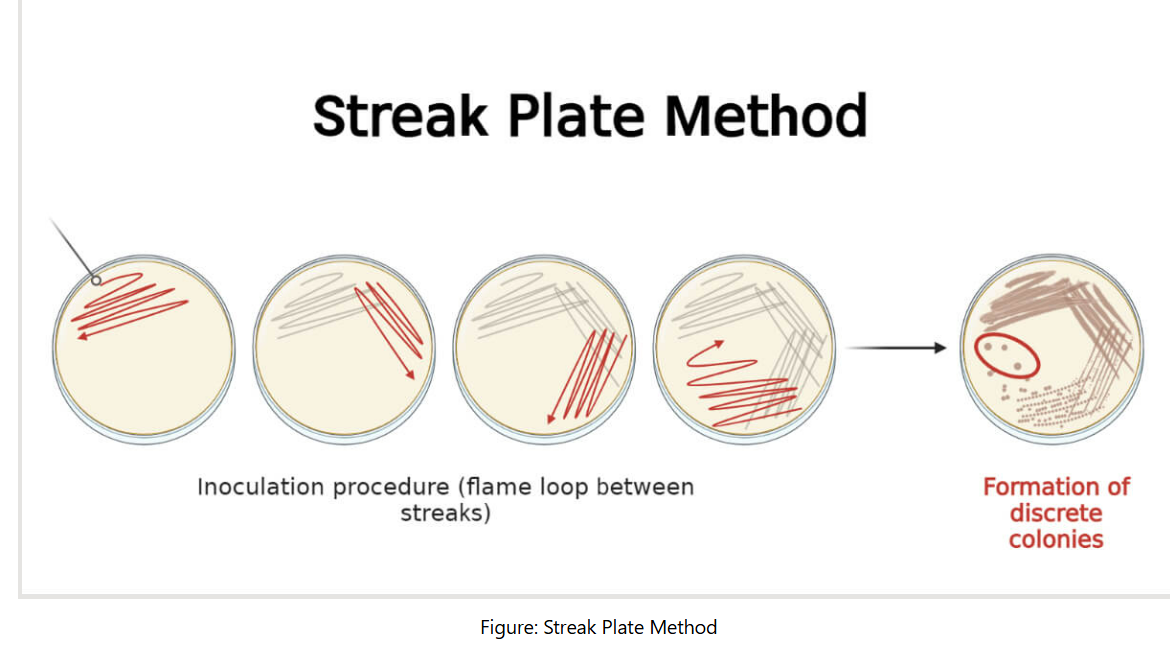
Objectives of the Streak Plate Technique
The main objectives of the streak plate method are:
to obtain a pure culture from a mixed culture
to obtain well-isolated colonies
to propagate bacteria on suitable culture media
These objectives are the reason why the method remains one of the most important routine procedures in microbiology laboratories.
Principle of Streak Plate Technique
The principle of the streak plate technique is based on progressive dilution of the inoculum across the surface of solid agar medium. A small amount of the sample is first placed on one edge of the plate and streaked in a particular pattern. Each successive streak carries fewer cells than the previous one. As the inoculum gets thinner, the cells become sufficiently separated to form discrete colonies after incubation.
The sample may be taken from:
a bacterial colony on solid media
a liquid broth or suspension
A sterile loop or swab is commonly used to transfer the inoculum. The streaking pattern controls the degree of dilution. When done correctly, the last streaked area has the lowest cell density and gives the best isolated colonies.
So, the principle can be summarised like this:
mechanical spreading + progressive dilution + incubation = isolated colonies
IMPORTANT FACT: The method was first devised and used by Loeffler and Gaffky in Koch’s laboratory to serially dilute bacteria over agar and obtain isolated colonies. It later became a standard and widely used tool in bacteriology.
Because of its historical use in the era of Robert Koch, the method is considered one of the classic microbiological isolation techniques.
Requirements for Streak Plate Technique
To perform the streak plate technique properly, several materials are needed.
1. Streaking Tool
A sterile tool is used to spread the specimen over the agar surface. Common tools include:
inoculating loop
cotton swab
toothpick
wooden, metal, or plastic stick
The most commonly used tool is the inoculating loop, especially the nichrome wire loop.
2. Sample Culture
The sample may be in the form of:
suspension
broth culture
colony taken from a solid agar surface
3. Solid Culture Medium
A suitable solid agar medium is required. The medium should be sterilised and properly solidified before use. The exact medium depends on the suspected organism and laboratory's purpose.
4. Bunsen Burner and Laboratory Support
A Bunsen burner is used to sterilise the inoculating loop and maintain a relatively sterile working zone. Other routine microbiology materials are also needed.
Types of Streak Plate Technique
Based on the streaking pattern, the streak plate technique can be classified into several forms. The file identifies the main types and also mentions modified variants. These include:
Quadrant streaking
T-streaking
Continuous streaking
Radiant streaking
Semi-quantitative streaking
Zigzag streaking
Each type has a specific use depending on sample load, laboratory objective, and plate availability.
4 Way Streak Plate Technique
The 4-way streak plate technique is the most common and most preferred method. It is also called:
four-quadrant streak
four-sector streak
In this method, the agar plate is divided into four equal sectors. The inoculum is streaked in the first quadrant with maximum density. Then, using streaks drawn from the previous quadrant, the second, third, and fourth quadrants are inoculated in sequence. This progressively dilutes the bacterial load until isolated colonies appear in the final area.
Why is it Preferred?
gives good dilution across the plate
usually produces clear, isolated colonies
easy to interpret
ideal for mixed culture isolation
Discontinuous vs Continuous Style
In most cases, a discontinuous fashion is used, where the loop is sterilised after each quadrant. If the bacterial load is already very low, a continuous fashion may also be used.
T-Streak Technique
In T-streaking, the plate is divided into three sections by imagining or drawing the letter T. The sample is first spread across one-third of the plate, then carried into the second and third sections in sequence. By the third sector, the inoculum becomes sufficiently diluted to yield isolated colonies.
This method is also called the three-sector streak method. Like quadrant streaking, it generally follows a discontinuous pattern, with loop sterilisation between sectors.
Continuous Streaking
Continuous streaking involves spreading the inoculum in one continuous motion across the agar surface without dividing the plate and without repeatedly sterilising the loop during the process. It is fast and simple, but it is most suitable when:
The inoculum is already diluted
The aim is propagation rather than careful isolation
Multiple samples need quick placement in separate sections of the same plate
This makes it useful in some clinical laboratory settings where time and resources matter.
Radiant Streaking
In radiant streaking, the inoculum is first spread near one edge of the agar plate. Then, after sterilising and cooling the loop, radial streak lines are drawn outward. These radial lines are later crossed by horizontal lines.
This pattern is useful mainly for:
propagating pure culture
handling dilute specimens
Semi-Quantitative Streaking
Semi-quantitative streaking is commonly used in urine culture. It is a modified form of continuous streaking and uses a calibrated loop, usually 1 µL or 2 µL, to transfer a defined volume of specimen. The inoculum is first placed as a central primary streak and then spread in a back-and-forth zigzag motion.
This method is important because it helps in:
approximate estimation of viable microbial load
isolation of colonies at the same time
Zigzag Streaking
Zigzag streaking is a form of continuous streaking in which the sample is spread across the plate in a zigzag pattern using a single continuous motion. It is mainly used to propagate pure cultures and achieve more uniform growth across the agar surface.
Streak Plate Technique Procedure
The streak plate technique procedure begins with proper preparation and aseptic handling.
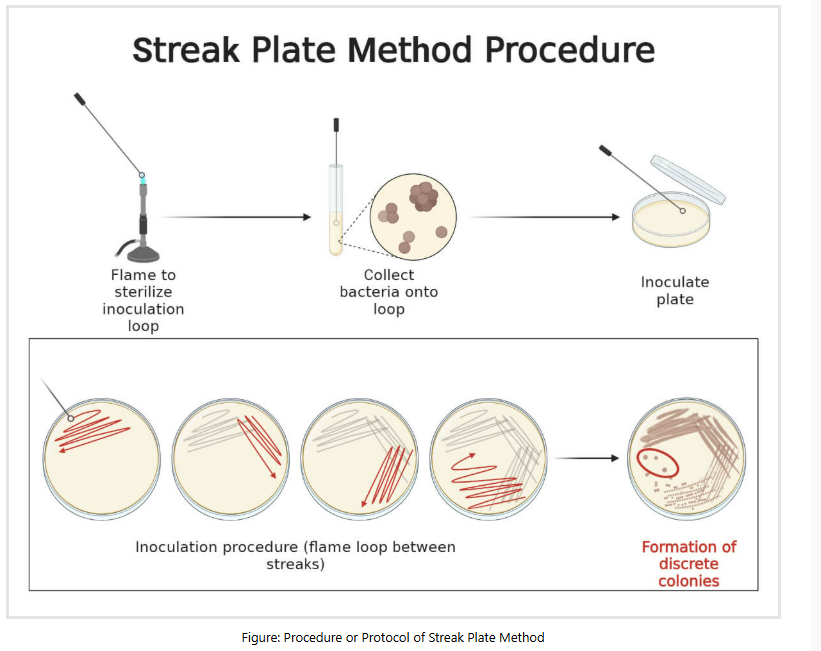
General Steps
Arrange all materials and wear PPE.
Sterilise the work surface.
Allow refrigerated media and samples to come to room temperature.
Sterilise the loop and let it cool.
Take a small amount of inoculum from a colony or broth.
Streak according to the selected method.
Label the plate properly.
Incubate the plate inverted under suitable conditions, usually for about 24 hours at 37°C.
The exact inoculation steps depend on the pattern used.
Quadrant Streaking Procedure
In the 4-way streak plate technique, the inoculum is first spread over about one-fourth of the plate from the rim toward the centre. Then the loop is re-flamed, cooled, and used to drag material from the last streaks of the first quadrant into the second quadrant. The same idea is repeated from the second to the third and the third to the fourth quadrants. By the fourth quadrant, the inoculum becomes highly diluted and gives isolated colonies.
T-Streaking Procedure
In T-streaking, one-third of the plate is first inoculated. Then the plate is turned, and the final streaks of the first section are drawn into the second section. The same process is repeated in the third section.
Continuous Streaking Procedure
In continuous streaking, the loop is placed at one end of the plate, and the inoculum is spread toward the centre in one continuous movement. Then the plate is rotated 180°, and the remaining half is streaked without sterilising the loop.
Radiant Streaking Procedure
The inoculum is first spread near one edge using a gentle zigzag motion. After loop sterilisation and cooling, radial lines are drawn outward. Then, horizontal lines are drawn to cross these radial streaks.
Semi-Quantitative Procedure
A calibrated loop is used to take the specimen. A central primary streak is made, and then the inoculum is spread continuously in a zigzag manner across the plate. The plate is labelled and incubated.
Result Interpretation
After incubation, the plate is examined mainly for the terminal streaks for isolated colonies.
Typical Findings
First streaked area: heavy growth, often fused colonies
Later streaks: progressively fewer colonies
Final streaks: well-isolated colonies if streaking was successful
Mixed vs Pure Culture
If the sample contains one species, colonies in the terminal streaks usually show the same morphology
If the sample contains multiple species, colonies of different morphology may appear
If different colony types are present, each type should be re-streaked on a fresh plate to obtain pure cultures.
Precautions During Streaking
Several precautions are essential for getting reliable results.
The media should be properly solidified before use
refrigerated plates should be brought to room temperature
Check plates for water droplets or contamination before use
treat unknown or clinical samples as hazardous
If the sample is liquid, mix it properly before taking the inoculum
If using a colony, touch only a small portion
always work in a sterile area
Properly sterilise the loop before and after use
Ensure the flamed loop is cooled before touching the specimen
Use appropriate culture media
Use only a small amount of the sample
streak gently without tearing the agar
Flame the loop after each quadrant in discontinuous methods
Rotate the plate properly between streaks
Label the plate correctly and incubate under proper conditions
These precautions directly affect whether isolated colonies appear.
Applications of the Streak Plate Technique
The applications of the streak plate technique are extensive in microbiology.
obtaining a pure culture from a mixed culture
determining whether a sample is pure or mixed
studying colony characteristics
producing colonies of genetically identical individuals
isolating pathogens from clinical samples
isolating and semi-quantifying uropathogens in urine culture using calibrated loops
This is why the method is widely used in diagnostic laboratories and teaching microbiology labs.
Advantages of Streak Plate Technique
The major advantages include:
simple and easy to perform
reliable and convenient
gives well-isolated colonies
allows direct further testing on isolates
Dilution occurs during inoculation, so separate dilution may not be needed
allows manual control of inoculum spread
Different streak patterns provide flexibility
useful for aerobic organisms
applicable to broth as well as colony samples
Limitations of the Streak Plate Technique
The method also has important limitations.
It is mainly a qualitative isolation method
not ideal for the exact quantification of microbial load
more suitable for aerobic organisms than anaerobes
Syntrophic bacteria cannot be purified by this method
A very heavy inoculum may prevent isolated colony formation
requires pre-solidified appropriate media
The agar surface may tear if handled poorly
The method may be time-consuming
There is a significant risk of contamination if the aseptic technique is poor
So, while highly useful, it still depends strongly on skill and aseptic handling.
For further understanding, you can explore related topics such as Microbiology, Compound Microscope Parts, Bacteria, Antibiotics, Inoculation, Molds and Yeasts, Kingdom Monera, Useful Microorganisms, and Microorganisms to reinforce your Biology foundation.
FAQs on Streak Plate Technique in Microbiology: Principle, Procedure, Types and Applications
1. What is the strategy of streak plating?
The strategy of streak plating is to spread a microbial sample across an agar plate in a way that gradually reduces the number of cells. This creates dilution zones, allowing single cells to grow into isolated colonies, each representing a clone from a single original cell.
2. What is a 4-way streak plate inoculation?
A 4-way streak plate inoculation is a method where the agar plate is divided into four sections and streaked step by step. Each section has fewer bacteria than the previous one, helping to produce well-isolated colonies in the final quadrant.
3. What is the three-streak method?
The three streak method, also called T-streaking, divides the plate into three parts using a “T” pattern. The sample is spread from one section to the next, reducing cell concentration and allowing isolated colonies to form in the last section.
4. What is a disadvantage of the streak plate technique?
A major disadvantage is the high risk of contamination, especially when the Petri dish is opened during the process. Poor aseptic technique can affect results and prevent proper isolation of colonies.
5. What are common streak plate mistakes?
Common mistakes include not sterilising the loop properly between streaks, using too much sample, or applying too much pressure on the agar. These errors can lead to overlapping growth instead of isolated colonies.
6. What streak colour indicates gold?
Gold produces a yellow or golden streak when rubbed on an unglazed porcelain surface, which helps distinguish it from similar-looking minerals.
7. Why do people go streaking?
Streaking in a non-scientific context refers to people running naked in public, usually as a prank or for attention, often seen at events or gatherings.
8. What are the three types of streaking?
The main streaking types include:
Quadrant streaking
T-streaking (three-sector streak)
Continuous streaking
(Some classifications also include radiant streaking as an additional type.)
9. What are the four methods of inoculation?
Four common inoculation methods are:
Needle injection
Stick method
Toothpick method
Mycelium method
10. What materials can be used as a streak plate?
Materials required include:
Bunsen burner
Sterile Petri dish with agar medium
Inoculating loop or swab
Sample culture
Marker pen and sealing material (like parafilm)
11. What are the benefits of the streak plate method?
The streak plate method helps isolate pure microbial colonies, making it easier to identify organisms and perform further tests such as biochemical analysis, antibiotic testing, and genetic studies with more accurate results.
