








Funaria Diagram and Key Features Explained for NEET Exam Preparation
The concept of Funaria is essential in biology and helps explain real-world biological processes and exam-level questions effectively. Understanding Funaria is especially important for topics like bryophytes, alternation of generations, and plant life cycles, all of which are frequently tested in the NEET exam.
Understanding Funaria
Funaria refers to a genus of mosses that are common representatives of bryophytes. Funaria is studied as a model organism to understand the life cycle, structure, and reproduction of non-vascular plants. This concept is important in areas like plant morphology, bryophyte classification, and alternation of generations.
Funaria: Classification and Examples
Funaria belongs to the division Bryophyta and is a member of the family Funariaceae. It is often used as a classic example of mosses in NEET exam questions due to its distinct features and clear alternation of generations. Common Indian species include Funaria hygrometrica, Funaria fascicularis, and Funaria obtusa.
Here’s a quick classification chart for Funaria:
| Category | Details |
|---|---|
| Kingdom | Plantae |
| Division | Bryophyta |
| Class | Bryopsida |
| Order | Funariales |
| Family | Funariaceae |
| Genus | Funaria |
| Examples | Funaria hygrometrica |
External Morphology and Structure of Funaria
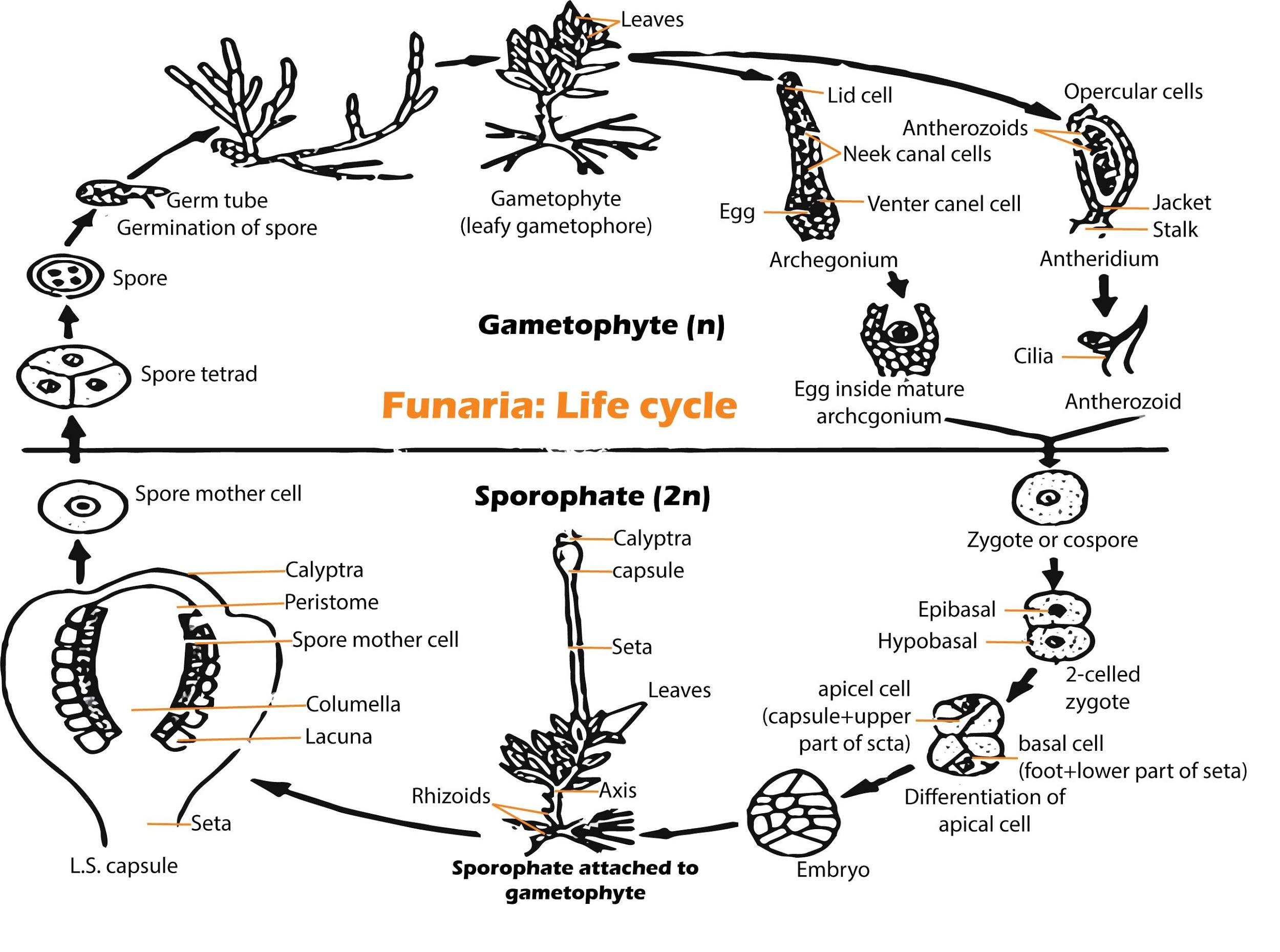
Funaria exists in two main stages—the dominant leafy gametophyte and the sporophyte. The main plant body (gametophyte) starts from a juvenile protonema stage and develops into an upright branched stem. The stem is green, photosynthetic, and has spirally arranged, sessile leaves with a distinct midrib. Rhizoids, which are multicellular and branched, anchor the plant to the soil and function like root hairs. The sporophyte, attached to the female gametophyte, consists of a foot, seta, and capsule.
Reproduction and Life Cycle of Funaria
Funaria shows both vegetative and sexual reproduction. The leafy plant is monoecious (both male and female reproductive organs on the same plant) and autoicous (male and female organs on different branches). The male branch is shorter and bears clusters of antheridia, while the female branch bears archegonia. Funaria is protandrous, so antheridia mature before archegonia to encourage cross-fertilization. Fertilization produces a zygote, which develops into a dependent sporophyte showing alternation of generations. The key steps are:
- Protonema development (juvenile gametophyte); forms buds.
- Gametophyte matures—antheridia and archegonia develop on different branches.
- Water helps sperm reach the egg in archegonium; fertilization occurs.
- Zygote becomes a sporophyte (foot, seta, capsule attached to gametophyte).
- Capsule produces haploid spores by meiosis.
- Spore germinates to give new protonema—cycle repeats.
Funaria Sporophyte and Spore Dispersal
The Funaria sporophyte is diploid and attached to the female branch as a partial parasite. It is differentiated into foot (anchoring), seta (stalk), and capsule (spore-producing structure). As the capsule matures, its operculum falls off, exposing peristome teeth. These teeth respond to humidity and help regulate gradual spore release. Spores germinate to produce the protonema, starting the cycle anew.
Here’s a helpful table to understand Funaria structures better:
Funaria Key Structures Table
| Part/Stage | Description | Haploid/Diploid |
|---|---|---|
| Protonema | Juvenile, filamentous stage; forms buds | Haploid |
| Leafy gametophyte | Main, green, branched, leafy stem | Haploid |
| Sporophyte | Foot, seta, capsule (spore-bearing) | Diploid |
| Capsule | Releases spores via peristome teeth | Diploid |
Practice Questions
- Describe the structure of Funaria with a labelled diagram.
- How does alternation of generations occur in Funaria?
- Differentiate between the gametophyte and sporophyte of Funaria.
- Is Funaria monoecious or dioecious? Explain your answer.
- Explain the importance of protonema in the Funaria life cycle.
Common Mistakes to Avoid
- Confusing Funaria with liverworts like Marchantia.
- Skipping the protonema stage when describing the moss life cycle.
- Mixing up monoecious and autoicous terminology.
- Ignoring the structure or function of the peristome teeth in spore dispersal.
Real-World Applications
The concept of Funaria is used as a reference in understanding primitive land plant colonization, ecological succession on rocks or moist soils, and as a model organism in plant biology. Vedantu helps students relate such topics to practical examples, such as understanding plant adaptations and the ecological role of mosses in retaining soil moisture and initiating soil formation.
In this article, we explored Funaria, its key processes, real-life significance, and how to solve questions based on it. To learn more and build confidence, keep practicing with Vedantu.
Related Topics for Further Learning
- Bryophytes
- Moss
- Plant Kingdom
- Kingdom Fungi
- Differences Between Bryophytes and Pteridophytes
- Reproduction in Plants
- Biological Classification
- Biotic and Abiotic
- Thallophyta
FAQs on Funaria: Structure, Classification, and Life Cycle for NEET
1. What is Funaria in NEET and why is it important?
Funaria is a genus of **moss** and a well-known **bryophyte** studied in the NEET Biology syllabus. It is important because it represents the **life cycle of non-vascular plants** and is frequently asked in questions related to **morphology**, **classification**, and **reproduction**. Understanding Funaria helps students accurately tackle **diagram-based questions** and **assertion-reason MCQs** in NEET.
2. How is Funaria classified among bryophytes?
Funaria belongs to the family **Funariaceae** and is classified as a **moss-type bryophyte**. It is a **monoecious** and **autoicous** plant, exhibiting characteristic features like a leafy **gametophyte** and a dependent **sporophyte**. The common Indian species include Funaria hygrometrica, Funaria fascicularis, and Funaria obtusa.
3. What are the main features and diagrams of Funaria for NEET?
The main features of Funaria include a differentiated **gametophyte** with an erect, branched **stem**, spirally arranged **leaves** with a midrib, and branched **multicellular rhizoids**. The **sporophyte** is attached to the gametophyte and consists of a **foot**, **seta**, and **capsule**. NEET questions often involve labelled **Funaria diagrams** depicting these structures, the **life cycle stages**, and reproductive organs like **antheridia** and **archegonia**.
4. Is Funaria monoecious or dioecious?
Funaria is **monoecious** and **autoicous**, meaning it bears both male (**antheridia**) and female (**archegonia**) reproductive organs on different branches of the same plant. Additionally, it exhibits **protandry** where the male organs mature before the female ones, promoting cross-pollination, a key concept for NEET MCQs.
5. How does Funaria reproduce—what is the life cycle?
Funaria reproduces both **sexually** and **vegetatively**. In sexual reproduction, the **antheridium** produces biflagellated **spermatozoids** that swim to the **archegonium** to fertilize the egg, forming a **zygote** that develops into the **sporophyte**. The sporophyte consists of a **foot**, **seta**, and **capsule** where **meiospores** are produced. These spores germinate into a **protonema**, which then buds to form new gametophytes, completing the life cycle.
6. What are the uses of Funaria hygrometrica?
Funaria hygrometrica is mainly studied for its role in understanding the **life cycle of bryophytes** and as a model organism in **plant biology**. Though it has no significant commercial or medicinal uses, it is important ecologically for **soil formation** and **moisture retention** in habitats where it grows, which are relevant environmental concepts in NEET.
7. Why do students confuse Funaria with liverworts in NEET?
Students often confuse Funaria with **liverworts** because both are **non-vascular bryophytes**. However, key differences include that Funaria (a moss) has **spirally arranged leaves with midribs** and branched **rhizoids**, whereas liverworts have **flattened thalloid bodies** without midrib and are generally less complex. Remembering these morphological distinctions helps avoid NEET mistakes.
8. How to avoid mistakes on Funaria’s monoecious/autoicous terminology?
To avoid confusion: Monoecious means both male and female reproductive organs are on the same plant, while autoicous means these organs are on different branches of the same plant. Funaria is both **monoecious** and **autoicous**; it has male and female organs on separate branches but on the same plant. Remember this by linking “auto-” to different branches and “mono-” to the same plant overall.
9. Why do many miss the protonema stage in life cycle MCQs?
The **protonema** is the first stage of the gametophyte that develops from spores and is often missed because it's a filamentous, less conspicuous stage before the mature gametophyte appears. NEET often includes this in **life cycle diagrams** or **sequence questions**. Remember it as the functional 'juvenile stage' that develops rhizoids and buds to form the main gametophyte.
10. What’s the best mnemonic to remember Funaria’s diagram labels?
A simple mnemonic for the three main sporophyte parts - Foot, Seta, Capsule - is: “Funaria Sporophyte’s Core”. For the reproductive structures, remember Antheridium (male) by “A” for **Androcyte sperms** and Archegonium (female) by “A” for **An egg** inside. Using these helps recall the key labels during exams.
11. How to avoid silly errors in Funaria vs Marchantia/bryophyte comparisons?
Errors arise because both are bryophytes but differ fundamentally. Funaria is a **moss** with leafy, erect gametophytes and multicellular rhizoids, while Marchantia is a **liverwort** with a flattened **thallus** and unicellular rhizoids. Focus on these clear morphological differences and memorize examples of each group to answer NEET comparison questions confidently.
12. Does NEET ask about Funaria’s ecological or medicinal uses?
NEET rarely focuses on **medicinal uses** of Funaria, but ecological importance like its role in **soil formation**, **moisture retention**, and as a pioneer species in disturbed habitats is sometimes asked. It's best to know these basic ecological functions to confidently answer related questions.
