









How is mRNA Formed During Dna Transcription for NEET?
DNA transcription and mRNA synthesis are fundamental biological processes that determine how genetic information is expressed within living cells. For NEET aspirants, understanding DNA transcription and the role of mRNA is crucial because these concepts are not only frequently examined but also form the backbone of molecular biology. Mastering this topic helps students connect genetic code with protein synthesis, an essential part of the NEET Biology syllabus and important for building deep conceptual understanding.
What is DNA Transcription and mRNA?
DNA transcription is the process by which the genetic code from a gene (segment of DNA) is copied into messenger RNA (mRNA). This step occurs inside the nucleus of eukaryotic cells and serves as the first stage of gene expression. Through transcription, specific DNA sequences are converted into a complementary RNA sequence by the enzyme RNA polymerase. The resulting mRNA carries this code from the DNA to the ribosomes, where proteins are synthesized. Without accurate transcription and mRNA production, the genetic instructions needed to build proteins cannot be correctly decoded, making this process a foundation of molecular genetics.
Core Principles of DNA Transcription and mRNA Synthesis
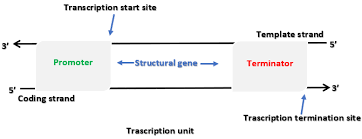
Understanding the Transcription Unit
A transcription unit is a segment of DNA that is transcribed into an RNA molecule. It includes three main parts: a promoter, the structural gene, and a terminator. The promoter serves as the binding site for RNA polymerase and determines where transcription begins. The terminator marks the endpoint of transcription.
Key Steps in Transcription
DNA transcription occurs in three main steps:
- Initiation - RNA polymerase binds to the promoter region, unwinds a segment of DNA, and prepares to synthesize RNA.
- Elongation - RNA polymerase reads the template strand (antisense strand) and assembles a complementary strand of mRNA.
- Termination - On reaching the terminator, transcription ends and the mRNA molecule detaches from the DNA template.
Features of mRNA
mRNA (messenger RNA) is a single-stranded molecule that carries genetic instructions from DNA in the nucleus to the ribosomes in the cytoplasm, where proteins are made. In eukaryotes, mRNAs are usually processed by capping, addition of a poly-A tail, and removal of non-coding introns (splicing).
Sub-concepts Related to DNA Transcription and mRNA
Coding and Template Strands
During transcription, only one DNA strand (template strand) is used to synthesize RNA. The other strand is the coding strand, which has the same sequence as mRNA (except for uracil replacing thymine in RNA).
Promoters, Enhancers, and Terminators
Promoters are specific DNA sequences where transcription begins. Enhancers can increase the rate of transcription, while terminators signal the enzyme to stop RNA synthesis. These sequences ensure proper control of gene expression.
Post-Transcriptional Modifications
In eukaryotes, the primary mRNA transcript undergoes modifications such as 5'-capping, 3'-polyadenylation, and removal of introns (splicing) before becoming mature mRNA ready for translation.
Key Rules and Relationships in Transcription
Transcription follows the base-pairing rule, where adenine pairs with uracil in RNA (instead of thymine), and cytosine pairs with guanine. It is always synthesized in the 5' to 3' direction. Also, only genes with accessible promoter regions can be transcribed at a given time, enabling regulation of gene expression.
Steps in DNA Transcription Process
- Recognition and binding of RNA polymerase to the promoter.
- Unwinding of DNA at the start site.
- RNA synthesis using the DNA template strand by complementary base pairing.
- Termination of transcription at the terminator sequence.
- Release of the newly formed mRNA molecule.
Importance of DNA Transcription and mRNA in NEET
DNA transcription and mRNA synthesis are frequently tested in NEET because they are central to understanding genetic coding, gene expression, and molecular basis of inheritance. Questions often involve interpreting diagrams, identifying key steps, and spotting differences between DNA and RNA. Mastering this topic strengthens your overall grip on genetics, biotechnology, and related biology chapters, building a foundation for solving application-based questions in NEET.
How to Study DNA Transcription and mRNA Effectively for NEET
- Begin with clear understanding of the basic definitions and the stepwise flow of genetic information (Central Dogma).
- Use labeled diagrams (such as the transcription unit diagram) to practice and recall each component and its role.
- Focus on comparing prokaryotic and eukaryotic transcription for conceptual clarity.
- Revise the functions of enzymes like RNA polymerase and associated regulating sequences (promoter, enhancer, terminator).
- Solve NEET previous year MCQs on this topic and analyze mistakes.
- Regularly update revision notes with diagrams and bullet points for quick referral before the exam.
Common Mistakes Students Make in DNA Transcription and mRNA
- Confusing the template strand with the coding strand and vice versa.
- Mixing up the functions of DNA and RNA polymerases.
- Forgetting post-transcriptional modifications, especially in eukaryotes.
- Neglecting the differences between prokaryotic and eukaryotic transcription mechanisms.
- Ignoring correct directionality (5'-3') of mRNA synthesis.
Quick Revision Points: DNA Transcription and mRNA
- Transcription is DNA to mRNA - first step in protein synthesis.
- RNA polymerase is the main enzyme responsible for synthesis.
- Promoter, coding (template) region, and terminator are main elements of transcription unit.
- mRNA carries genetic code from the nucleus to the cytoplasm.
- In RNA, uracil replaces thymine.
- Post-transcriptional changes include capping, polyadenylation, and splicing (in eukaryotes).
- Only one DNA strand is transcribed at a time.
- Practice diagrams and flowcharts for better recall during NEET exam.
FAQs on Dna Transcription mRNA Explained for NEET Students
1. What is DNA transcription in NEET syllabus?
DNA transcription is the process in which a segment of DNA is copied into mRNA using the enzyme RNA polymerase. Key points include:
- Occurs in the nucleus of eukaryotic cells
- Produces messenger RNA (mRNA) from the DNA template
- Essential for gene expression in biology and NEET exams
- Involves initiation, elongation, and termination stages
2. What is the function of mRNA formed during transcription?
mRNA (messenger RNA) acts as a template for protein synthesis after being formed during transcription.
- Carries the genetic code from DNA to ribosomes
- Guides the assembly of amino acids into proteins through translation
- Essential for expressing genetic information in living organisms
- Frequently asked topic in NEET Biology
3. How does RNA polymerase work during transcription in NEET biology?
RNA polymerase catalyzes the synthesis of mRNA from a DNA template during transcription.
- Binds to the promoter region on DNA
- Unwinds the DNA double helix locally
- Adds complementary RNA nucleotides following base-pairing rules
- Detaches at the terminator region, releasing the new mRNA strand
4. What are the steps involved in the process of DNA transcription?
DNA transcription involves three main steps in NEET syllabus:
- Initiation: RNA polymerase binds to the promoter and DNA unwinds
- Elongation: RNA polymerase synthesizes mRNA using complementary base pairing
- Termination: Synthesis ends and the mRNA detaches from the DNA template
5. Why is transcription needed before translation in mRNA synthesis?
Transcription is necessary to produce an mRNA copy of the DNA code, which can then be read by ribosomes during translation.
- Allows genetic information transfer from nucleus to cytoplasm
- Ensures proteins are synthesized as coded by DNA
- Critical concept for NEET Biology and understanding gene expression
6. What is the difference between DNA replication and transcription?
DNA replication forms an identical copy of DNA, while transcription forms an mRNA strand from DNA.
- DNA replication: Both DNA strands are copied; necessary for cell division
- Transcription: Only one DNA strand is used as a template; produces mRNA for protein synthesis
7. Where does DNA transcription occur in eukaryotic cells according to NEET?
In eukaryotic cells as per NEET, DNA transcription takes place inside the nucleus.
- Transcription produces pre-mRNA which is processed before leaving the nucleus
- The mature mRNA then moves to the cytoplasm for translation
- This nuclear location is a standard NEET exam fact
8. What is a transcription unit in DNA for NEET syllabus?
A transcription unit in DNA is a segment that includes all necessary sequences for RNA synthesis.
- Consists of a promoter, the coding region, and a terminator
- The promoter signals start, coding region has the actual gene, and terminator signals end of transcription
- A concept often asked in NEET Biology exams
9. Define promoter and terminator in the context of DNA transcription.
In DNA transcription, the promoter is the region where transcription starts, and the terminator is where it stops.
- Promoter: Binding site for RNA polymerase, initiates transcription
- Terminator: Sequence that signals the end of transcription
- Covers important regulation and control concepts for the NEET exam
10. Which enzymes are involved in DNA transcription as per NEET Biology?
The main enzyme involved in DNA transcription is RNA polymerase.
- RNA polymerase: Catalyzes the synthesis of mRNA from DNA template
- Other proteins and factors (transcription factors) assist in initiation and regulation
- Enzyme-focused questions are routine in NEET Biology
11. What is the template strand in transcription?
The template strand is the DNA strand that serves as the pattern for mRNA synthesis during transcription.
- Also called the antisense strand
- Complementary bases are added to form the mRNA
- Understanding template strand vs. coding strand is crucial for NEET syllabus
12. What happens to mRNA after transcription is complete?
After transcription, the mRNA undergoes processing and moves to the cytoplasm for translation.
- In eukaryotes, mRNA is capped, tailed, and spliced
- The mature mRNA then exits the nucleus
- This step is essential for accurate protein formation, often tested in NEET
