









Types of Bones in the Human Body with Examples and Functions
The concept of Bones In Your Body An Overview is essential in biology and helps explain real-world biological processes and exam-level questions effectively. Understanding the human skeletal system is crucial for NEET and provides a strong foundation for topics related to movement, protection, and support in living organisms.
Understanding Bones In Your Body An Overview
Bones In Your Body An Overview refers to the structure, classification, and function of bones within the human body. This concept is important in areas like the human skeletal system, body movement, and organ protection. In humans, bones make up the skeleton, giving the body its shape, supporting organs, enabling movement, and serving as a reservoir for minerals like calcium.
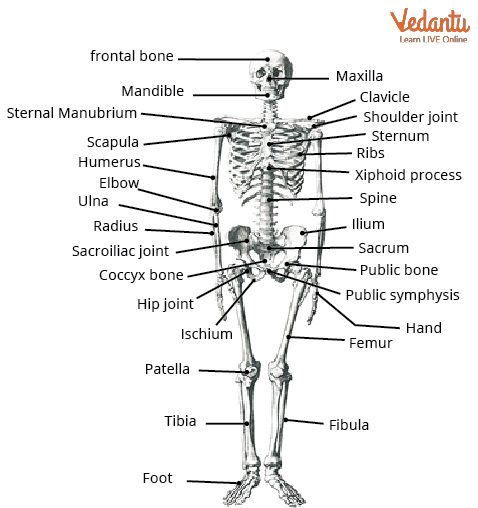
Structure and Classification of Bones In Your Body
An adult human body contains 206 bones. These bones are mainly grouped into:
- Axial Skeleton (80 bones): Includes the skull, vertebral column, and thoracic cage (ribs & sternum). It forms the central axis and protects vital organs like the brain, heart, and lungs.
- Appendicular Skeleton (126 bones): Includes the bones of limbs, pelvic girdle, and pectoral girdle. These bones help in movement and interaction with the environment.
Based on shape and function, bones are further classified as:
- Long Bones: e.g., femur, humerus; support body weight and enable movement.
- Short Bones: e.g., carpals (wrist) and tarsals (ankles); provide stability and some movement.
- Flat Bones: e.g., sternum, ribs, scapula; protect internal organs and serve as muscle attachment sites.
- Irregular Bones: e.g., vertebrae, some skull bones; have complex shapes for specific functions.
- Sesamoid Bones: e.g., patella; embedded in tendons, protect them from wear and tear.
Functions of Bones In Your Body
Bones In Your Body An Overview also involves understanding their core functions:
- Provide structural support to the body
- Protect delicate organs (e.g., skull protects brain, ribs protect lungs/heart)
- Enable movement through joints and muscle attachments
- Store minerals, especially calcium and phosphate
- Contain bone marrow for blood cell production (hematopoiesis)
Here’s a helpful table to understand Bones In Your Body An Overview better:
Bones Classification Table
| Type of Bone | Example | Function |
|---|---|---|
| Long Bone | Femur, Humerus | Movement, Support |
| Short Bone | Carpals, Tarsals | Stability, Flexibility |
| Flat Bone | Sternum, Skull | Protection, Muscle Attachment |
| Irregular Bone | Vertebrae, Pelvis | Protection, Support |
| Sesamoid Bone | Patella | Reduces Friction, Tendon Protection |
Major Named Bones and Regions
In exams, you may need to recall the major bones and their locations. Here’s a quick list grouped by region:
| Body Region | Major Bones (Examples) |
|---|---|
| Skull | Cranium, Maxilla, Mandible |
| Vertebral Column | Cervical, Thoracic, Lumbar vertebrae, Sacrum, Coccyx |
| Thoracic Cage | Ribs, Sternum |
| Shoulder/Pectoral Girdle | Clavicle, Scapula |
| Arms | Humerus, Radius, Ulna |
| Hands | Carpals, Metacarpals, Phalanges |
| Pelvis | Ilium, Ischium, Pubis |
| Legs | Femur, Patella, Tibia, Fibula |
| Feet | Tarsals, Metatarsals, Phalanges |
Common Mistakes to Avoid
- Confusing axial and appendicular skeletons in MCQs.
- Mixing up the types of bones and examples in labelling questions.
- Difficulties remembering all bone names—use mnemonics and grouping techniques.
Real-World Applications
The concept of Bones In Your Body An Overview is used in fields like medicine (fracture management, orthopaedics), sports science, anthropology, and even forensic studies. Vedantu helps students relate bone structure and function to daily life, medical cases, and health awareness.
Practice Questions
- What are the main functions of bones in the human body?
- List the differences between axial and appendicular skeletons.
- Classify bones with suitable examples.
- Draw and label a diagram of the human skeleton indicating main bones.
In this article, we explored Bones In Your Body An Overview, its structure, classification, real-life significance, and how to solve related NEET questions. To learn more and build your confidence for NEET, keep practicing questions and diagrams with Vedantu.
Related Internal Links for Deeper Understanding
- Human Skeletal System – Detailed overview of bone structure and physiology
- Locomotion and Movement – Understand how bones and muscles work together
- Body Movements – See how skeletal parts coordinate movement
- Types of Joints – Learn about the points where bones articulate
- Difference Between Bone and Cartilage – Compare key supporting tissues
- Human Body Anatomy – Visual guide to structure for diagram practice
- Connective Tissue – Deepen knowledge of bone as a type of connective tissue
- Vertebrae – Focused look at spinal bones and column
FAQs on Bones in Your Body: Full Overview for NEET
1. What is Bones In Your Body An Overview in NEET?
Bones in your body overview in NEET covers the human skeletal system, including the total of 206 bones in adults, their classification into axial and appendicular skeletons, bone types, and their crucial roles in support, protection, movement, and mineral storage. It forms a foundational concept for NEET 2027 Biology preparation, helping students understand bone names, functions, and typical exam questions effectively.
2. How many bones are present in a human adult?
An adult human skeleton typically comprises 206 bones. These are broadly categorized into the axial skeleton (80 bones including the skull, vertebral column, ribs, and sternum) and the appendicular skeleton (126 bones including limbs and girdles). This composition is essential knowledge for NEET exams.
3. What are the main types of bones in the body?
The human skeleton consists of five primary types of bones:
– Long bones (e.g., femur, humerus) that support weight and facilitate movement.
– Short bones (e.g., carpals, tarsals) that provide flexibility and support.
– Flat bones (e.g., skull bones, ribs) that protect internal organs.
– Irregular bones (e.g., vertebrae, pelvis) with complex shapes.
– Sesamoid bones (e.g., patella) embedded in tendons to reduce friction and absorb strain.
4. Why are bones important for movement and protection?
Bones are vital because they:
– Provide support and structure to the body.
– Protect soft organs like the brain (skull), heart, and lungs (rib cage).
– Facilitate movement, acting as levers where muscles attach.
– Store minerals like calcium and phosphorus essential for body functions.
Understanding these functions helps answer NEET MCQs and diagram-based questions effectively.
5. How to memorise the names of all 206 bones for NEET?
Effective memorisation tips include:
– Using mnemonics and visual aids for bone groups.
– Dividing bones into axial and appendicular categories.
– Practising with labelled diagrams and tables.
– Employing frequent revision sessions.
– Associating bones with their functions and locations.
This approach aligns with NEET exam patterns, reducing confusion between bone types.
6. Why do students confuse axial and appendicular skeletons in MCQs?
Confusion arises because:
– Both are major divisions of the skeletal system with overlapping functions.
– The axial skeleton includes skull, vertebral column, ribs, and sternum, while the appendicular skeleton includes limbs and girdles.
– Inadequate understanding of bone grouping or lack of practice with labelled diagrams.
Students should memorise distinct bone lists and use visual mnemonics to differentiate clearly for NEET MCQs.
7. Are there differences between bone numbers in adults vs. children?
Yes, children have approximately 270 bones at birth, which fuse over time to form the adult total of 206 bones. The difference mainly arises due to the fusion of certain bones (e.g., in the skull and spine) during growth. NEET syllabus emphasizes this developmental difference, relevant in certain conceptual questions.
8. How should I approach diagram-based bone questions in NEET?
For diagram questions:
– Learn labelled diagrams of both axial and appendicular skeletons.
– Practice identifying bones in key regions like the skull, vertebrae, limbs, and pelvis.
– Use colour-coded charts to visualise bone types.
– Understand bone functions related to their locations.
Regular practice helps avoid common mistakes and improves accuracy in NEET.
9. What common silly mistakes are made with bone classification in NEET questions?
Common mistakes include:
– Misclassifying sesamoid bones as long or short bones.
– Confusing flat bones with irregular bones.
– Mixing up bones of the axial and appendicular skeleton.
– Forgetting the exact number of bones in categories.
Clear understanding of definitions and regular revision of bone groups prevent such errors.
10. Do bones appear in assertion-reason type NEET questions?
Yes, bones frequently feature in assertion-reason type questions in NEET. These questions test knowledge of:
– Bone structure and classification.
– Functions such as protection and support.
– Differences between bone types.
– Skeletal system components (axial vs appendicular).
Preparing with clear concept explanations and practicing past PYQs enhances performance in this question format.
11. What is the importance of bones in the human body?
Bones are crucial for:
– Providing structural support to maintain body shape.
– Protecting vital organs like the brain, heart, and lungs.
– Facilitating movement through joints and muscle attachments.
– Acting as a reservoir for minerals such as calcium and phosphorus.
– Supporting blood cell formation in the bone marrow.
Understanding these roles aligns with NEET’s focus on skeletal system functions.
12. What are the 7 types of bones in the human body?
While the NEET syllabus generally includes five main bone types, some resources mention up to seven types, considering subcategories. These include:
– Long bones
– Short bones
– Flat bones
– Irregular bones
– Sesamoid bones
– Pneumatic bones (bones with air spaces, e.g., certain skull bones)
– Sutural (wormian) bones (small bones within sutures of skull)
This expanded classification is sometimes discussed in advanced NEET concepts or biology revision materials.
