




Stepwise NCERT Answers & PDF for Class 5 English Chapter 5 Santoor The Frog
Let us Think (Page 66)
A. Answer the following questions.
Question 1. Where does the frog like to sit or spend time?
Answer: The frog wishes to rest and enjoy its time in the ponds.
Question 2. How does the frog catch its food?
Answer: The frog snaps up its food by quickly flicking out its tongue.
Question 3. How does the frog move in water and on land?
Answer: The frog swims by pushing through the water with its back legs. On land, it uses those same powerful legs to hop around.
Question 4. What helps the frog hide in its surroundings?
Answer: The frog’s brown and green colours help it blend into its environment and stay hidden.
B. Think and Discuss
Question 1. What would it feel like to live like a frog, both in water and on land?
Answer: I would feel delighted if I had the ability to live in both water and on land just like a frog.
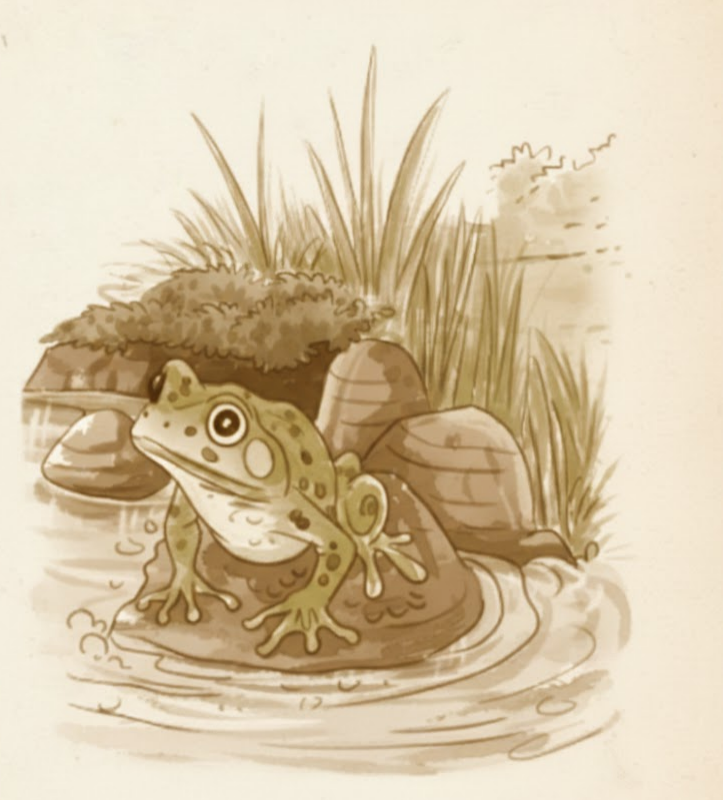
Question 2. If you could hop as high as a frog, what fun things would you do?
Answer: If I could jump as high as a frog, I would go up the stairs by lifting both feet together and leaping two or three steps at once, and I might even move along the road in the same hopping style.
Question 3. How is a frog’s life different from a fish’s life?
Answer: Frogs are amphibians, so they can live in water when they are tadpoles and later on land as adults. However, a fish cannot remain on land for an extended period and will not survive there.
Question 4. How are frogs’ webbed feet similar to the flippers used by scuba divers?
Answer: Both a frog’s webbed feet and a scuba diver’s flippers have wide, flat surfaces. This greater area helps them push more water with every kick, allowing both the frog and the swimmer to move forward more efficiently.
Let us Learn (Pages 57-58)
A. Choose the correct words from the brackets and fill in the blanks.
Question 1. My colours match the plants ………… trees. (or/and)
Answer: and
Question 2. Would you like to learn about frogs ……….. tadpoles? (because/and)
Answer: and
Question 3. I hop around happily, ……… I must watch out for snakes! (but/so)
Answer: but
Question 4. Frogs swim easily ………. they have webbed feet. (because/or)
Answer: because
B. The following words have been rearranged into sentences. Choose the correct option.
Question 1. hunts/night/the/silently/tiger/at
OPTIONS:
a. The tiger hunts silently at night.
b. Tiger hunts the silently at night.
c. Hunts the tiger at night silently.
Answer: a. The tiger hunts silently at night.
Question 2. elephants/in/forests/live/large/ groups/in
OPTIONS:
a. Elephants live large in groups forests.
b. In groups large, elephants live in forests.
c. Elephants live in large groups in forests.
Answer: c. Elephants live in large groups in forests.
Question 3. web/a/spider/carefully/its/weaves
OPTIONS:
a. A spider carefully weaves its web.
b. Spider carefully weaves its web a.
c. Carefully a spider weaves web its.
Answer: a. A spider carefully weaves its web.
Question 4. crocodile/waits/the/silently/riverbank/ the/near
OPTIONS:
a. Crocodile waits the silently the near riverbank.
b. The silently crocodile waits near the riverbank.
c. The crocodile waits silently near the riverbank.
Answer: c. The crocodile waits silently near the riverbank.
Question 5. a/swims/turtle/slowly/in/ocean/the
OPTIONS:
a. A turtle swims slowly in the ocean.
b. Swims turtle slowly an ocean in.
c. The ocean swims a slowly turtle in.
Answer: a. A turtle swims slowly in the ocean.
Let us Speak (Page 58-59)
A. Three tongue twisters are given below. Try speaking each tongue twister slowly at first. Gradually increase your speed with each repetition. Count how many times you can say it correctly without making a mistake.
Question 1. Four fierce frogs fight for flies.
Answer: Students should do it by themselves.
Question 2. Fast frogs flip-flop across fluffy fields.
Answer: Students should do it by themselves.
Question 3. Funny frogs flap floppy feet.
Answer: Students should do it by themselves.
B. Listen and repeat
Your teacher will say aloud the following pairs of words. Listen carefully and repeat each pair.
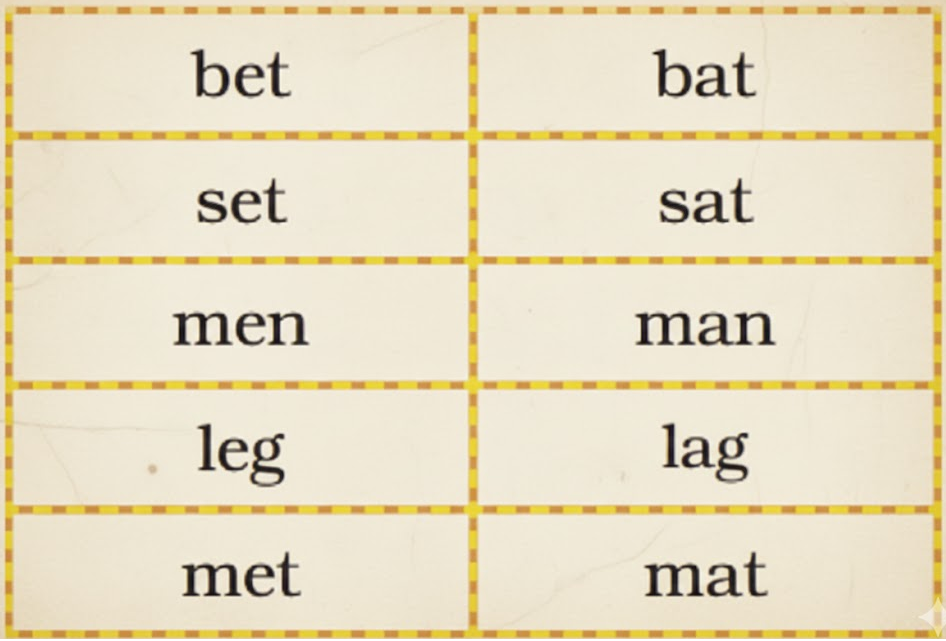
Answer: Students should do it by themselves.
Note to the Teacher
Say aloud every pair of words. Ensure that learners pronounce it clearly.
Do this exercise at regular and frequent intervals.
Let us Listen (Page 59-60)
My Frog’s World
Your teacher will read out instructions for you to follow and create your own ‘Frog’s World’ in the space provided on the next page.
Answer: Students should do it by themselves.
1. Draw the place: Imagine a place where your frog might be happy, like a pond, a forest or a rainy area.
2. Draw your frog: Draw a frog in the above setting.
3. Decorate with words: Around your drawing, write some words from the poem that describe the frog’s life. You can even write your own short sentence about the frog’s world.
4. Colour it: Use colours to bring your frog’s world to life! Be creative and make it as colourful as you would like.
My Frog’s World
……………………..
……………………..
……………………..
Answer: Students should do it by themselves.
Note to the Teacher
Read the instructions given in the ‘Let us Listen’ section, adding details of your own. For example, the first instruction may include details like trees, shrubs, plants, water, etc. Similarly, for the second you may elaborate on its webbed feet, its colour, and even its tongue, catching food.
Let us Write (Page 61)
Here is a message for you from Hopper, the frog.
Dear Reader,
Hello! I am Hopper. I am writing this message to you from my big lily leaf pad. I like splashing water when it rains. My favourite hobby is sitting in water puddles and croaking.
I love eating mosquitoes and other insects. What do you like to do?
Your friend,
Hopper
Write a reply to Hopper in your notebook and share it with your class.
Answer:
M-28, Sector 21
Noida
18th June 20XX
Dear Hooper,
I hope this letter reaches you in good health and cheerful spirits. It was wonderful to learn about your interests and hobbies.
You wanted to know how I spend my free time and what foods I enjoy. I study in Class 6, so a large part of my day is devoted to reading my school books. When I am free, I enjoy playing ludo and chess with my family. I also love playing cricket and football whenever I get the chance.
My favourite food is rice with cheese. I make sure to eat some fruit every day, and I drink a glass of milk regularly.
Your friend,
Aryan
Did you Know?
How is a frog different from a toad?
Frogs usually have smooth, moist skin, and long legs for hopping, while toads have dry, rough, bumpy skin, and shorter legs for walking or hopping.
Let us Do (Page 62-64)
A. Five of us are hiding In the picture. Can you find us?
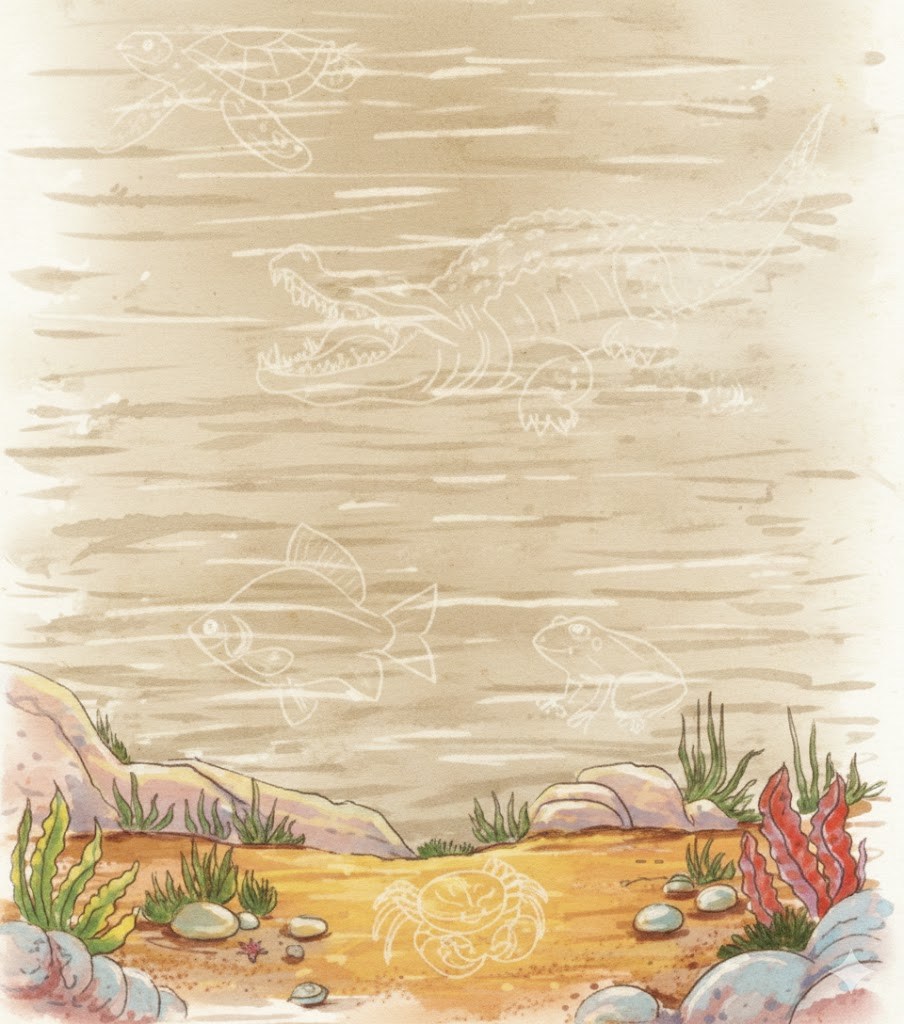
Answer:
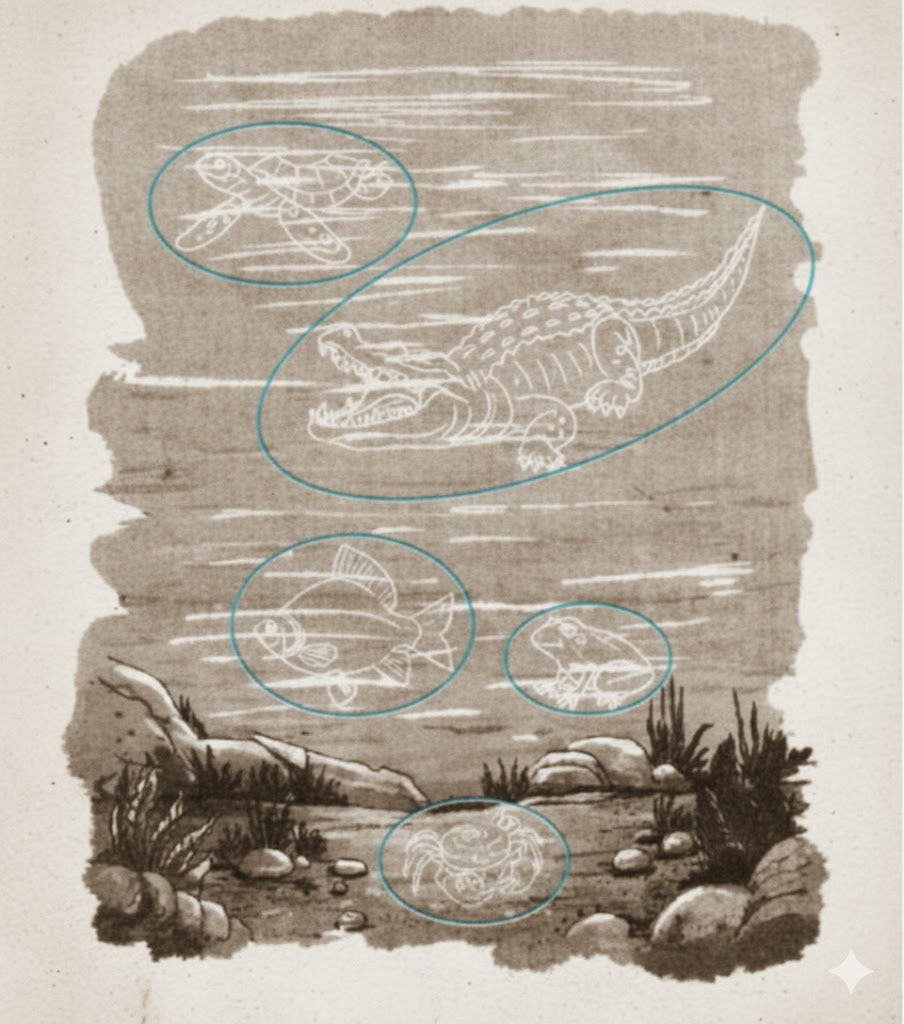
B. Look at the following steps carefully and draw a duck in the given space.
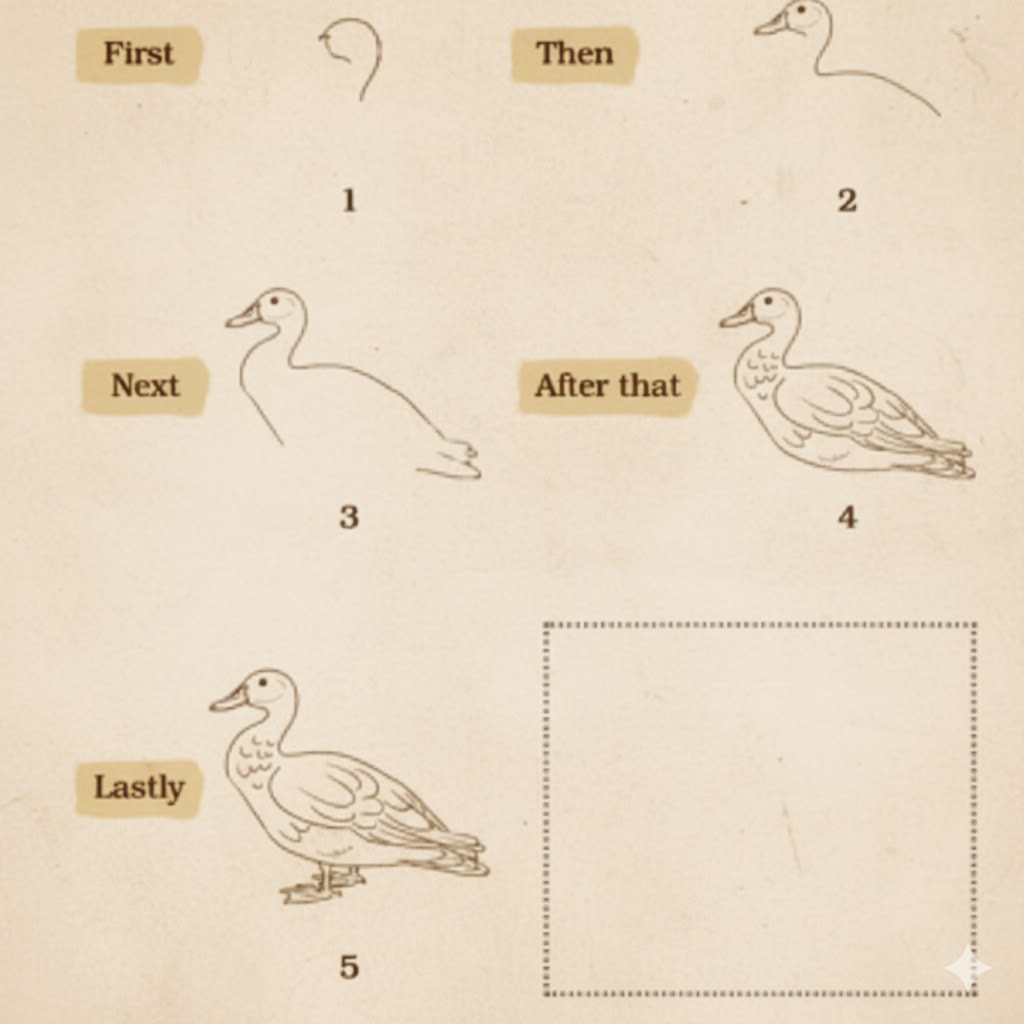
Answer: Students should do it by themselves.
C. Move three crayons to change the direction in which the fish is swimming.

Answer:

Did you Know?
Which is our national aquatic animal?
It’s the Ganges river dolphin! It cannot see well, so it uses sounds to find its way in the water!
Let us Explore (Page 64)
Choose any two of the below and find out a few facts about them.
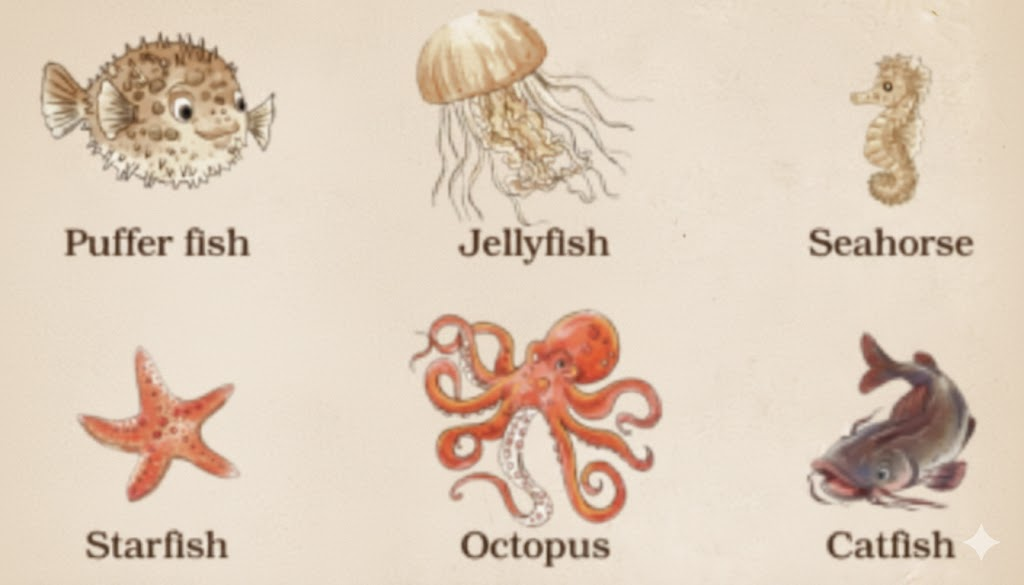
Answer:
Puffer Fish
There are more than 190 species of puffer fish found around the world.
Their bodies lack scales or spines.
They possess strong teeth and powerful jaws.
These fish contain poison, making them dangerous if eaten.
A puffer fish has two teeth on top and two on the bottom, all fused into a single beak-like structure.
Jellyfish
Jellyfish have existed for millions of years—long before dinosaurs ever appeared.
Their mouth is located right in the centre of their body.
They digest their meals—such as fish, shrimp, crabs, and tiny plants—very quickly.
A jellyfish sting can hurt humans, and in some species, it can even be fatal.
Seahorse
In seahorses, it is the male that carries the developing young.
About 36 species of seahorses live in warm and mild coastal waters, swimming upright among sea plants.
Their bodies are covered with small, spiky plates from head to tail.
Female seahorses deposit dozens or even hundreds of eggs into a pouch on the male’s belly called a brood pouch, similar to a kangaroo’s pouch.
Seahorses are excellent at blending in with their surroundings, helping them hide from predators and sneak up on prey.
Starfish
Starfish are capable of regrowing lost arms.
They do not have a brain or blood.
Their upper surface is made of calcium carbonate, giving them a tough, protective outer layer.
Starfish can see—they have eyespots at the tips of their arms.
They move using hundreds of tiny tube feet beneath their arms.
Because their mouth is very small, located on their underside, they have developed a unique method to eat food larger than their mouths.
Octopus
An octopus has blue blood because its oxygen-carrying molecule is copper-based.
It has three hearts: two pump blood to the gills, and the third sends it to the rest of the body.
Every species of octopus is venomous, though only the blue-ringed octopus is dangerous to humans.
Octopuses, like squids and cuttlefish, are experts at camouflage—they can instantly change colour, pattern, brightness, and even skin texture.
Each arm can work independently because it has its own large nerve centre, functioning like a small brain.
Catfish
Catfish are able to survive in extremely hot or very cold water.
Certain Asian catfish species can move from one water pool to another by “walking.”
They have an excellent sense of hearing due to the Weberian apparatus, which boosts underwater sound vibrations.
The biggest catfish ever recorded was a Mekong giant catfish weighing 646 pounds.
Some catfish, like the Asian stone mini catfish, grow only to about an inch in length.
Their bodies are covered with thousands of taste buds, allowing them to locate food with great accuracy.
NCERT Solutions Class 5 English Chapter 5 Santoor The Frog (2026-27)
Mastering NCERT Solutions Class 5 English Chapter 5 Santoor The Frog helps students build confidence in poetry comprehension. Regularly revising chapter-wise solutions sharpens your ability to answer both direct and creative questions in exams.
With updated solutions for the 2026-27 edition, students can learn about amphibian life, grammar concepts, and fun vocabulary. Important exam tips include reading the poem carefully and practicing exercises for clear conceptual understanding.
For the best results, attempt the chapter exercises on your own first. Using these NCERT Class 5 English Chapter 5 solutions ensures strong preparation and boosts problem-solving speed for school assessments.
FAQs on NCERT Solutions For Class 5 English Chapter 5 The Frog - 2026-27 Free PDF Download (Login Required)
1. What are the NCERT Solutions for Class 5 English Chapter 5 Santoor The Frog?
The NCERT Solutions for Class 5 English Chapter 5 Santoor The Frog provide stepwise answers for all textbook exercises, following the CBSE marking scheme. These solutions include:
- Intext and back exercise question answers
- Detailed explanations for every question
- Expert tips for scoring full marks
- Free PDF downloads for offline study
2. How do I write stepwise NCERT answers to score full marks in Class 5 English Chapter 5?
To score full marks in Class 5 English Chapter 5 Santoor The Frog, present answers in a clear, stepwise manner:
- Start with a direct answer to the question
- Include important keywords from the chapter
- Break down longer answers into points or steps
- Write in neat and simple language
- Support answers with examples or definitions, if required
3. Which questions from Chapter 5 Santoor The Frog are likely to be asked in school exams?
For Class 5 English Chapter 5 Santoor The Frog exams, the following types of questions are common:
- Short answer questions based on the story or poem
- Long answer questions asking for explanations of key events
- Definitions of important terms or concepts
- Value-based questions or moral lessons from the story
4. Are diagrams or definitions mandatory in the answers for Class 5 English Chapter 5?
Definitions are often required if the question asks to explain a term, but diagrams are not typically mandatory unless specified in instructions. To ensure full marks:
- Write clear, concise definitions for key terms
- Draw diagrams only when the question mentions it
- Neatness and correct labelling earn extra marks in applicable questions
5. How should I structure long answers for Class 5 English Chapter 5 to get better marks?
Long answers should be structured for clarity and coverage of points:
- Begin with an introductory sentence
- Use bullet points or numbered steps for main ideas
- Include key details and examples from the chapter
- End with a conclusion or summary
6. Where can I download the Chapter 5 Santoor The Frog solutions PDF for Class 5 English?
You can download the free PDF of NCERT Solutions for Class 5 English Chapter 5 Santoor The Frog from educational websites offering CBSE resources. The PDF includes:
- Complete exercise-wise solutions
- Exam tips and important questions
- Revision notes for quick preparation
7. Are NCERT Solutions enough for Class 5 English exams?
NCERT Solutions provide comprehensive, syllabus-aligned answers and are sufficient for most Class 5 English exam questions. For best results:
- Revise all back and intext exercises
- Practice important questions and sample papers
- Use revision notes for quick recall
8. How can I present long answers to match the CBSE marking scheme?
To match the CBSE marking scheme, long answers should:
- Cover all key points in a logical order
- Use headings or bullet points where relevant
- Include keywords, examples, and short definitions
- Maintain clear handwriting and proper structure
9. What are some important revision tips for Class 5 English Chapter 5 Santoor The Frog?
For fast and effective revision, follow these tips for Class 5 English Chapter 5 Santoor The Frog:
- Review all NCERT Solutions and key definitions
- Make short notes or flashcards of important points
- Practice writing answers step by step
- Attempt sample questions and previous year papers
10. Do examiners award partial marks for correct steps even if the final answer is wrong?
Yes, in CBSE exams for Class 5 English, examiners often give partial marks if correct steps or relevant points are shown, even if the final answer is incomplete or has minor errors. Always:
- Write all known steps
- Show method or logic behind your answer
- Highlight key terms from the solution
11. What are the key topics covered in Class 5 English Chapter 5 Santoor The Frog?
Class 5 English Chapter 5 Santoor The Frog covers important topics such as:
- The story of Santoor the Frog
- Life lessons and morals from the chapter
- New words and their definitions
- Comprehension and character-based questions
12. How can I quickly revise Class 5 English Chapter 5 before the exam?
To quickly revise Chapter 5 Santoor The Frog for Class 5 English:
- Read the summary of the chapter
- Go through all stepwise solutions
- Memorise key definitions and values from the story
- Practice sample and important questions
