









What is the formula for volume and surface area of a cuboid with examples
What is Cuboid?
A cuboid is around us in day-to-day life. We see it in the form of bricks, shoeboxes, cuboid objects, etc. A cuboid is a three-dimensional figure which has six rectangular faces, twelve edges, and eight vertices. The cuboid shape is formed with a closed rectangular face.
Cuboid Examples
The boxes we use, the lunch boxes we take to school, the bricks we use to build a house, the pencil box, etc. are the known examples existing around us. These are some common examples that we have seen in our surroundings. The following pictures have some of the common examples.

Cuboid Examples
What is Surface Area?
The surface area is the area of a solid object that measures the surface that occupies the object. The surface area of a cuboid is the area of 6 rectangular faces. There is a formula to calculate the surface area of a cuboid.
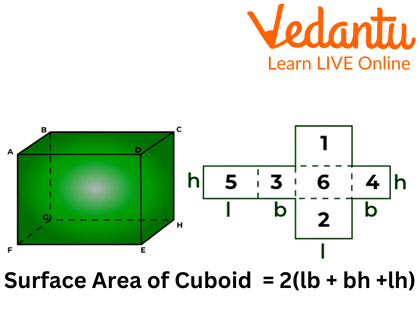
Surface Area
Formula for the Surface Area of Cuboid:
Curved surface area : \[2h\left( {l + b} \right)\]
Total Surface area : \[2\left( {lb + bh + hl} \right)\]
Where l is length, b is the breadth and h stands for height.
Cuboid Examples: Surface Area
Example 1: The cuboid has its dimension given as length is 8 cm, width is 6 cm and height is 5 cm. Find the Total surface area of the given cuboid.
Given
Height(h) \[ = {\rm{ }}5{\rm{ }}cm\]
Width(w) \[ = {\rm{ }}6{\rm{ }}cm\]
Length(l) \[ = {\rm{ }}8{\rm{ }}cm\]
Total surface area \[ = {\rm{ }}2\left( {lb + bh + hl} \right)\]
\[ = {\rm{ }}2\left[ {{\rm{ }}\left( {8 \times 6} \right){\rm{ }} + {\rm{ }}\left( {6 \times 5} \right){\rm{ }} + {\rm{ }}\left( {5 \times 8} \right)} \right]\]
\[ = {\rm{ }}2{\rm{ }}\left[ {{\rm{ }}48{\rm{ }} + {\rm{ }}30{\rm{ }} + {\rm{ }}40{\rm{ }}} \right]\]
\[ = {\rm{ }}2 \times 118\]
\[ = 236\]
Hence, the total surface area is \[236c{m^2}.\]
Volume Of Cuboid
The volume of a cuboid is the product of length, breadth, and height in cubic units.
The formula of the volume of cuboid: length \[ \times \] breadth \[ \times \] height
Let’s understand it by doing some examples.
Cuboid Example: Volume Of The Cuboid
Example 2: Calculate the volume of a cuboid with a length of 8 cm, breadth of 25 cm, and height of 50 cm.
Given
Length \[ = \;8{\rm{ }}cm\]
Breadth \[ = {\rm{ }}25{\rm{ }}cm\]
Height \[ = {\rm{ }}50{\rm{ }}cm\]
The volume of cuboid: length \[ \times \] breadth \[ \times \] height
\[ = \,8\, \times \,25\, \times \,50\]
\[ = \,10000\,\,c{m^3}\]
Solved Questions:
1. Find the surface area of a cuboid whose length is 5 cm, breadth is 6 cm and height is 9 cm.
Given
Length \[ = {\rm{ }}5{\rm{ }}cm\]
Breadth \[ = \,6{\rm{ }}cm\]
Height \[{\rm{ = }}9{\rm{ }}cm\]
Surface are of cuboid \[ = {\rm{ }}2\left( {lb + bh + hl} \right)\]
\[ = {\rm{ }}2{\rm{ }}\left[ {\left( {5 \times 6} \right){\rm{ }} + {\rm{ }}\left( {6 \times 9} \right){\rm{ }} + {\rm{ }}\left( {9 \times 5} \right)} \right]\]
\[ = {\rm{ }}2{\rm{ }}\left[ {{\rm{ }}30 + 54 + 45{\rm{ }}} \right]\]
\[ = {\rm{ }}2 \times 129\]
\[\; = {\rm{ }}258{\rm{ }}c{m^2}.\]
2. Find the volume of the cuboid whose length is 8 cm, breadth is 7 cm and height is 4cm.
Given
Length \[{\rm{ = }}8{\rm{ }}cm\]
Breadth \[{\rm{ = }}7{\rm{ }}cm\]
Height \[{\rm{ = }}4{\rm{ }}cm\]
The volume of the cuboid is length × breadth × height
\[ = {\rm{ }}8 \times 7 \times 4\]
\[ = {\rm{ }}224{\rm{ }}c{m^3}.\]
3. Find the sum of the surface area and the volume of the cuboid whose length is 4 cm, breadth is 2 cm and height is 1 cm.
Given
Length \[ = {\rm{ }}4{\rm{ }}cm\]
Breath \[ = {\rm{ }}2{\rm{ }}cm\]
Height \[ = {\rm{ }}1{\rm{ }}cm\]
Surface area of cuboid \[ = {\rm{ }}2\left( {lb + bh + hl} \right)\]
\[ = {\rm{ }}2{\rm{ }}\left[ {{\rm{ }}\left( {4 \times 2} \right){\rm{ }} + {\rm{ }}\left( {2 \times 1} \right){\rm{ }} + {\rm{ }}\left( {1 \times 4} \right)} \right]\]
\[ = {\rm{ }}2{\rm{ }}\left[ {{\rm{ }}8{\rm{ }} + {\rm{ }}2{\rm{ }} + {\rm{ }}4{\rm{ }}} \right]\]
\[ = {\rm{ }}2 \times 14\]
\[ = {\rm{ }}28{\rm{ }}c{m^2}\].
The volume of the cuboid is length × breadth × height
\[ = {\rm{ }}4 \times 2 \times 1\]
\[ = {\rm{ }}8{\rm{ }}c{m^3}.\]
Sum of the surface area and the volume \[ = \,\,28\,\, + \,\,8\,\, = \,\,36\,cm\]
Summary
In this chapter, we have studied the cuboid. A cuboid is a three-dimensional solid object and the measure that the object occupies is the surface of the cuboid and the product of length, breadth, and height is the volume of the object.We also solved the various examples and solved questions to understand the surface area and volume of a cuboid.
FAQs on Volume and Surface Area of a Cuboid Explained Clearly
1. What is the volume of a cuboid?
The volume of a cuboid is the amount of space it occupies, calculated using the formula V = l × b × h.
- Here, l = length, b = breadth (width), and h = height.
- The unit of volume is cubic units such as cm³, m³, etc.
- Example: If l = 5 cm, b = 3 cm, h = 2 cm, then V = 5 × 3 × 2 = 30 cm³.
2. What is the formula for the surface area of a cuboid?
The total surface area of a cuboid is given by the formula TSA = 2(lb + bh + hl).
- It includes the areas of all six rectangular faces.
- l = length, b = breadth, h = height.
- Example: If l = 4 cm, b = 3 cm, h = 2 cm, then TSA = 2(12 + 6 + 8) = 2 × 26 = 52 cm².
3. How do you calculate the lateral surface area of a cuboid?
The lateral surface area (LSA) of a cuboid is calculated using LSA = 2h(l + b).
- It includes only the four vertical faces, excluding the top and bottom.
- h = height, l = length, b = breadth.
- Example: If l = 6 cm, b = 4 cm, h = 3 cm, then LSA = 2 × 3 × (6 + 4) = 6 × 10 = 60 cm².
4. What is the difference between volume and surface area of a cuboid?
The volume of a cuboid measures the space inside it, while the surface area measures the total area of its outer faces.
- Volume formula: V = l × b × h (cubic units).
- Total surface area formula: 2(lb + bh + hl) (square units).
- Volume is in cm³ or m³, while surface area is in cm² or m².
5. How do you find the length of a cuboid if the volume is given?
The length of a cuboid can be found using l = V ÷ (b × h) when volume is known.
- Start from V = l × b × h.
- Rearrange to l = V / (b × h).
- Example: If V = 120 cm³, b = 4 cm, h = 5 cm, then l = 120 ÷ (4 × 5) = 120 ÷ 20 = 6 cm.
6. What are the units of volume and surface area of a cuboid?
The unit of volume is cubic units, and the unit of surface area is square units.
- Volume units: cm³, m³, in³, etc.
- Surface area units: cm², m², in², etc.
- Example: If dimensions are in meters, volume is in m³ and surface area is in m².
7. Can you give an example of finding the volume and surface area of a cuboid?
To find both, use V = l × b × h and TSA = 2(lb + bh + hl).
- Let l = 5 cm, b = 4 cm, h = 3 cm.
- Volume: 5 × 4 × 3 = 60 cm³.
- Total surface area: 2(20 + 12 + 15) = 2 × 47 = 94 cm².
8. Why is the surface area formula of a cuboid 2(lb + bh + hl)?
The formula 2(lb + bh + hl) is used because a cuboid has three pairs of equal rectangular faces.
- Top and bottom: area = lb each.
- Front and back: area = bh each.
- Left and right: area = hl each.
- Adding them gives 2lb + 2bh + 2hl = 2(lb + bh + hl).
9. How is a cuboid different from a cube in terms of volume and surface area?
A cube has all sides equal, while a cuboid has length, breadth, and height that may differ.
- Volume of cuboid: l × b × h.
- Volume of cube: a³.
- Surface area of cuboid: 2(lb + bh + hl).
- Surface area of cube: 6a².
10. What are common mistakes when calculating volume and surface area of a cuboid?
Common mistakes include using wrong formulas or mixing up square and cubic units.
- Confusing volume with surface area.
- Forgetting to multiply the surface area expression by 2.
- Writing cm² instead of cm³ for volume.
- Not using consistent units for length, breadth, and height.
