









Definition types and examples of terms in algebraic expressions
An algebraic expression is a mathematical expression consisting of variables and constants using mathematical operations such as multiplication, division, addition, and subtraction. It is made up of terms like "coefficient," "variable," and "constant."
What is an Algebraic Expression?
An algebraic expression is an expression composed of variables, constants, and algebraic operations such as addition, subtraction, division, and multiplication.
For e.g. \[2{\rm{x}} + 3 = 0\]
Algebraic expression is composed of terms , coefficient, variable and constant.
Few more examples:
\[4x\]
\[2a + 3b\]
\[3{x^2} - 4xy + 2{y^2}^{}\]
Types of Algebraic Expressions
There are three main types of algebraic expressions that contain:
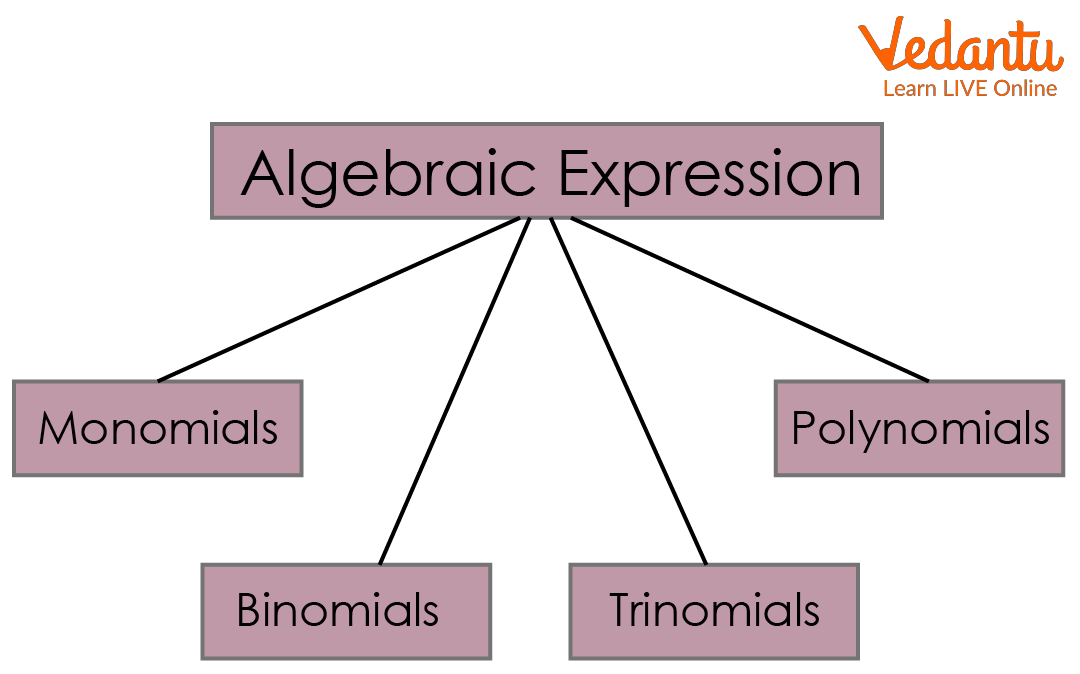
Types of Algebraic Expression
Monomial : An algebraic expression with only one term is called a monomial.
Examples 3x, 9y, and so on.
Binomial : A binomial expression is an algebraic expression made up of two different terms.
Examples include \[5{\rm{x}} + 8{\rm{y}}\], \[{\rm{a}} + 4{\rm{b}}\] and so on.
Trinomial: An algebraic expression made up of three terms is known as trinomial.
Example: \[4{\rm{x}} + 3{\rm{y}} + 2{\rm{xy}}\]
Polynomial: An expression with two or more terms with nonnegative integer exponents of a variable is called a polynomial.
Examples \[a{\rm{x}} + {\rm{by}} + {\rm{c}}\], \[4{\rm{x}} + 4{\rm{y}} + 4{\rm{z}}\] , and so on.
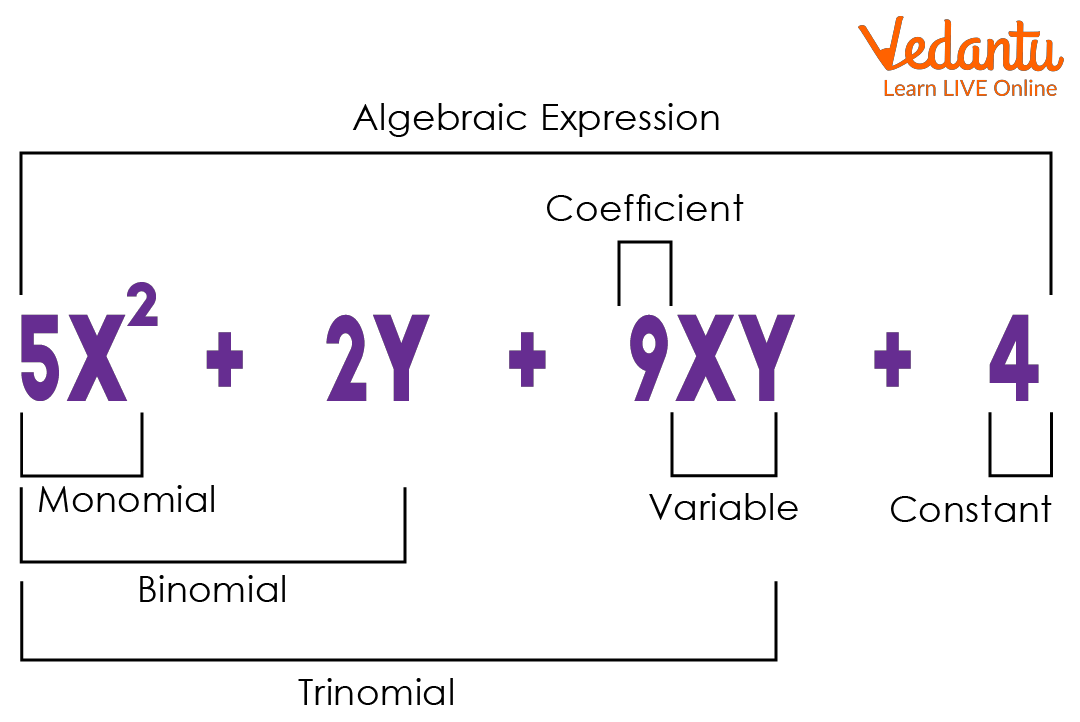
Algebraic Expression
Terms Related to Expression
Terms: Each expression consists of terms. A term can be a signed number, variable, or constant multiplied by a variable.
Coefficients in Algebraic Expression: A coefficient is an integer that is either multiplied by the variable it is associated with or written alongside the variable.
Variable: A variable is defined as a numeric value or literal symbol representing a number whose value keeps on changing.
Constant in Algebraic Expression: A number whose value cannot be changed.
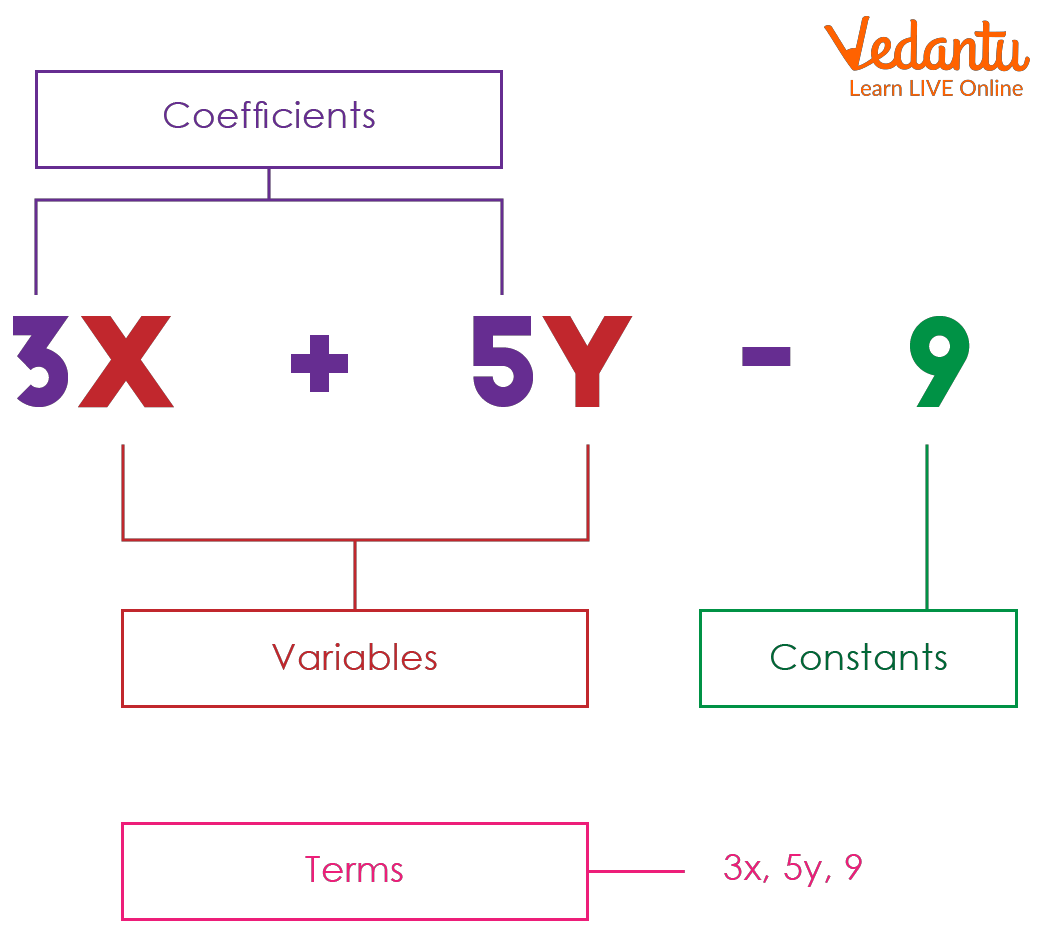
Terms, Coefficient, Variable and Constant
What is a Term in Algebraic Expression?
Each part of an algebraic expression separated by a plus sign $(+)$ or minus sign $(-)$ is known as a term of the algebraic expression. Division sign $(\div)$ or multiplication sign [ (\times) ] does not separate terms in algebraic expressions. Algebraic expressions can be simple, complex, or constant:
A simple algebraic expression consists of a single term.
A complex algebraic expression consists of two or more terms.
A term in an algebraic expression that has a fixed numerical value and no variables is called a constant term in an algebraic expression.
Conclusion
In mathematics, an algebraic expression is one that comprises variables, constants, coefficients, and arithmetic operations. The algebraic expression's multiple parts are broken down into the following list. Expressions with a monomial have only one term. The terms in binomial expressions are two. An expression having three terms is referred to as a trinomial, and so on.
Solved Examples:
Define the terms of the following expression.
a]\[12{\rm{x}} + 4\]
b] \[3{\rm{ab}} + 4{\rm{a}} + 2{\rm{abc}}\]
Solution:
a] \[12x + 4\]
Terms: \[12x, 4\]
b] \[3{\rm{ab}} + 4{\rm{a}} + 2{\rm{abc}}\]
Terms: \[3ab, 4a, 2abc\]
Classify the types of following algebraic expressions.
\[12x + 5y\]
\[5{\rm{a}} + 4{\rm{c}} + 5{\rm{ab}}\]
Solution:
a]\[12x + 5y\]
Binomial as it has two terms.
b]\[5{\rm{a}} + 4{\rm{c}} + 5{\rm{ab}}\]
Trinomial as well as polynomial as it has three term ( more than two terms)
Find the value of the expression \[5x + 4\] if the value of \[{\rm{x}} = - 5\]
Solution: \[5x + 4\]
Substitute \[{\rm{x}} = - 5\] in the expression \[ = 5[ - 5] + 4\]
\[ = - 25 + 4\]
\[ = - 21\]
Thus the value of expression is \[-21\]
Is 9 an algebraic expression?
Solution: Yes, 9 is algebraic because it can be viewed as a monomial.
FAQs on Understanding Terms in an Algebraic Expression
1. What are terms in an algebraic expression?
The terms in an algebraic expression are the individual parts separated by plus (+) or minus (−) signs. Each term can be a number, a variable, or a product of numbers and variables.
- In 5x + 3y − 7, the terms are 5x, 3y, and −7.
- Terms are separated only by + or −, not by × or ÷.
- Each term may contain a coefficient, variable, or both.
2. What is a constant term in an algebraic expression?
A constant term is a term that has no variable and remains fixed in value. It is simply a number.
- In 4x² + 6x + 9, the constant term is 9.
- Constants do not change when the variable changes.
- They usually appear at the end of a polynomial.
3. What is the difference between like terms and unlike terms?
The difference between like terms and unlike terms is that like terms have the same variables with the same powers, while unlike terms do not.
- 3x and 7x are like terms.
- 5x² and 5x are unlike terms (different powers).
- Only like terms can be combined.
4. How do you identify terms in an algebraic expression?
You identify terms in an algebraic expression by splitting the expression at each plus (+) or minus (−) sign.
- Example: In 8a − 3b + 4, the terms are 8a, −3b, and 4.
- Multiplication inside a term does not separate it.
- Always include the sign with the term.
5. What is a coefficient in a term?
A coefficient is the numerical factor multiplied by a variable in a term. It shows how many times the variable is taken.
- In 6x, the coefficient is 6.
- In −4y², the coefficient is −4.
- If no number is written, the coefficient is 1 (e.g., x = 1x).
6. How do you combine like terms in an algebraic expression?
To combine like terms, add or subtract their coefficients while keeping the variable part unchanged.
- Example: 3x + 5x = 8x.
- Example: 7y − 2y = 5y.
- Unlike terms such as 3x and 3y cannot be combined.
7. Can a single number be considered a term?
Yes, a single number by itself is considered a term and is called a constant term. It does not contain any variable.
- In 2x + 5, the number 5 is a term.
- In −9, the entire expression is one term.
8. What are monomials, binomials, and trinomials?
Monomials, binomials, and trinomials are algebraic expressions classified by the number of terms they contain.
- Monomial: one term (e.g., 7x).
- Binomial: two terms (e.g., x + 3).
- Trinomial: three terms (e.g., x² + 2x + 1).
9. What is an example of identifying terms in an expression?
An example of identifying terms is breaking the expression at plus or minus signs to list each separate part.
- Given: 5x² − 3x + 8 − 2y
- Terms are: 5x², −3x, 8, −2y
- Each separated part is one term.
10. Why are terms important in algebraic expressions?
Terms are important in algebraic expressions because they help in simplifying, solving, and classifying expressions. Understanding terms allows you to combine like terms and solve equations correctly.
- They determine whether an expression is a monomial, binomial, or polynomial.
- They help in performing addition and subtraction of expressions.
- Correct identification prevents common algebra mistakes.
