









How to Explain Multiplication Concepts and Tables for Grade 3 with Examples
An Introduction to Multiplication in Year 3
As kids are promoted to the third grade, they are introduced to concepts like multiplication and division. Kids might know some basic rules and methods of the multiplication operation from the previous grades but it is important to have a strong understanding of the basics of multiplication.
The topics covered in multiplication in Grade 3 includes the multiplication of a two-digit number by a single digit. The article provides important topics that are taught in multiplication this year. The article also mentions some important methods that can help parents and teachers to develop a deeper understanding of the concept by the kids.
Topics Taught in Multiplication for Kids
The topics taught in multiplication in year 3 include the simple multiplication process. The kids are introduced to the concept of multiplication. Kids are also encouraged to memorise tables of 2, 3, 4 and 5. Apart from multiplication, students are also introduced to simple division problems. These problems can be easily solved if a kid has a grasp of the table. A common technique that can be used to help students better understand multiplication is using real-life examples.
Example
A girl has 2 boxes of apples, each box has 4 apples. Find how many apples are there in total.
In this case, the total number of apples can be calculated by multiplying the number of apples by the number of boxes.
Total number of apples = 2 4= 8
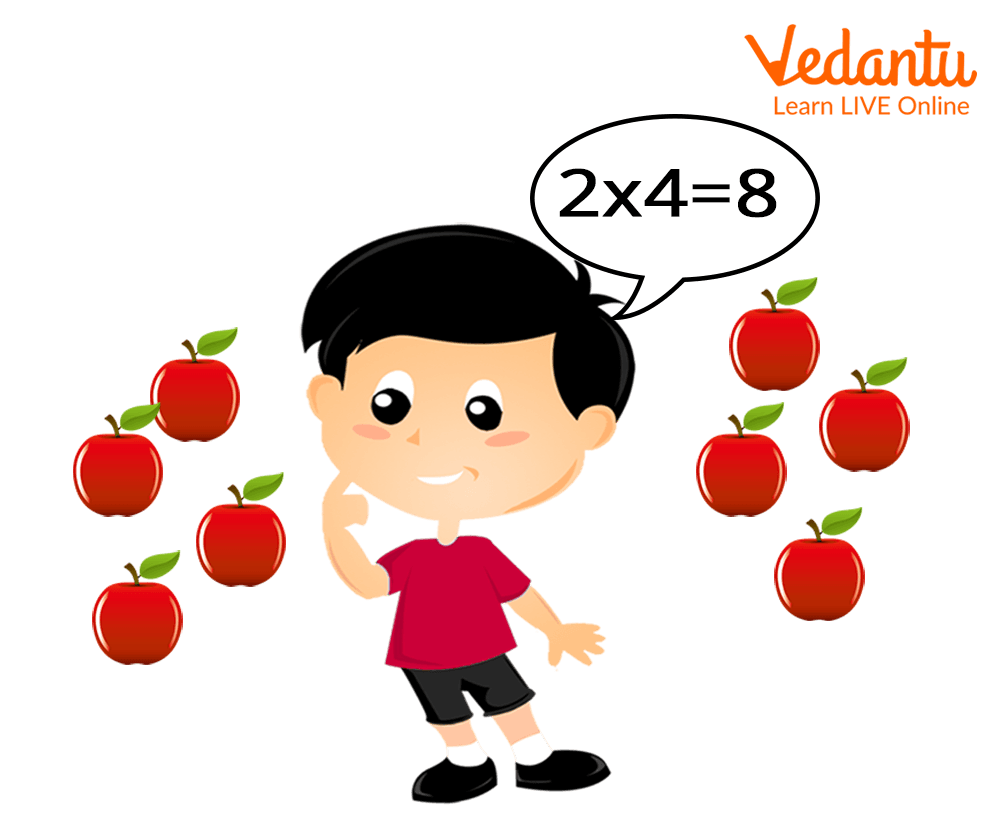
Multiplication of numbers
Fun Ways of Teaching Multiplication in Grade 3
We now have a fair idea of some of the important topics that are covered in the syllabus of multiplication for kids in third grade. Let us look into some of the ways that can help parents and teachers to teach effectively.
Practising Tables
Memorising tables is a critical skill in understanding the concepts of Mathematics. Parents can help kids in memorising the table by engaging with kids. Parents or teachers can print colourful cards that contain the number tables and learn them along with the kid.
Using Real-life Examples
One of the most effective ways of teaching new concepts to kids is incorporating the concepts into the practical world. In the case of multiplication, parents can assist their children by demonstrating real-life instances of a timetable. A muffin tray, for example, will often feature four rows of three muffin cups apiece, demonstrating the multiplication 4 x 3.
Using Different Strategies for Solving Multiplication Questions
At school, children will learn a variety of conceptual and informal strategies for solving multiplication questions, and some formal approaches such as column multiplication. Choose a multiplication problem and solve it along with your student and work out the answer independently to master these strategies.
Compare and contrast your approaches. Discuss which method is favoured, and why. This approach will help students to use the optimal approach for any given question since they will be able to employ various strategies. By allowing kids to practise a variety of approaches for multiplying numbers, you may help them acquire confidence in both formal and informal methods.
Exploring Connections between Different Concepts
It is beneficial to be able to connect multiplication and division in order to solve complex mathematical problems. Encourage your kid to investigate the relationships between multiplication, arrays, and division, as well as the relationships between fractions and division. Although it is important to know that this can take a little more time as kids in third grade are newly introduced to the topic.
Conclusion
This was the complete discussion on how to teach multiplication in Grade 3. We have explored the basic concepts that are taught in the topic; we have also looked into some of the methods that can help kids to develop a better understanding of the concept. An important point to note here is that it is through regular practice that a kid can enhance their skills. Lastly, we hope to have helped in providing insight on the introduction to multiplication.
FAQs on Teaching Multiplication to Third Grade Students
1. What is multiplication for Grade 3 students?
Multiplication is repeated addition of the same number. In Grade 3, students learn that multiplication helps find the total of equal groups quickly.
- Example: 4 × 3 means 4 groups of 3.
- This is the same as 3 + 3 + 3 + 3.
- The total is 12.
2. How do you teach multiplication to a 3rd grader?
You teach multiplication to a 3rd grader by starting with equal groups and repeated addition. Follow these simple steps:
- Use objects like blocks or counters to show equal groups.
- Write the repeated addition sentence (e.g., 2 + 2 + 2).
- Show the multiplication sentence (3 × 2 = 6).
- Practice with pictures, arrays, and word problems.
3. What are multiplication facts in Grade 3?
Multiplication facts are basic number sentences from 0 to 12 that students memorize. These facts help solve problems quickly without counting.
- Example: 5 × 4 = 20
- Example: 7 × 3 = 21
4. What is the multiplication formula for kids?
The basic multiplication formula is Multiplicand × Multiplier = Product. The answer in multiplication is called the product.
- Example: 6 × 2 = 12
- 6 is the multiplicand.
- 2 is the multiplier.
- 12 is the product.
5. How do you explain multiplication using arrays?
An array explains multiplication by arranging objects in rows and columns. Arrays visually show equal groups.
- Example: 3 rows with 4 objects in each row.
- This represents 3 × 4.
- Total objects = 12.
6. What is the difference between addition and multiplication?
Addition combines numbers once, while multiplication combines equal groups repeatedly. Multiplication is faster when adding the same number many times.
- Addition example: 3 + 3 + 3 + 3 = 12
- Multiplication form: 4 × 3 = 12
7. What are the properties of multiplication for Grade 3?
The main properties of multiplication in Grade 3 are the commutative property, associative property, and identity property.
- Commutative: 3 × 5 = 5 × 3 = 15
- Associative: (2 × 3) × 4 = 2 × (3 × 4)
- Identity: Any number × 1 = the same number
8. How do you solve a simple multiplication word problem?
To solve a multiplication word problem, identify the number of groups and the number in each group. Follow these steps:
- Read the problem carefully.
- Find equal groups.
- Write a multiplication sentence.
- Solve to get the product.
9. Why is learning multiplication important in Grade 3?
Learning multiplication in Grade 3 is important because it builds the foundation for division, fractions, and higher math. It helps students:
- Solve problems faster.
- Understand patterns and number relationships.
- Prepare for multi-digit multiplication.
10. What are common mistakes kids make in multiplication?
Common multiplication mistakes include confusing addition with multiplication and mixing up multiplication facts. Students often:
- Add instead of multiply.
- Forget multiplication tables.
- Reverse numbers incorrectly in word problems.
