









List of Math Words That Start With G With Definitions and Examples
There are several words in mathematics that begin with the alphabet ‘g’. Thorough knowledge of these words will help kids lay a foundation for mathematics in the long run. Learning and practicing the math words that start with g will therefore enhance their mathematical vocabulary and prevent them from mixing up the meaning and concept of these words. So here’s a list of the important math words that start with the alphabet ‘g’, along with their meaning in mathematics.
List of Math Words That Start With G
Geometry: It is a branch of mathematics that involves the theories of 2D and 3D lines, shapes, and solids. Geometry covers all the properties, theorems, and construction of these figures.
Gallon: A gallon is a standard unit used for measuring the volume of liquids.
1 gallon = 231 cubic inches = 3.785411784 litres
Gram: A metric unit for measuring the physical quantity, mass.
1 kilogram = 1 gram
Geometric Mean: This is a type of average or mean, in which the quantities to be averaged are multiplied together, first. Then a square root of the product (when two quantities are given), or a cube root of the product (when three quantities are given) is calculated to obtain the final result. The value of the square root or cube root is called the geometric mean.
G.M. of a,b =\[\sqrt{ab}\]
Geometric Progression: It is a sequence of numbers that have a common factor, called the common ratio. Each number in the sequence is multiplied by the common ratio to obtain the next number.
An example of geometric progression: 2, 4, 8, 16, 32.
Graph: It is a visual representation of data, displaying the relationship among variables for different constant values. It comprises a set of points and lines connecting the points. Usually, graphs are plotted in the quadrant of the x and y axes.
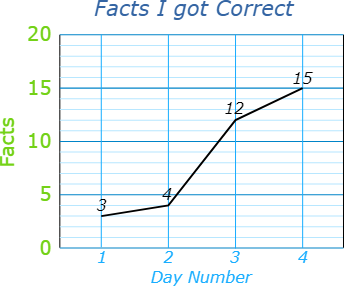
Image of a graph
Greatest Common Factor: It represents the number that is a common factor of two or more numbers. To calculate the greatest common factor for a set of numbers, we first need to find all the factors for the numbers. Then, the largest of the common factors of them all will give us the greatest common factor for the given set of numbers. It is also referred to as GCF.
Gradient: The gradient of a line gives the measure of its steepness. It is also referred to as the slope of a line. For example, if a straight line is given on a graph, we will first draw a right-angled triangle taking the given straight line as the hypotenuse. The ratio of the perpendicular to the base of this right-angled triangle will give us the gradient of the given straight line.
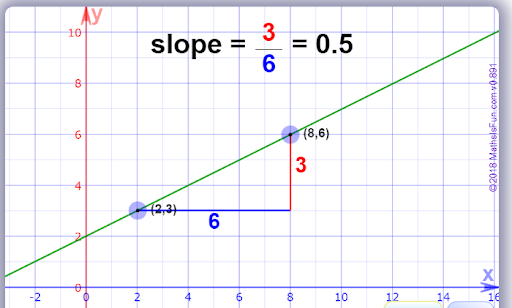
Image of the slope or gradient of a line
Golden Ratio: The golden ratio is obtained when a line is divided into two unequal parts, such that, the ratio of the longer part to the shorter part is equal to the ratio of the whole length to the longer part.
The value of the golden ratio is 1.618033989.
Golden Ratio = \[\frac{1+\sqrt{5}}{2}\]
Gross: Gross means to the total amount before any deductions. For example, gross income refers to the amount payable before deduction of income taxes and any other expenses. Another meaning of gross is 12 dozen, that is, 1 Gross = 144.
Gaussian Distribution: It is also referred to as the Normal Distribution. When a representation of data tends to be distributed evenly around a central value, with the central value being the greatest, it is called a Normal or Gaussian distribution. The curve obtained for a Gaussian distribution is closest to the shape of a bell. Hence it is called the bell curve.
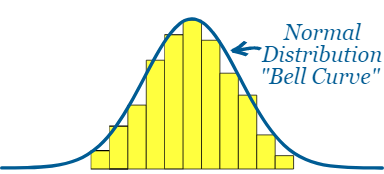
Image of a histogram and the Gaussian distribution Curve
Greater Than: The symbol for ‘greater than’ is given as >. When two numbers or quantities are compared, then the bigger number or quantity is called greater than the smaller number or quantity. For example, 6 is greater than 5, that is, 6>5.
Giga: It is used as a prefix to many units, to represent 1 billion, that is, 109. The symbol for ‘Giga’ is G. Gigabyte, gigameter, etc. are common examples of units where this prefix is used.
Conclusion
The above-discussed list of math words that start with g comprise some of the most commonly used mathematical terms. Learning these words will certainly equip kids with an upper hand at understanding the concepts of mathematics covered in their school curriculum. You can also refer to the lists of math words starting with common alphabets like A, B, O, V, etc. on Vedantu and guide your kids through a fun way of learning some fundamental concepts of math.
FAQs on Math Words That Start With G Explained for Students
1. What is geometry in math?
Geometry is the branch of mathematics that studies shapes, sizes, angles, distances, and the properties of space. It focuses on figures such as points, lines, triangles, circles, and solids.
- Includes plane geometry (2D shapes like squares and circles)
- Includes solid geometry (3D shapes like cubes and spheres)
- Uses formulas for area, perimeter, volume, and angles
2. What is a graph in mathematics?
A graph is a visual representation of data or a mathematical relationship plotted on coordinate axes. In algebra, graphs show how one variable changes with another.
- Uses an x-axis (horizontal) and y-axis (vertical)
- Each point represents an ordered pair (x, y)
- Example: The graph of y = 2x is a straight line
3. What is gradient in math?
The gradient is the measure of the steepness or slope of a line. It tells how much the y-value changes for each unit increase in x.
- Formula: m = (y₂ − y₁) / (x₂ − x₁)
- Positive gradient: line rises
- Negative gradient: line falls
4. What is a geometric sequence?
A geometric sequence is a sequence where each term is found by multiplying the previous term by a constant ratio. This constant is called the common ratio.
- Formula: aₙ = a₁ × rⁿ⁻¹
- Example: 3, 6, 12, 24 (r = 2)
- Each term is multiplied by the same number
5. What is geometric mean?
The geometric mean of two numbers is the square root of their product. It represents a type of average used for ratios and growth rates.
- Formula for two numbers a and b: √(ab)
- Example: Geometric mean of 4 and 9 is √(36) = 6
6. What is a grid in math?
A grid is a network of evenly spaced horizontal and vertical lines used to locate points or draw graphs. It forms squares or rectangles across a plane.
- Commonly used in coordinate geometry
- Helps in plotting ordered pairs
- Used in area models and transformations
7. What is a geometric transformation?
A geometric transformation is a change in the position, size, or shape of a figure on a plane. Transformations move or alter figures according to specific rules.
- Translation: sliding a shape
- Rotation: turning a shape
- Reflection: flipping over a line
- Dilation: resizing proportionally
8. What is a Gaussian distribution?
A Gaussian distribution, also called the normal distribution, is a symmetrical bell-shaped probability distribution centered around the mean. Most data values cluster around the average.
- Mean = Median = Mode
- Defined by mean (μ) and standard deviation (σ)
- Total area under the curve equals 1
9. What is a greatest common factor (GCF)?
The greatest common factor (GCF) is the largest number that divides two or more numbers exactly. It is also called the greatest common divisor (GCD).
- Example: Factors of 12: 1,2,3,4,6,12
- Factors of 18: 1,2,3,6,9,18
- GCF of 12 and 18 is 6
10. What is a geometric formula for the area of a triangle?
The geometric formula for the area of a triangle is A = ½ × base × height. It calculates the space inside a triangle using its base and perpendicular height.
- Identify the base (b)
- Find the perpendicular height (h)
- Multiply: ½ × b × h
