




You are given benzene, conc. ${{\rm{H}}_{\rm{2}}}{\rm{S}}{{\rm{O}}_{\rm{4}}}$ and ${\rm{NaOH}}$. Write the equations for the preparation of phenol using these reagents.
Answer
 Verified
301.2k+ views
Hint: In synthesis two or more compounds or elements combine to make a more complex substance. To form benzene sulphonic acid we have to use benzene and conc. sulphuric acid in presence of heat.
Complete step by step answer:
We know that benzene is an organic compound and molecular formula is ${{\rm{C}}_6}{{\rm{H}}_{\rm{6}}}$. Benzene reacts with concentrated sulphuric acid $\left({{\rm{conc}}{\rm{.}}{{\rm{H}}_{\rm{2}}}{\rm{S}}{{\rm{O}}_{\rm{4}}}} \right)$ in presence of heat and form benzene sulphonic acid. Benzene sulphonic acid is an organosulfur compound with formula ${{\rm{C}}_{\rm{6}}}{{\rm{H}}_{\rm{6}}}{{\rm{O}}_{\rm{3}}}{\rm{S}}$. Now, we write the reaction between benzene and conc. sulphuric acid in presence of heat is as follows:
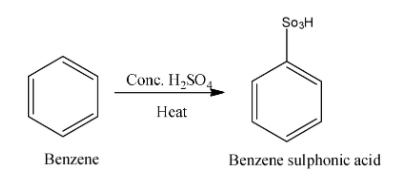
After formation of benzene sulphonic acid it is then heated with sodium hydroxide and form sodium phenoxide. Now we write the reaction between benzene sulphonic acid and sodium hydroxide in presence of heat is as follows:

After formation of sodium phenoxide hydrolysis of sulphuric acid given phenol. Sodium phenoxide is an organic compound with molecular formula ${\rm{NaO}}{{\rm{C}}_{\rm{6}}}{{\rm{H}}_{\rm{5}}}$. For the formation of phenol from sodium phenoxide heat is not required. We write the reaction of formation of phenol is as follows:
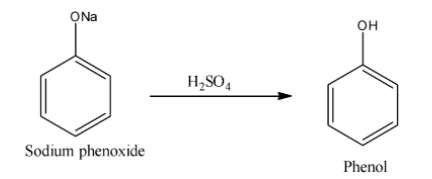
Additional Information: Phenol is a volatile solid that is found in white crystalline form. Phenol contains one $ - {\rm{OH}}$ group. Phenol is an aromatic compound and molecular formula is ${{\rm{C}}_{\rm{5}}}{{\rm{H}}_{\rm{6}}}{\rm{OH}}$. Phenols are used as disinfectants, mouthwash, household cleaners, antiseptics etc.
Note: Hydrolysis is a chemical reaction which one or more chemical bonds break up by a molecule of water. The term is commonly used for replacement, reduction and solving reactions in which nucleophile is water. In industry hydrolysis is commonly used to break down chemicals into smaller fractions or parts. Do not confuse this formation of phenol reaction with sulfonation reaction.
Complete step by step answer:
We know that benzene is an organic compound and molecular formula is ${{\rm{C}}_6}{{\rm{H}}_{\rm{6}}}$. Benzene reacts with concentrated sulphuric acid $\left({{\rm{conc}}{\rm{.}}{{\rm{H}}_{\rm{2}}}{\rm{S}}{{\rm{O}}_{\rm{4}}}} \right)$ in presence of heat and form benzene sulphonic acid. Benzene sulphonic acid is an organosulfur compound with formula ${{\rm{C}}_{\rm{6}}}{{\rm{H}}_{\rm{6}}}{{\rm{O}}_{\rm{3}}}{\rm{S}}$. Now, we write the reaction between benzene and conc. sulphuric acid in presence of heat is as follows:
After formation of benzene sulphonic acid it is then heated with sodium hydroxide and form sodium phenoxide. Now we write the reaction between benzene sulphonic acid and sodium hydroxide in presence of heat is as follows:
After formation of sodium phenoxide hydrolysis of sulphuric acid given phenol. Sodium phenoxide is an organic compound with molecular formula ${\rm{NaO}}{{\rm{C}}_{\rm{6}}}{{\rm{H}}_{\rm{5}}}$. For the formation of phenol from sodium phenoxide heat is not required. We write the reaction of formation of phenol is as follows:
Additional Information: Phenol is a volatile solid that is found in white crystalline form. Phenol contains one $ - {\rm{OH}}$ group. Phenol is an aromatic compound and molecular formula is ${{\rm{C}}_{\rm{5}}}{{\rm{H}}_{\rm{6}}}{\rm{OH}}$. Phenols are used as disinfectants, mouthwash, household cleaners, antiseptics etc.
Note: Hydrolysis is a chemical reaction which one or more chemical bonds break up by a molecule of water. The term is commonly used for replacement, reduction and solving reactions in which nucleophile is water. In industry hydrolysis is commonly used to break down chemicals into smaller fractions or parts. Do not confuse this formation of phenol reaction with sulfonation reaction.
Recently Updated Pages
Differentiate between homogeneous and heterogeneous class 12 chemistry JEE_Main

What is isoelectric point class 12 chemistry JEE_Main
Chlorobenzene is extremely less reactive towards a class 12 chemistry JEE_Main
In order to convert Aniline into chlorobenzene the class 12 chemistry JEE_Main
Give one chemical test to distinguish between the following class 12 chemistry JEE_Main
The coordination number of an atom in a fcc lattice class 12 chemistry JEE_Main
Trending doubts
JEE Main 2026: Exam Dates, Session 2 Updates, City Slip, Admit Card & Latest News
Understanding the Electric Field of a Uniformly Charged Ring
Electron Gain Enthalpy and Electron Affinity Explained
Derivation of Equation of Trajectory Explained for Students
Understanding Atomic Structure for Beginners
How to Convert a Galvanometer into an Ammeter or Voltmeter
Other Pages
NCERT Solutions For Class 12 Chemistry Chapter 2 Electrochemistry - 2026-27 Free PDF Download (Sign-in Required)
NCERT Solutions For Class 12 Chemistry Chapter 1 Solutions - 2026-27 Free PDF Download (Sign-in Required)
NCERT Solutions For Class 12 Chemistry Chapter 3 Chemical Kinetics - 2026-27 Free PDF Download (Login Required)
CBSE Notes Class 12 Chemistry Chapter 1 - Solutions - 2026-27 PDF Download (Login Required)
NCERT Solutions for Class 12 Chemistry Chapter 6 Haloalkanes and Haloarenes - 2026-27 Free PDF Download (Sign-In Required)
NCERT Solutions For Class 12 Chemistry Chapter 7 Alcohol Phenol And Ether - 2026-27 Free PDF Download (Login Required)
NCERT Solutions For Class 12 Chemistry Chapter 2 Electrochemistry - 2026-27 Free PDF Download (Sign-in Required)
NCERT Solutions For Class 12 Chemistry Chapter 1 Solutions - 2026-27 Free PDF Download (Sign-in Required)
NCERT Solutions For Class 12 Chemistry Chapter 3 Chemical Kinetics - 2026-27 Free PDF Download (Login Required)