




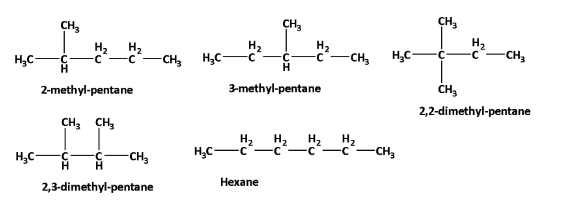
Write the structural formula of all the isomers of an alkane with six C-atoms \[({C_6}{H_{14}})\].
Answer
 Verified
283.5k+ views
Hint: The molecular formula is a way to write a substance using the chemical symbol and number subscripts to mention the number of the atoms into that chemical compound. On the other hand, a condensed formula is basically like the structural formula but here it is showing that all groups are attached with one single atom.
Complete step by step answer:
There are some compounds which have the same molecular formula but a different arrangement of atoms with different properties are known as isomers to each other.
There are different kinds of isomers. They are,
Constitutional isomers: which compounds are the same in the molecular formula but bonds are different in between the atoms is called constitutional isomers.
Stereoisomers: which compounds are the same in the molecular formula; bonds are the same in between the atoms but the relative positions of the groups are different; those compounds are called Stereoisomers.
In case \[{C_6}{H_{14}}\] there are a total of five constitutional isomers present but no stereoisomers are present.
Now the molecular formula of those isomers of hexane is \[{C_6}{H_{14}}\] . But the condensed isomers are different in each isomer, this is because the bonds between the atoms of the molecule are different in the isomers of hexane.
The structural formula of all five isomers of hexane with six C-atoms \[({C_6}{H_{14}})\] is,
2-methyl-pentane \[(C{H_3}CH(C{H_3})C{H_2}C{H_2}C{H_3})\] , 3-methyl-pentane \[(C{H_3}C{H_2}CH(C{H_3})C{H_2}C{H_3})\] , 2,2-dimethyl-butane \[(C{H_3}C{(C{H_3})_2}C{H_2}C{H_3})\] , 2,3-dimethyl-butane \[(C{H_3}CH(C{H_3})CH(C{H_3})C{H_3})\] , hexane\[(C{H_3}C{H_2}C{H_2}C{H_2}C{H_2}C{H_3})\] .
Structures are,
Note:
The empirical formula of any compound gives the lowest value of the ratio of the elements present in a molecule. But from this formula the actual number of the elements present in the molecule cannot be defined. . The molecular formula of a compound is with the actual number of the elements present in a compound. The relation between them is given by,\[{\text{ }}molecular{\text{ }}formula = {\left( {{\text{ }}emperical{\text{ }}formula} \right)_n}\].
Complete step by step answer:
There are some compounds which have the same molecular formula but a different arrangement of atoms with different properties are known as isomers to each other.
There are different kinds of isomers. They are,
Constitutional isomers: which compounds are the same in the molecular formula but bonds are different in between the atoms is called constitutional isomers.
Stereoisomers: which compounds are the same in the molecular formula; bonds are the same in between the atoms but the relative positions of the groups are different; those compounds are called Stereoisomers.
In case \[{C_6}{H_{14}}\] there are a total of five constitutional isomers present but no stereoisomers are present.
Now the molecular formula of those isomers of hexane is \[{C_6}{H_{14}}\] . But the condensed isomers are different in each isomer, this is because the bonds between the atoms of the molecule are different in the isomers of hexane.
The structural formula of all five isomers of hexane with six C-atoms \[({C_6}{H_{14}})\] is,
2-methyl-pentane \[(C{H_3}CH(C{H_3})C{H_2}C{H_2}C{H_3})\] , 3-methyl-pentane \[(C{H_3}C{H_2}CH(C{H_3})C{H_2}C{H_3})\] , 2,2-dimethyl-butane \[(C{H_3}C{(C{H_3})_2}C{H_2}C{H_3})\] , 2,3-dimethyl-butane \[(C{H_3}CH(C{H_3})CH(C{H_3})C{H_3})\] , hexane\[(C{H_3}C{H_2}C{H_2}C{H_2}C{H_2}C{H_3})\] .
Structures are,
Note:
The empirical formula of any compound gives the lowest value of the ratio of the elements present in a molecule. But from this formula the actual number of the elements present in the molecule cannot be defined. . The molecular formula of a compound is with the actual number of the elements present in a compound. The relation between them is given by,\[{\text{ }}molecular{\text{ }}formula = {\left( {{\text{ }}emperical{\text{ }}formula} \right)_n}\].
Recently Updated Pages
Disproportionation Reaction: Definition, Example & JEE Guide

JEE Main 2025-26 Mock Test: Binomial Theorem & Quick Practice
Properties of Solids and Liquids Mock Test 2025
JEE Main Mock Test 2025-26: Principles Related To Practical
JEE Main Mock Test 2025-26: Dual Nature of Matter & Radiation
JEE Main 2025-26 Work, Energy and Power Mock Test – Free Practice Online
Trending doubts
JEE Main 2026: Exam Dates, Session 2 Updates, City Slip, Admit Card & Latest News
Understanding the Electric Field of a Uniformly Charged Ring
Understanding Atomic Structure for Beginners
Derivation of Equation of Trajectory Explained for Students
Electron Gain Enthalpy and Electron Affinity Explained
How to Convert a Galvanometer into an Ammeter or Voltmeter
Other Pages
JEE Advanced Percentile vs Marks 2026: JEE Main Cutoff, AIR & IIT Admission Guide
JEE Advanced 2026 Notification Out with Exam Date, Registration (Extended), Syllabus and More
NCERT Solutions For Class 11 Chemistry In Hindi Chapter 1 Some Basic Concepts Of Chemistry - 2026-27
Understanding Electromagnetic Waves and Their Importance
Understanding Instantaneous Velocity
NCERT Solutions For Class 11 Chemistry Chapter 8 Organic Chemistry - Some Basic Principles And Techniques - 2026-27