




Which of the following metals is present in the green-colored pigment chlorophyll of plants?
A. Fe
B. Mg
C. Na
D. Al
Answer
 Verified
259.5k+ views
Hint: Chlorophyll is a green pigment present in the chloroplasts of algae and plants.It is one of the significant elements used in the process of photosynthesis. Photosynthesis is the process through which green plants and other organisms utilise sunlight to prepare nutrients from carbon dioxide and water.
Complete Step by Step Solution:
The colour of green plants is due to the chlorophyll pigment. Pyrrole is a five-membered heterocyclic aromatic organic compound containing a nitrogen atom.
The structure of pyrrole is as follows:
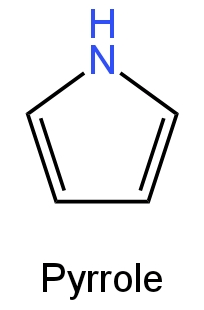
Image: Pyrrole
When four pyrrole subunits are connected through methine bridges, they form a union of heterocyclic organic compounds called porphyrins.
Methine is derived from methane and is a trivalent functional group.
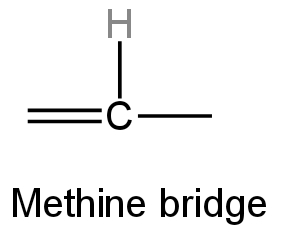
Image: Methine bridge
Metal complexes originating from porphyrins are formed naturally.
Heme, a pigment in red blood cells and also a cofactor of the protein haemoglobin, is one type of the porphyrin complex.
Chlorophyll also originates from porphyrin.
In chlorophyll, the four pyrrole units are attached by a central metal atom which is Magnesium.
Here the central magnesium atom is enclosed by a porphyrin ring which is attached to a long carbon-hydrogen side chain called a phytol chain.
So, option B is correct.
Additional Information: The word chlorophyll originates from the Greek word khloros which means green and phyllon which means leaves.
Chlorophyll is a green pigment that works as a photoreceptor in plants.
Note: Chlorophyll has a crucial part in photosynthesis as it enables the plants to absorb energy from the light given by the sun. This energy is later used to carry on the photosynthesis process. Magnesium is an important unit of chlorophyll. Chlorophyll is categorised into five types i.e., chlorophyll a, b, c, d, and d and e.
Complete Step by Step Solution:
The colour of green plants is due to the chlorophyll pigment. Pyrrole is a five-membered heterocyclic aromatic organic compound containing a nitrogen atom.
The structure of pyrrole is as follows:
Image: Pyrrole
When four pyrrole subunits are connected through methine bridges, they form a union of heterocyclic organic compounds called porphyrins.
Methine is derived from methane and is a trivalent functional group.
Image: Methine bridge
Metal complexes originating from porphyrins are formed naturally.
Heme, a pigment in red blood cells and also a cofactor of the protein haemoglobin, is one type of the porphyrin complex.
Chlorophyll also originates from porphyrin.
In chlorophyll, the four pyrrole units are attached by a central metal atom which is Magnesium.
Here the central magnesium atom is enclosed by a porphyrin ring which is attached to a long carbon-hydrogen side chain called a phytol chain.
So, option B is correct.
Additional Information: The word chlorophyll originates from the Greek word khloros which means green and phyllon which means leaves.
Chlorophyll is a green pigment that works as a photoreceptor in plants.
Note: Chlorophyll has a crucial part in photosynthesis as it enables the plants to absorb energy from the light given by the sun. This energy is later used to carry on the photosynthesis process. Magnesium is an important unit of chlorophyll. Chlorophyll is categorised into five types i.e., chlorophyll a, b, c, d, and d and e.
Recently Updated Pages
Disproportionation Reaction: Definition, Example & JEE Guide

Hess Law of Constant Heat Summation: Definition, Formula & Applications
JEE General Topics in Chemistry Important Concepts and Tips
JEE Extractive Metallurgy Important Concepts and Tips for Exam Preparation
JEE Atomic Structure and Chemical Bonding important Concepts and Tips
JEE Amino Acids and Peptides Important Concepts and Tips for Exam Preparation
Trending doubts
JEE Main 2026: Exam Dates, Session 2 Updates, City Slip, Admit Card & Latest News
JEE Main Participating Colleges 2026 - A Complete List of Top Colleges
JEE Main Marking Scheme 2026- Paper-Wise Marks Distribution and Negative Marking Details
Hybridisation in Chemistry – Concept, Types & Applications
Understanding the Electric Field of a Uniformly Charged Ring
Understanding the Different Types of Solutions in Chemistry
Other Pages
JEE Advanced 2026 - Exam Date (Released), Syllabus, Registration, Eligibility, Preparation, and More
JEE Advanced Marks vs Ranks 2025: Understanding Category-wise Qualifying Marks and Previous Year Cut-offs
CBSE Notes Class 11 Chemistry Chapter 5 - Thermodynamics - 2025-26
JEE Advanced Weightage 2025 Chapter-Wise for Physics, Maths and Chemistry
Derivation of Equation of Trajectory Explained for Students
Understanding Atomic Structure for Beginners