




The value of ‘g’ on the surface of the earth is
A. Maximum at poles
B. Maximum at equator
C. Same everywhere
D. Minimum at poles
Answer
 Verified
272.4k+ views
Hint: Solution can be found by observing the gravitational attraction formula, where gravitational force is inversely proportional to the distance from the center of the earth. Thus, extending it to the concept that Earth is not a perfect sphere and the distance of poles and the equator is different from the center of earth.
Complete step-by-step answer:
Gravitational attractive force felt by a body on the earth’s surface is given as;
$\overset{\to }{\mathop{F}}\,=\dfrac{GMm}{{{r}^{2}}}$
G is the gravitational constant
r is the distance from the earth’s center
M is the mass of the earth
M is the mass of the body.
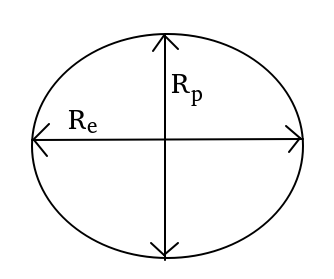
We can observe from the above image that earth is not a perfect sphere. It is slightly bulged at the equator, and flattened at the poles. Thus, from the above diagram we can observe that;
$R_e > R_p$
where, $R_e$ is the diameter at the equator, $R_p$ is the diameter at the poles
We know from the gravitational attraction and thus the acceleration due to gravity ‘g’ becomes:
$\begin{align}
& g=\dfrac{GM}{{{r}^{2}}} \\
& \Rightarrow g\propto \dfrac{1}{{{r}^{2}}} \\
\end{align}$
Thus, for poles:
${{g}_{p}}\propto \dfrac{1}{R_{p}^{2}}$
Thus, for equator:
${{g}_{p}}\propto \dfrac{1}{R_{e}^{2}}$
So, since ${{R}_{e}}>{{R}_{p}},{{g}_{e}}$ will be less than ${{g}_{p}}$. That is, gravitational force and the ‘g’ will be maximum at the poles.
Therefore, the correct answer to this question is option A. That is ‘g’ is maximum at poles.
Note: The gravitational force is an attractive force that is, it always attracts and never repels. It never pushes two masses further, only a pulling force is generated. The ‘g’ is the acceleration of gravity and is equal to $9.8m/{{s}^{2}}$ at Earth surface, i.e., at sea level.
Complete step-by-step answer:
Gravitational attractive force felt by a body on the earth’s surface is given as;
$\overset{\to }{\mathop{F}}\,=\dfrac{GMm}{{{r}^{2}}}$
G is the gravitational constant
r is the distance from the earth’s center
M is the mass of the earth
M is the mass of the body.
We can observe from the above image that earth is not a perfect sphere. It is slightly bulged at the equator, and flattened at the poles. Thus, from the above diagram we can observe that;
$R_e > R_p$
where, $R_e$ is the diameter at the equator, $R_p$ is the diameter at the poles
We know from the gravitational attraction and thus the acceleration due to gravity ‘g’ becomes:
$\begin{align}
& g=\dfrac{GM}{{{r}^{2}}} \\
& \Rightarrow g\propto \dfrac{1}{{{r}^{2}}} \\
\end{align}$
Thus, for poles:
${{g}_{p}}\propto \dfrac{1}{R_{p}^{2}}$
Thus, for equator:
${{g}_{p}}\propto \dfrac{1}{R_{e}^{2}}$
So, since ${{R}_{e}}>{{R}_{p}},{{g}_{e}}$ will be less than ${{g}_{p}}$. That is, gravitational force and the ‘g’ will be maximum at the poles.
Therefore, the correct answer to this question is option A. That is ‘g’ is maximum at poles.
Note: The gravitational force is an attractive force that is, it always attracts and never repels. It never pushes two masses further, only a pulling force is generated. The ‘g’ is the acceleration of gravity and is equal to $9.8m/{{s}^{2}}$ at Earth surface, i.e., at sea level.
Recently Updated Pages
WBJEE 2026 Result Live: Important Dates, Last Date Apply Online 2026

Circuit Switching vs Packet Switching: Key Differences Explained
Dimensions of Pressure in Physics: Formula, Derivation & SI Unit
JEE General Topics in Chemistry Important Concepts and Tips
JEE Extractive Metallurgy Important Concepts and Tips for Exam Preparation
JEE Atomic Structure and Chemical Bonding important Concepts and Tips
Trending doubts
JEE Main 2026: Exam Dates, Session 2 Updates, City Slip, Admit Card & Latest News
JEE Main Participating Colleges 2026 - A Complete List of Top Colleges
Understanding the Electric Field of a Uniformly Charged Ring
Understanding Atomic Structure for Beginners
Derivation of Equation of Trajectory Explained for Students
How to Convert a Galvanometer into an Ammeter or Voltmeter
Other Pages
JEE Advanced 2026 Notification Out with Exam Date, Registration (Extended), Syllabus and More
JEE Advanced Percentile vs Marks 2026: JEE Main Cutoff, AIR & IIT Admission Guide
CBSE Notes Class 11 Physics Chapter 1 - Units And Measurements - 2026-27
NCERT Solutions For Class 11 Physics Chapter 1 Units And Measurements - 2025-26
Important Questions For Class 11 Physics Chapter 1 Units and Measurement - 2025-26
JEE Advanced Weightage Chapter Wise 2026 for Physics, Chemistry, and Mathematics