




The system shown is just on the verge of slipping. The coefficient of static friction between the block and the tabletop is
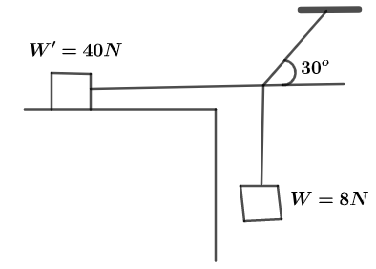
(A) $0.5$
(B) $0.95$
(C) $0.15$
(D) $0.35$
Answer
 Verified
265.2k+ views
Hint: In order to solve this question, we will first draw the free diagram with all the forces acting on the blocks and string of the system and then by applying the forces equilibrium condition, we will solve for the coefficient of static friction between the block and tabletop.
Complete answer:
Let us first draw the free diagram of the system with all the forces acting on the system as
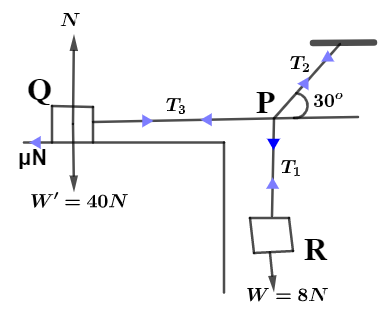
where, N is the normal force for block Q, ${T_1},{T_2},{T_3}$ be the Tension force acting on the strings and $\mu N$ be the static frictional force between block Q and tabletop. Now,
For equilibrium of block R we have,
${T_1} = W = 8N$
Equilibrium at point P, the vertical component of ${T_2}$ is equal to ${T_1}$ so, we have
${T_2}\sin {30^o} = {T_1}$
on putting the values, we get
$
{T_2}\dfrac{1}{2} = 8 \\
{T_2} = 16N \\
$
Now, the horizontal component of ${T_2}$ is equal to ${T_3}$ so, equilibrium for block Q is
${T_2}\cos {30^o} = {T_3}$
on putting the values, we get
$
(16)\dfrac{{\sqrt 3 }}{2} = {T_3} \\
{T_3} = 8\sqrt 3 N \\
$
Now, normal reaction force on block Q is $N = W' = 40N$ and the static frictional force is balanced by the tension ${T_3} = \mu N$
so, on putting the values we get
$
8\sqrt 3 = \mu (40) \\
\mu = \dfrac{{\sqrt 3 }}{5} \\
\mu = 0.35 \\
$
So, the coefficient of static friction between tabletop and block is $\mu = 0.35$
Hence, the correct answer is option (D) $0.35$
Note: It should be remembered that, basic trigonometric values must be known which are used here as
$
\sin {30^o} = \dfrac{1}{2} \\
\cos {30^o} = \dfrac{{\sqrt 3 }}{2} \\
$
And always draw the free diagram with all necessary forces acting on the system with their direction to solve such problems.
Complete answer:
Let us first draw the free diagram of the system with all the forces acting on the system as
where, N is the normal force for block Q, ${T_1},{T_2},{T_3}$ be the Tension force acting on the strings and $\mu N$ be the static frictional force between block Q and tabletop. Now,
For equilibrium of block R we have,
${T_1} = W = 8N$
Equilibrium at point P, the vertical component of ${T_2}$ is equal to ${T_1}$ so, we have
${T_2}\sin {30^o} = {T_1}$
on putting the values, we get
$
{T_2}\dfrac{1}{2} = 8 \\
{T_2} = 16N \\
$
Now, the horizontal component of ${T_2}$ is equal to ${T_3}$ so, equilibrium for block Q is
${T_2}\cos {30^o} = {T_3}$
on putting the values, we get
$
(16)\dfrac{{\sqrt 3 }}{2} = {T_3} \\
{T_3} = 8\sqrt 3 N \\
$
Now, normal reaction force on block Q is $N = W' = 40N$ and the static frictional force is balanced by the tension ${T_3} = \mu N$
so, on putting the values we get
$
8\sqrt 3 = \mu (40) \\
\mu = \dfrac{{\sqrt 3 }}{5} \\
\mu = 0.35 \\
$
So, the coefficient of static friction between tabletop and block is $\mu = 0.35$
Hence, the correct answer is option (D) $0.35$
Note: It should be remembered that, basic trigonometric values must be known which are used here as
$
\sin {30^o} = \dfrac{1}{2} \\
\cos {30^o} = \dfrac{{\sqrt 3 }}{2} \\
$
And always draw the free diagram with all necessary forces acting on the system with their direction to solve such problems.
Recently Updated Pages
JEE Main Mock Test 2025-26: Principles Related To Practical

JEE Main 2025-26 Experimental Skills Mock Test – Free Practice
JEE Main 2025-26 Electronic Devices Mock Test: Free Practice Online
JEE Main 2025-26 Mock Tests: Free Practice Papers & Solutions
JEE Main 2025-26: Magnetic Effects of Current & Magnetism Mock Test
JEE Main Statistics and Probability Mock Test 2025-26
Trending doubts
JEE Main 2026: Exam Dates, Session 2 Updates, City Slip, Admit Card & Latest News
JEE Main Participating Colleges 2026 - A Complete List of Top Colleges
Hybridisation in Chemistry – Concept, Types & Applications
Understanding the Electric Field of a Uniformly Charged Ring
Derivation of Equation of Trajectory Explained for Students
Understanding Atomic Structure for Beginners
Other Pages
JEE Advanced 2026 Notification Out with Exam Date, Registration (Extended), Syllabus and More
JEE Advanced Percentile vs Marks 2026: JEE Main Cutoff, AIR & IIT Admission Guide
CBSE Notes Class 11 Physics Chapter 1 - Units And Measurements - 2025-26
JEE Advanced Marks vs Rank 2025 - Predict Your IIT Rank Based on Score
NCERT Solutions For Class 11 Physics Chapter 1 Units And Measurements - 2025-26
Important Questions For Class 11 Physics Chapter 1 Units and Measurement - 2025-26