




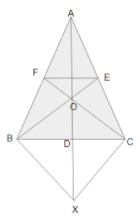
The side \[{\text{BC}}\] of a triangle \[{\text{ABC}}\] is bisected at \[{\text{D}}\]; \[{\text{O}}\] is any point in \[{\text{AD}}\]. \[{\text{BO}}\] and \[{\text{CO}}\] produced to meet \[{\text{AC}}\] and \[{\text{AB}}\] in \[{\text{E}}\] and \[{\text{F}}\] respectively and \[{\text{AD}}\] is produced to \[{\text{X}}\] so that \[{\text{D}}\] is the midpoint of \[{\text{OX}}\]. Prove that \[{\text{AO:AX = AF:AB}}\] and show that \[{\text{EF}}\] is parallel to \[{\text{BC}}\].
Answer
 Verified
268.5k+ views
Hint— The quadrilateral \[{\text{BOCX}}\] represents a parallelogram as the diagonals \[{\text{OX}}\] and \[{\text{BC}}\] intersects each other. So use the definition of a parallelogram which states that the opposite sides of a parallelogram are parallel to each other as \[{\text{D}}\] is the midpoint of the line \[{\text{BC}}\] which divides the line into two parts equally.
Complete step-by-step solution
We are given in the question that the side \[{\text{BC}}\] of a triangle \[{\text{ABC}}\] is bisected at \[{\text{D}}\]; \[{\text{O}}\] is any point in \[{\text{AD}}\]. \[{\text{BO}}\] and \[{\text{CO}}\] are produced to meet \[{\text{AC}}\] and \[{\text{AB}}\] in \[{\text{E}}\] and \[{\text{F}}\] respectively and \[{\text{AD}}\] is produced to \[{\text{X}}\] so that \[{\text{D}}\] is the midpoint of \[{\text{OX}}\].
There are two objectives that need to be fulfilled. First is to prove that \[{\text{AO:AX = AF:AB}}\] and secondly we need to show that \[{\text{EF}}\] is parallel to \[{\text{BC}}\].
Consider the first objective,
As from the figure it is clear that, in a quadrilateral \[{\text{BOCX}}\] \[{\text{BD = DC}}\] and \[{\text{DO = DX}}\] as \[{\text{D}}\] is the midpoint of the line \[{\text{BC}}\] and \[{\text{OX}}\].
Since, the diagonals \[{\text{OX}}\] and \[{\text{BC}}\] of a quadrilateral \[{\text{BOCX}}\] intersects each other at \[{\text{D}}\].
Therefore, the quadrilateral \[{\text{BOCX}}\] becomes the parallelogram \[{\text{BOCX}}\].
Further, use the definition of parallelogram, which states that the opposite sides of a parallelogram are parallel to each other.
Thus, we get that,
\[{\text{BX||CO}}\] and \[{\text{CX||BO}}\]
Or \[{\text{BX||CF}}\] and \[{\text{CX||BE}}\]
Or \[{\text{BX||OF}}\] and \[{\text{CX||OE}}\]
Now, since \[{\text{BX||OF}}\] in the \[\Delta {\text{ABX}}\],
We get, \[\dfrac{{{\text{AO}}}}{{{\text{AX}}}} = \dfrac{{{\text{AF}}}}{{{\text{AB}}}}\]
Thus, from equation (1) we can conclude that \[{\text{AO:AX = AF:AB}}\]
Consider the second objective,
From above solution we have, \[\dfrac{{{\text{AO}}}}{{{\text{AX}}}} = \dfrac{{{\text{AF}}}}{{{\text{AB}}}}\] ---(1)
Next, we have \[{\text{CX||OE}}\] in the \[\Delta {\text{ACX}}\],
Thus, we get, \[\dfrac{{{\text{AO}}}}{{{\text{AX}}}} = \dfrac{{{\text{AE}}}}{{{\text{AC}}}}\] ---(2)
Consider the equations (1) and (2),
We get that,
\[\dfrac{{{\text{AF}}}}{{{\text{AB}}}} = \dfrac{{{\text{AE}}}}{{{\text{AC}}}}\]
Thus, we can conclude that as the points \[{\text{E}}\] and \[{\text{F}}\] divides the lines \[{\text{AB}}\] and \[{\text{AC}}\] respectively in the same ratio, so, \[{\text{FE||BC}}\].
Note: Do not forget to use the fact that as the diagonals of a quadrilateral bisect each other then the quadrilateral becomes the parallelogram and as the lines are parallel to each other, we can determine the ratio between the lines as the particular point cuts them. The midpoint divides the line into exactly two parts and both the parts are of equal length. When the points divide the lines in the same ratio then the lines are parallel to each other as shown.
Complete step-by-step solution
We are given in the question that the side \[{\text{BC}}\] of a triangle \[{\text{ABC}}\] is bisected at \[{\text{D}}\]; \[{\text{O}}\] is any point in \[{\text{AD}}\]. \[{\text{BO}}\] and \[{\text{CO}}\] are produced to meet \[{\text{AC}}\] and \[{\text{AB}}\] in \[{\text{E}}\] and \[{\text{F}}\] respectively and \[{\text{AD}}\] is produced to \[{\text{X}}\] so that \[{\text{D}}\] is the midpoint of \[{\text{OX}}\].
There are two objectives that need to be fulfilled. First is to prove that \[{\text{AO:AX = AF:AB}}\] and secondly we need to show that \[{\text{EF}}\] is parallel to \[{\text{BC}}\].
Consider the first objective,
As from the figure it is clear that, in a quadrilateral \[{\text{BOCX}}\] \[{\text{BD = DC}}\] and \[{\text{DO = DX}}\] as \[{\text{D}}\] is the midpoint of the line \[{\text{BC}}\] and \[{\text{OX}}\].
Since, the diagonals \[{\text{OX}}\] and \[{\text{BC}}\] of a quadrilateral \[{\text{BOCX}}\] intersects each other at \[{\text{D}}\].
Therefore, the quadrilateral \[{\text{BOCX}}\] becomes the parallelogram \[{\text{BOCX}}\].
Further, use the definition of parallelogram, which states that the opposite sides of a parallelogram are parallel to each other.
Thus, we get that,
\[{\text{BX||CO}}\] and \[{\text{CX||BO}}\]
Or \[{\text{BX||CF}}\] and \[{\text{CX||BE}}\]
Or \[{\text{BX||OF}}\] and \[{\text{CX||OE}}\]
Now, since \[{\text{BX||OF}}\] in the \[\Delta {\text{ABX}}\],
We get, \[\dfrac{{{\text{AO}}}}{{{\text{AX}}}} = \dfrac{{{\text{AF}}}}{{{\text{AB}}}}\]
Thus, from equation (1) we can conclude that \[{\text{AO:AX = AF:AB}}\]
Consider the second objective,
From above solution we have, \[\dfrac{{{\text{AO}}}}{{{\text{AX}}}} = \dfrac{{{\text{AF}}}}{{{\text{AB}}}}\] ---(1)
Next, we have \[{\text{CX||OE}}\] in the \[\Delta {\text{ACX}}\],
Thus, we get, \[\dfrac{{{\text{AO}}}}{{{\text{AX}}}} = \dfrac{{{\text{AE}}}}{{{\text{AC}}}}\] ---(2)
Consider the equations (1) and (2),
We get that,
\[\dfrac{{{\text{AF}}}}{{{\text{AB}}}} = \dfrac{{{\text{AE}}}}{{{\text{AC}}}}\]
Thus, we can conclude that as the points \[{\text{E}}\] and \[{\text{F}}\] divides the lines \[{\text{AB}}\] and \[{\text{AC}}\] respectively in the same ratio, so, \[{\text{FE||BC}}\].
Note: Do not forget to use the fact that as the diagonals of a quadrilateral bisect each other then the quadrilateral becomes the parallelogram and as the lines are parallel to each other, we can determine the ratio between the lines as the particular point cuts them. The midpoint divides the line into exactly two parts and both the parts are of equal length. When the points divide the lines in the same ratio then the lines are parallel to each other as shown.
Recently Updated Pages
Area vs Volume: Key Differences Explained for Students

Mutually Exclusive vs Independent Events: Key Differences Explained
JoSAA Counselling 2026 TODAY: Registration, Choice Filling and Ranks
JEE Main 2024 (January 25 Shift 1) Chemistry Question Paper with Solutions [PDF]
Differential Calculus: Concepts, Rules & Applications Explained
Torque and Rotational Motion Explained: Physics Made Simple
Trending doubts
JEE Main Marks vs Percentile 2026: Predict Your Score Easily
JEE Main Cutoff 2026: Category-wise Qualifying Percentile
JEE Main 2026: Exam Dates, Session 2 Updates, City Slip, Admit Card & Latest News
JEE Main Marks vs Rank 2026: Expected Rank for 300 to 0 Marks
NIT Cutoff 2026: Tier-Wise Opening and Closing Ranks for B.Tech. Admission
JEE Mains 2026 Subject Wise Percentile Explained
Other Pages
CBSE Class 10 Maths Question Paper 2026 OUT Download PDF with Solutions
Complete List of Class 10 Maths Formulas (Chapterwise)
NCERT Solutions For Class 10 Maths Chapter 11 Areas Related To Circles - 2025-26
All Mensuration Formulas with Examples and Quick Revision
NCERT Solutions For Class 10 Maths Chapter 13 Statistics - 2025-26
NCERT Solutions For Class 10 Maths Chapter 14 Probability - 2025-26