




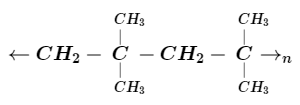
The monomer unit of the given polymer is :
A. 
B. 
C. 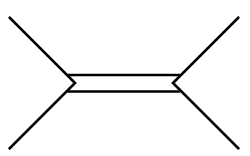
D. 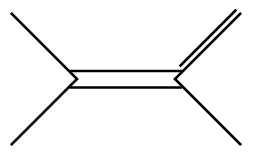
Answer
 Verified
284.1k+ views
Hint : We know that a repeating unit produces the complete polymer or we can say that the polymers are formed by the repetition of a specific unit. These units are called basic units of polymer. A monomer reacts with another monomer to form a larger polymer. Polymers are composed of multiples of simpler units known as monomers.
Complete step by step solution:
We can identify monomer units in any polymer because these monomer units are the building block of the polymer. Here in the problem we are given a section of polymer and asked to identify the monomer so to solve this problem we need to pick a point and then look across and check when the next repetition point came. By doing this trick we will get a repeating unit of the polymer. On observing the given structure we come to know that the repeating unit is $ - C{H_2}C{(C{H_3})_2} - $ which is known as isobutylene. In isobutylene double bond breaks and another molecule of isobutylene attached to it hence the chain continues. So here option A is the correct answer to this problem because it is the structural representation of isobutylene$(2 - $ methylpropene) which is a colourless flammable gas.
Note : We know that polymers are very useful in our daily life. Polymer formation exactly takes place by bonding of carbon atoms one to the next into a long chain. These long chains are called the backbone of polymers. Polymers used to be very resistant to chemicals. They act as thermal and electrical insulators. They had a broad range of uses in industries also.
Complete step by step solution:
We can identify monomer units in any polymer because these monomer units are the building block of the polymer. Here in the problem we are given a section of polymer and asked to identify the monomer so to solve this problem we need to pick a point and then look across and check when the next repetition point came. By doing this trick we will get a repeating unit of the polymer. On observing the given structure we come to know that the repeating unit is $ - C{H_2}C{(C{H_3})_2} - $ which is known as isobutylene. In isobutylene double bond breaks and another molecule of isobutylene attached to it hence the chain continues. So here option A is the correct answer to this problem because it is the structural representation of isobutylene$(2 - $ methylpropene) which is a colourless flammable gas.
Note : We know that polymers are very useful in our daily life. Polymer formation exactly takes place by bonding of carbon atoms one to the next into a long chain. These long chains are called the backbone of polymers. Polymers used to be very resistant to chemicals. They act as thermal and electrical insulators. They had a broad range of uses in industries also.
Recently Updated Pages
JEE Main Mock Test 2025-26: Principles Related To Practical

JEE Main 2025 Organic Compounds Containing Oxygen Mock Test
JEE Main 2025-26 Organic Compounds Containing Oxygen Mock Test
JEE Main 2025-26 Mock Test: Purification & Characterisation of Organic Compounds
JEE Main 2025-26 Mock Test: Principles Related To Practical
JEE Main Mock Test 2025-26: Free Practice & Solutions
Trending doubts
JEE Main 2026: Exam Dates, Session 2 Updates, City Slip, Admit Card & Latest News
Understanding the Electric Field of a Uniformly Charged Ring
Understanding Atomic Structure for Beginners
Derivation of Equation of Trajectory Explained for Students
Electron Gain Enthalpy and Electron Affinity Explained
How to Convert a Galvanometer into an Ammeter or Voltmeter
Other Pages
JEE Advanced Percentile vs Marks 2026: JEE Main Cutoff, AIR & IIT Admission Guide
NCERT Solutions For Class 12 Chemistry Chapter 2 Electrochemistry - 2026-27
NCERT Solutions For Class 12 Chemistry Chapter 1 Solutions - 2026-27 Free PDF Download (Sign-in Required)
NCERT Solutions For Class 12 Chemistry Chapter 3 Chemical Kinetics - 2026-27
CBSE Notes Class 12 Chemistry Chapter 1 - Solutions - 2026-27
NCERT Solutions For Class 12 Chemistry Chapter 6 Haloalkanes And Haloarenes - 2026-27 PDF Download (Login Required)