




The lengths of the sides of a triangle is \[{\text{5 }}m\], \[1.2\] decameter and \[130{\text{ }}dm\]. Then its area is _______.
A. \[24{\text{ }}{m^2}\]
B. \[30{\text{ }}{m^2}\]
C. \[48{\text{ }}{m^2}\]
D. \[40{\text{ }}{m^2}\]
Answer
 Verified
266.7k+ views
Hint: First of all, convert the lengths of sides of the triangle in meters. Now, use the formula, area of triangle \[ = \dfrac{1}{2} \times b \times h\] where \[b\] is the base of triangle and \[h\] is the height of the triangle in meters.
Complete step-by-step solution
Here, we have to find the area of the triangle having lengths of sides equal to 5m, \[1.2\] decameter and \[130{\text{ }}dm\].
We know that 1 decameter is \[10{\text{ }}m\] and \[{\text{1 }}dm = 0.1{\text{ }}m\]. Therefore, \[1.2\] decameter \[ = 1.2 \times 10 = 12{\text{ }}m\] and \[130{\text{ }}dm = 130 \times 0.1 = 13{\text{ }}m\].
So, the lengths of sides of the triangle in meters are \[{\text{5 }}m\], \[{\text{12 }}m\] and \[{\text{13 }}m\]. Let AB is \[{\text{5 }}m\], BC is \[{\text{12 }}m\] and CA is \[{\text{13 }}m\]. Then we can say that this triangle is a right-angled triangle because\[A{B^2} + B{C^2} = A{C^2}\].
\[
A{B^2} + B{C^2} = A{C^2} \\
{\left( 5 \right)^2} + {\left( {12} \right)^2} = {\left( {13} \right)^2} \\
25 + 144 = 169 \\
169 = 169 \\
\]
We know that the area of the triangle \[ = \dfrac{1}{2} \times b \times h\]…..(i) where \[b\] is the base of the triangle and \[h\] is the height of the triangle.
As we know that in a right angled triangle, the side with maximum length is hypotenuse. Therefore, CA is the hypotenuse of the triangle. We can take AB to be the height of the triangle and BC to be the base of the triangle.
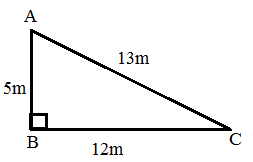
Height of the triangle \[h\] is \[{\text{5 }}m\].
Base of the triangle \[b\] is \[{\text{12 }}m\].
So, by substituting the value of \[h = {\text{5 }}m\]and \[b = {\text{12 }}m\] in equation (i), we get, area of triangle \[ = \dfrac{1}{2} \times b \times h\]
\[
= \dfrac{1}{2} \times 12 \times 5 \\
= 6 \times 5 \\
= 30{\text{ }}{m^2} \\
\]
So, we get the area of the triangle \[ = 30{m^2}\].
Therefore, the correct option is B.
Note: In this question, first of all, note that the units of length are different for all the sides. While calculating the area of a triangle all the length should be in the same unit. Also, identify the type of triangle before applying any formula because different types of triangles have different formulas to find area.
Complete step-by-step solution
Here, we have to find the area of the triangle having lengths of sides equal to 5m, \[1.2\] decameter and \[130{\text{ }}dm\].
We know that 1 decameter is \[10{\text{ }}m\] and \[{\text{1 }}dm = 0.1{\text{ }}m\]. Therefore, \[1.2\] decameter \[ = 1.2 \times 10 = 12{\text{ }}m\] and \[130{\text{ }}dm = 130 \times 0.1 = 13{\text{ }}m\].
So, the lengths of sides of the triangle in meters are \[{\text{5 }}m\], \[{\text{12 }}m\] and \[{\text{13 }}m\]. Let AB is \[{\text{5 }}m\], BC is \[{\text{12 }}m\] and CA is \[{\text{13 }}m\]. Then we can say that this triangle is a right-angled triangle because\[A{B^2} + B{C^2} = A{C^2}\].
\[
A{B^2} + B{C^2} = A{C^2} \\
{\left( 5 \right)^2} + {\left( {12} \right)^2} = {\left( {13} \right)^2} \\
25 + 144 = 169 \\
169 = 169 \\
\]
We know that the area of the triangle \[ = \dfrac{1}{2} \times b \times h\]…..(i) where \[b\] is the base of the triangle and \[h\] is the height of the triangle.
As we know that in a right angled triangle, the side with maximum length is hypotenuse. Therefore, CA is the hypotenuse of the triangle. We can take AB to be the height of the triangle and BC to be the base of the triangle.
Height of the triangle \[h\] is \[{\text{5 }}m\].
Base of the triangle \[b\] is \[{\text{12 }}m\].
So, by substituting the value of \[h = {\text{5 }}m\]and \[b = {\text{12 }}m\] in equation (i), we get, area of triangle \[ = \dfrac{1}{2} \times b \times h\]
\[
= \dfrac{1}{2} \times 12 \times 5 \\
= 6 \times 5 \\
= 30{\text{ }}{m^2} \\
\]
So, we get the area of the triangle \[ = 30{m^2}\].
Therefore, the correct option is B.
Note: In this question, first of all, note that the units of length are different for all the sides. While calculating the area of a triangle all the length should be in the same unit. Also, identify the type of triangle before applying any formula because different types of triangles have different formulas to find area.
Recently Updated Pages
Mutually Exclusive vs Independent Events: Key Differences Explained

Area vs Volume: Key Differences Explained for Students
Carbon Disulfide Formula - Properties, Molecular Formula and FAQs
Force vs Pressure: Key Differences Explained Simply
Basic Math Formulas: Essential Guide for Students
Exploring | What is Pure Substance and Mixture
Trending doubts
JEE Main Marks vs Percentile 2026: Predict Your Score Easily
JEE Main Cutoff 2026: Category-wise Qualifying Percentile
JEE Main 2026: Exam Dates, Session 2 Updates, City Slip, Admit Card & Latest News
JEE Main Marks vs Rank 2026: Expected Rank for 300 to 0 Marks
NIT Cutoff 2026: Tier-Wise Opening and Closing Ranks for B.Tech. Admission
JEE Mains 2026 Subject Wise Percentile Explained
Other Pages
CBSE Class 10 Maths Question Paper 2026 OUT Download PDF with Solutions
Complete List of Class 10 Maths Formulas (Chapterwise)
NCERT Solutions For Class 10 Maths Chapter 11 Areas Related To Circles - 2025-26
All Mensuration Formulas with Examples and Quick Revision
NCERT Solutions For Class 10 Maths Chapter 13 Statistics - 2025-26
NCERT Solutions For Class 10 Maths Chapter 14 Probability - 2025-26