




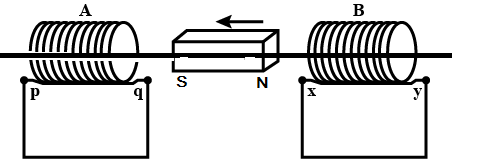
The direction of induced current in the coils A and B in the situation shown in the figure is then:
A) p to q in coil A and x to y in coil B
B) q to p in coil A and x to y in coil B
C) p to q in coil A and y to x in coil B
D) q to p in coil A and y to x in coil B
Answer
 Verified
258.6k+ views
Hint: A current can be induced in a current loop if it is exposed to a changing magnetic field. Induced current always opposes the cause of it according to Lenz's law.
Complete step by step solution: The direction of the current can be determined by considering Lenz's law, which states that an induced electric current will flow in such a way that it creates a magnetic field that resists change in the field it produces. In other words, if the applied magnetic field continues to increase, the current flowing in the wire will flow in such a way that the magnetic field generated around the wire will decrease the applied magnetic field.
Here in the given figure In coil A, the south pole develops in Q and in coil B also the south pole develops in X. Thus, the current flowing in coil A will be from Q to P and the current flowing in coil B will be from x to y.
Additional Information: In 1831, Michael Faraday conducted several experiments in an attempt to prove that electricity could be produced by magnetism. Within a few weeks, the great experimenter not only explicitly demonstrated this phenomenon, now known as electromagnetic induction.
Note: A current can be induced in conducting loop,If it comes in contact with a changed magnetic field, This change can happen in a variety of ways; You can change the strength of the magnetic field, move the conductor in and out of the field, change the distance between the magnet and the conductor, or change the field of the loop located in a constant magnetic field. Considering how the variant is obtained, the result, the transmitted current, is the same.
Complete step by step solution: The direction of the current can be determined by considering Lenz's law, which states that an induced electric current will flow in such a way that it creates a magnetic field that resists change in the field it produces. In other words, if the applied magnetic field continues to increase, the current flowing in the wire will flow in such a way that the magnetic field generated around the wire will decrease the applied magnetic field.
Here in the given figure In coil A, the south pole develops in Q and in coil B also the south pole develops in X. Thus, the current flowing in coil A will be from Q to P and the current flowing in coil B will be from x to y.
Additional Information: In 1831, Michael Faraday conducted several experiments in an attempt to prove that electricity could be produced by magnetism. Within a few weeks, the great experimenter not only explicitly demonstrated this phenomenon, now known as electromagnetic induction.
Note: A current can be induced in conducting loop,If it comes in contact with a changed magnetic field, This change can happen in a variety of ways; You can change the strength of the magnetic field, move the conductor in and out of the field, change the distance between the magnet and the conductor, or change the field of the loop located in a constant magnetic field. Considering how the variant is obtained, the result, the transmitted current, is the same.
Recently Updated Pages
JEE Main Mock Test 2025-26: Electromagnetic Induction & Alternating Currents

JEE Main Mock Test 2025-26: Optics Chapter Practice Online
JEE Main 2025-26 Mock Test: Properties of Solids and Liquids
JEE Main Mock Test 2025-26: Dual Nature of Matter & Radiation
JEE Main 2025-26 Electromagnetic Waves Mock Test with Solutions
JEE Main 2025-26 Mock Test: Electronic Devices Chapter Practice
Trending doubts
JEE Main Marking Scheme 2026- Paper-Wise Marks Distribution and Negative Marking Details
Hybridisation in Chemistry – Concept, Types & Applications
Understanding Electromagnetic Waves and Their Importance
Electron Gain Enthalpy and Electron Affinity Explained
Ideal and Non-Ideal Solutions Explained for Class 12 Chemistry
What Are Alpha, Beta, and Gamma Decay in Nuclear Physics?
Other Pages
JEE Advanced Marks vs Rank 2025 - Predict Your IIT Rank Based on Score
Understanding the Electric Field Due to Infinite Linear Charge and Cylinders
Understanding Average and RMS Value in Electrical Circuits
Understanding Displacement and Velocity Time Graphs
Understanding Electric Flux and Area Vector in Physics
A point charge is placed at the corner of a cube The class 12 physics JEE_Main