




The angles of elevation of a cliff at a point A on the ground and a point B 100 m vertically above are \[60^\circ \] and \[30^\circ \] respectively. The height of cliff is
A. \[100\sqrt 3 {\text{ m}}\]
B. \[150\sqrt 3 {\text{ m}}\]
C. \[150{\text{ m}}\]
D. \[\dfrac{{200}}{{\sqrt 3 }}{\text{ m}}\]
Answer
 Verified
232.8k+ views
Hint: Here, we will first draw the triangle using the given condition to simplify the calculation. Then use the tangential property, that is, \[\tan {\text{A}} = \dfrac{p}{b}\], where \[p\] is the perpendicular and \[b\] is the base. Apply this property, and then use the given conditions to find the required value.
Complete step by step answer
Given that the angles of elevation of a chiff at a point A on the ground and a point B 100 m vertically above are \[60^\circ \] and \[30^\circ \] respectively.
Let us assume that the height of the tower DC is \[h\] and the length AC and BE is \[x\].
First, we will draw the triangle using the given conditions.
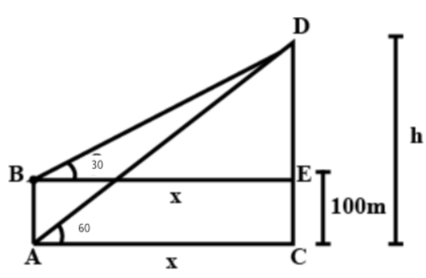
We will first take the triangle \[\Delta {\text{ACD}}\],
We will use the tangential property, that is, \[\tan {\text{A}} = \dfrac{p}{b}\], where \[p\] is the perpendicular and \[b\] is the base.
Using the above tangential property, we get
\[\tan 60^\circ = \dfrac{{{\text{DC}}}}{{{\text{AC}}}}\]
Substituting the values of the length AC and DC in the above equation, we get
\[
\tan 60^\circ = \dfrac{h}{x} \\
\sqrt 3 = \dfrac{h}{x} \\
\]
Cross-multiplying the above equation, we get
\[h = \sqrt 3 x{\text{ ......}}\left( 1 \right)\]
We will now take the triangle \[\Delta {\text{BCD}}\],
We will use the tangential property, that is, \[\tan {\text{A}} = \dfrac{p}{b}\], where \[p\] is the perpendicular and \[b\] is the base.
Using the above tangential property, we get
\[\tan 30^\circ = \dfrac{{{\text{DC}}}}{{{\text{BE}}}}\]
Substituting the values of the length DE and BE in the above equation, we get
\[
\tan 30^\circ = \dfrac{{h - 100}}{x} \\
\dfrac{1}{{\sqrt 3 }} = \dfrac{{h - 100}}{x} \\
\]
Cross-multiplying the above equation, we get\[150\]
\[\sqrt 3 \left( {h - 100} \right) = x{\text{ ......}}\left( 2 \right)\]
From equation \[\left( 1 \right)\] and equation \[\left( 2 \right)\], we get
\[
\Rightarrow \sqrt 3 \left( {\sqrt 3 \left( {h - 100} \right)} \right) = h \\
\Rightarrow \sqrt 3 \left( {\sqrt 3 h - 100\sqrt 3 } \right) = h \\
\Rightarrow 3h - 300 = h \\
\Rightarrow 3h - h = 300 \\
\Rightarrow 2h = 300 \\
\Rightarrow h = \dfrac{{300}}{2} \\
\Rightarrow h = 150{\text{ m}} \\
\]
Thus, the height of the tower is 150 meters.
Note: In solving these types of questions, you should be familiar with the concept of angle of elevation and the tangential properties. Students should not use any other trigonometric functions like sine or cosine of the given angle because the given condition of the problem, which is provided to us, is of the height of the triangle and a base. So, finding the hypotenuse for the sine and cosine function will be time taking to find the required value.
Complete step by step answer
Given that the angles of elevation of a chiff at a point A on the ground and a point B 100 m vertically above are \[60^\circ \] and \[30^\circ \] respectively.
Let us assume that the height of the tower DC is \[h\] and the length AC and BE is \[x\].
First, we will draw the triangle using the given conditions.
We will first take the triangle \[\Delta {\text{ACD}}\],
We will use the tangential property, that is, \[\tan {\text{A}} = \dfrac{p}{b}\], where \[p\] is the perpendicular and \[b\] is the base.
Using the above tangential property, we get
\[\tan 60^\circ = \dfrac{{{\text{DC}}}}{{{\text{AC}}}}\]
Substituting the values of the length AC and DC in the above equation, we get
\[
\tan 60^\circ = \dfrac{h}{x} \\
\sqrt 3 = \dfrac{h}{x} \\
\]
Cross-multiplying the above equation, we get
\[h = \sqrt 3 x{\text{ ......}}\left( 1 \right)\]
We will now take the triangle \[\Delta {\text{BCD}}\],
We will use the tangential property, that is, \[\tan {\text{A}} = \dfrac{p}{b}\], where \[p\] is the perpendicular and \[b\] is the base.
Using the above tangential property, we get
\[\tan 30^\circ = \dfrac{{{\text{DC}}}}{{{\text{BE}}}}\]
Substituting the values of the length DE and BE in the above equation, we get
\[
\tan 30^\circ = \dfrac{{h - 100}}{x} \\
\dfrac{1}{{\sqrt 3 }} = \dfrac{{h - 100}}{x} \\
\]
Cross-multiplying the above equation, we get\[150\]
\[\sqrt 3 \left( {h - 100} \right) = x{\text{ ......}}\left( 2 \right)\]
From equation \[\left( 1 \right)\] and equation \[\left( 2 \right)\], we get
\[
\Rightarrow \sqrt 3 \left( {\sqrt 3 \left( {h - 100} \right)} \right) = h \\
\Rightarrow \sqrt 3 \left( {\sqrt 3 h - 100\sqrt 3 } \right) = h \\
\Rightarrow 3h - 300 = h \\
\Rightarrow 3h - h = 300 \\
\Rightarrow 2h = 300 \\
\Rightarrow h = \dfrac{{300}}{2} \\
\Rightarrow h = 150{\text{ m}} \\
\]
Thus, the height of the tower is 150 meters.
Note: In solving these types of questions, you should be familiar with the concept of angle of elevation and the tangential properties. Students should not use any other trigonometric functions like sine or cosine of the given angle because the given condition of the problem, which is provided to us, is of the height of the triangle and a base. So, finding the hypotenuse for the sine and cosine function will be time taking to find the required value.
Recently Updated Pages
Mutually Exclusive vs Independent Events: Key Differences Explained

Area vs Volume: Key Differences Explained for Students
Area of an Octagon Formula Explained Simply
Absolute Pressure Formula Explained: Key Equation & Examples
Central Angle of a Circle Formula Explained Quickly
Difference Between Vapor and Gas: JEE Main 2026
Trending doubts
JEE Main 2026: Session 2 Registration Open, City Intimation Slip, Exam Dates, Syllabus & Eligibility
JEE Main 2026 Jan 21 Shift 1 Question Papers with Solutions & Answer Keys – Detailed Day 1 Analysis
JEE Main Response Sheet 2026 Released – Key Dates and Official Updates by NTA
JEE Main 2026 Answer Key OUT – Download Session 1 PDF, Response Sheet & Challenge Link
JEE Main Marks vs Percentile 2026: Calculate Percentile and Rank Using Marks
JEE Main 2026 Jan 22 Shift 1 Today Paper Live Analysis With Detailed Solutions
Other Pages
Pregnancy Week and Due Date Calculator: Find How Far Along You Are
NCERT Solutions For Class 10 Maths Chapter 11 Areas Related to Circles (2025-26)
NCERT Solutions For Class 10 Maths Chapter 12 Surface Areas and Volumes (2025-26)
All Mensuration Formulas with Examples and Quick Revision
Complete List of Class 10 Maths Formulas (Chapterwise)
NCERT Solutions for Class 10 Maths Chapter 13 Statistics