








How Does the Turning Effect of Force Work?
The Turning Effect Of Force is fundamental in rotational motion studies and is essential for cracking competitive exams like JEE. With Vedantu, you can master this topic for conceptual clarity and application-based questions.
Understanding the Turning Effect of Force
When a force acts in such a way that it causes an object to rotate about a fixed point or axis, this phenomenon is described as the turning effect of force. The turning effect of force is called the moment of force. This crucial idea appears across physics, engineering, and even daily life scenarios.
A familiar example is opening or closing a door by pushing at its edge. The farther from the hinge you push, the easier it is to rotate the door, illustrating the dependence on perpendicular distance from the pivot point.
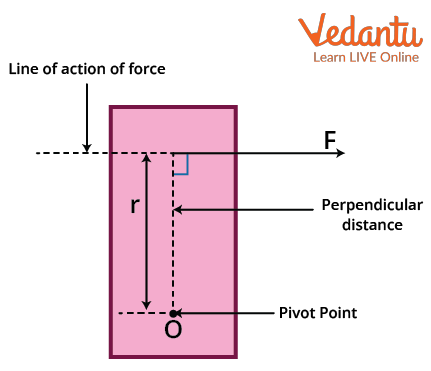
Turning Effect of Force: Meaning and Definition
The turning effect of force definition states it as the tendency of a force to rotate an object about a pivot. This rotational influence is commonly referred to as the moment of force or torque, each playing a substantial role in the mechanics syllabus of class 8 and class 9.
The turning effect of force depends primarily on two factors: the magnitude of force applied and the perpendicular distance from the pivot point to the line of action of the force. Adjusting either alters the moment produced.
Mathematical Formula: Quantifying the Turning Effect
When a force F is applied at a distance r from a fixed point (pivot), the moment of force or turning effect (denoted as M) is calculated as:
- Moment of force = Applied force × perpendicular distance
- M = F × r
- Measured in Newton-meters (N·m)
If the force tends to rotate the object clockwise, the moment is negative by convention; if anticlockwise, it is positive. This mathematical precision is critical in problem-solving and conceptual understanding in competitive physics exams.
Torque is a closely related term frequently encountered in the study of rotational motion. For advanced clarity, see the topic torque for in-depth insights.
Factors Affecting the Turning Effect of Force
Several parameters influence the turning effect of force. Recognizing these allows you to predict or manipulate rotational motion in various systems or applications.
- Magnitude of the force applied
- Perpendicular distance from the pivot point
- Direction of the force with respect to the axis
Increasing the applied force, or the distance from the pivot, increases the turning effect. This foundational concept appears in class 9 and class 8 physics under different scenarios and practical tasks.
Distinguishing Moment of Force and Torque
While often used interchangeably, moment of force and torque present nuanced differences, especially in mechanical contexts. Both share the unit Newton-meter, yet torque typically describes rotational force causing angular acceleration, while moment of force can include static situations.
| Moment of Force | Torque |
|---|---|
| Tendency to rotate, even if not moving | Actual rotational effect with angular motion |
| Can exist without motion | Associated with movement |
| Found in static equilibrium analyses | Seen in engines and rotating systems |
For applied and theoretical distinctions, visit our difference between motor and generator page for related concepts.
Everyday Turning Effect of Force Examples
Turning effect of force examples abound in daily life. Opening a tap, swinging a cricket bat, or using a wrench all demonstrate the concept practically. In Urdu, the turning effect of force meaning is “quwati gardish ka asar”—highlighting its universal relevance across languages and curricula.
- Pushing a door open at its edge
- Using a fork to twist pasta
- Pedaling a bicycle
- Balancing a seesaw on a playground
Further examples and comparative details appear in the topic angular momentum of rotating body, connecting rotational principles with conservation laws.
Sample Solved Numericals: Applying the Formula
Consider a wrench applying a force of 50 N at a distance of 0.2 meters from a bolt. The moment of force is calculated as M = F × r = 50 × 0.2 = 10 N·m. This simple calculation illustrates the quantitative use of the turning effect of force formula.
Suppose two children are on a seesaw. If one child applies a downward force of 250 N at a seat 1.5 meters from the pivot, the turning effect exerted will be 250 × 1.5 = 375 N·m in the downward direction. Practice like this helps prepare for both theoretical and numerical problems in JEE Main Physics.
Why the Turning Effect of Force Matters in Physics
Many real-world mechanisms rely on a controlled turning effect of force, from vehicle steering systems to industrial robots. Mastery of this concept helps in deeper topics such as rotational equilibrium, torque-induced motion, and conservation of angular momentum.
For a more comprehensive view of forces in rotating systems, explore our article on moment of force and circular motion for detailed real and theoretical examples.
Further Exploration and Practice
Students are encouraged to use worksheets to reinforce their understanding. These often include turning effect of forces worksheet problems tailored for class 8 and class 9, covering both direct calculation and conceptual reasoning with force and distance changes.
Working through diverse numericals and scenarios with Vedantu ensures a thorough grip over turning effect of force examples, limitations, and its pivotal formula, setting you up for success in exams like JEE and beyond.


FAQs on Understanding the Turning Effect of Force in Physics
1. What is the turning effect of force?
The turning effect of force is called moment of force or torque. It refers to the ability of a force to rotate an object about a fixed point or axis. This concept is essential in physics for understanding how levers, doors, and other rotating objects work.
- The turning effect depends on both the magnitude of the force and the distance from the pivot.
- The formula is: Torque = Force × Perpendicular distance from the pivot.
- This effect is crucial in mechanics and real-life applications like using a spanner or opening a door.
2. What factors affect the turning effect of a force?
The turning effect of a force depends mainly on two factors:
- Magnitude of the force applied.
- Perpendicular distance from the line of action of the force to the pivot or axis of rotation.
A greater force or a larger distance from the pivot increases the moment of force.
3. State the unit of the turning effect of force.
The SI unit of turning effect of force, also known as moment of force (torque), is Newton-metre (N·m).
- 1 N·m = 1 Newton × 1 metre
4. How can you increase the turning effect of force applied to a body?
To increase the turning effect of force on a body:
- Push with a larger force.
- Apply the force further from the pivot point.
- Use a longer handle (like in levers or spanners).
These changes increase the moment of force and make rotation easier.
5. Give an example of turning effect of force in daily life.
A common example of the turning effect of force is opening a door:
- You apply force at the edge, far from the hinges (pivot).
- The door turns more easily because the perpendicular distance is large.
Other examples include using a see-saw, steering a bicycle, or loosening a nut with a spanner.
6. What is meant by the moment of force and how is it calculated?
The moment of force is the turning effect produced by a force about a pivot. It is calculated as:
- Moment of force = Force (N) × Perpendicular distance (m) from pivot
It is measured in Newton-metre (N·m).
7. What is the condition for the equilibrium of a turning body?
For a body to remain in equilibrium under the action of turning forces:
- The sum of clockwise moments about a point must equal the sum of anticlockwise moments about the same point.
This is known as the principle of moments.
8. Define the principle of moments.
The principle of moments states:
- For a body in equilibrium, the sum of clockwise moments about a point is equal to the sum of anticlockwise moments about that point.
This principle helps in solving balance and lever problems.
9. What is meant by the line of action of a force?
The line of action of a force is the straight path along which a force acts on a body.
- The perpendicular distance from the pivot to this line determines the moment of force.
10. How does the direction of force affect its turning effect?
The direction of force affects the turning effect as follows:
- A force perpendicular to the lever arm produces maximum turning effect (torque).
- If the force is parallel to the lever arm, the turning effect is zero.
11. Name the two types of moments and explain each.
There are two types of moments based on direction:
- Clockwise moment: Tends to turn the object in the clockwise direction.
- Anticlockwise moment: Tends to turn the object in the opposite direction (counterclockwise).
12. What happens to the turning effect if the perpendicular distance from the pivot increases?
If the perpendicular distance from the pivot increases, the turning effect of force (moment) also increases, making it easier to rotate the object.
