




Explain the formation of the following molecules using valence bond theory
(a) ${N_2}$ molecules
(b) ${O_2}$ molecules
Answer
 Verified
278.4k+ views
Hint: Valence bond theory explains formation of molecule. If in a system, force of attraction between electrons of an atom and nucleus of another atom increases, energy of the system decreases and then the possibility of chemical bonding exists.
Complete step by step answer:
We can explain the formation of ${O_2}$ and ${N_2}$ molecules on the basis of valence bond theory. A covalent bond is formed by partial overlay of two half-filled atomic orbitals containing electrons with opposite spin.
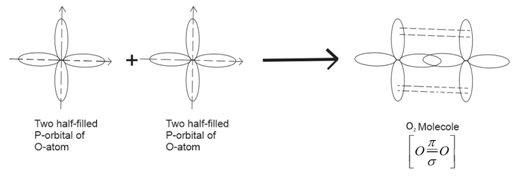
Formation of ${O_2}$molecule:
Electronic configuration of oxygen is, $1{s^2}2{s^2}2p_x^22p_y^12p_2^1.$
When an atom of oxygen approaches another atom unpaired electrons present in $2{p_y}$ and $2{p_z}$ orbital overlap and form covalent bonds.
Two atoms are held by one $\sigma $-bond and one $\pi $-bond.
Formation of ${N_2}$ molecule:
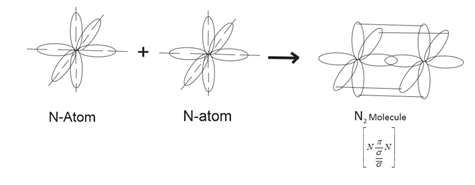
Electronic configuration of nitrogen is, $1{s^2}2{s^2}2p_x^12p_y^12p_2^1.$
When one atom of Nitrogen approaches another atom of $N$,then$2{p_x},2{p_y}$ and $2{p_z}$ atomic orbitals overlap and form a covalent bond. As orbitals approach each other the energy of the system gets lower and forms stable molecules both nitrogen atoms held together by one $\sigma $ and two $\pi $ bonds.
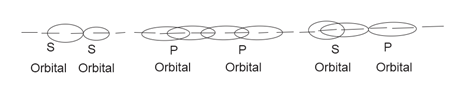
Sigma bonds form by overlap of atomic orbitals of two atoms along the internuclear axis.
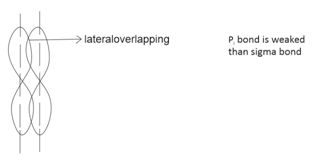
P1 $(\pi )$ bond formed by lateral overlapping of p-orbitals.
Note: Oxygen molecule has double bond between two O-atoms one bond is sigma bond and other bond is $\pi $ bond. Nitrogen molecules have a Triple bond between two N-atoms of which one bond is a sigma bond and two bonds or $\pi $-bonds.
Triple bond is stronger than double bond.
Complete step by step answer:
We can explain the formation of ${O_2}$ and ${N_2}$ molecules on the basis of valence bond theory. A covalent bond is formed by partial overlay of two half-filled atomic orbitals containing electrons with opposite spin.
Formation of ${O_2}$molecule:
Electronic configuration of oxygen is, $1{s^2}2{s^2}2p_x^22p_y^12p_2^1.$
When an atom of oxygen approaches another atom unpaired electrons present in $2{p_y}$ and $2{p_z}$ orbital overlap and form covalent bonds.
Two atoms are held by one $\sigma $-bond and one $\pi $-bond.
Formation of ${N_2}$ molecule:
Electronic configuration of nitrogen is, $1{s^2}2{s^2}2p_x^12p_y^12p_2^1.$
When one atom of Nitrogen approaches another atom of $N$,then$2{p_x},2{p_y}$ and $2{p_z}$ atomic orbitals overlap and form a covalent bond. As orbitals approach each other the energy of the system gets lower and forms stable molecules both nitrogen atoms held together by one $\sigma $ and two $\pi $ bonds.
Sigma bonds form by overlap of atomic orbitals of two atoms along the internuclear axis.
P1 $(\pi )$ bond formed by lateral overlapping of p-orbitals.
Note: Oxygen molecule has double bond between two O-atoms one bond is sigma bond and other bond is $\pi $ bond. Nitrogen molecules have a Triple bond between two N-atoms of which one bond is a sigma bond and two bonds or $\pi $-bonds.
Triple bond is stronger than double bond.
Recently Updated Pages
With which part the mRNA should be bound to initiate class 12 biology JEE_Main

Which one of the following is an example of a biofertiliser class 12 biology JEE_Main
A straight line goes through the points pq and rs -class-11-mathematics-JEE_Main
Which of the following protein destroys the antigen class 12 biology JEE_Main
Which of the following scientists discovered the Pasteurization class 11 biology JEE_Main
Explain the experiment of Julius von Sachs class 11 biology JEE_Main
Trending doubts
JEE Main 2026: Exam Dates, Session 2 Updates, City Slip, Admit Card & Latest News
Understanding the Electric Field of a Uniformly Charged Ring
Derivation of Equation of Trajectory Explained for Students
Understanding Atomic Structure for Beginners
How to Convert a Galvanometer into an Ammeter or Voltmeter
Understanding Combined Translation and Rotational Motion
Other Pages
JEE Advanced 2026 Notification Out with Exam Date, Registration (Extended), Syllabus and More
JEE Advanced Percentile vs Marks 2026: JEE Main Cutoff, AIR & IIT Admission Guide
JEE Advanced Weightage Chapter Wise 2026 for Physics, Chemistry, and Mathematics
NCERT Solutions For Class 11 Chemistry In Hindi Chapter 1 Some Basic Concepts Of Chemistry - 2026-27
Electron Gain Enthalpy and Electron Affinity Explained
Understanding Instantaneous Velocity