




What is the distance between the circumcentre and the centroid of a triangle having coordinates as (6,0), (0,6), and (6,6)?
A. 2
B. $\sqrt 2 $
C. 1
D. $2\sqrt 2 $
Answer
 Verified
249.6k+ views
Hint: Observe the type of triangle given in the question. The centroid of a triangle is a point where the medians of the triangle intersect. The circumcentre of a triangle at which all the perpendicular bisectors intersect. It can also be said that the circumcentre of a triangle is the center of the circle circumscribing it. The coordinates of the centroid of a triangle having the vertices as $\left( {{x_1},{y_1}} \right),\left( {{x_2},{y_2}} \right),\left( {{x_3},{y_3}} \right)$ are $\left( { \dfrac{{{x_1} + {x_2} + {x_3}}}{3}, \dfrac{{{y_1} + {y_2} + {y_3}}}{3}} \right)$ respectively.
Formula used:
1. The distance between the two points \[\left( {{x_1},{y_1}} \right)\]and \[\left( {{x_2},{y_2}} \right)\] is given by the distance formula.
\[d=\sqrt{(\mathrm{(x_2-x_1)}^2)+(\mathrm{(y_2-y_1)}^2)}\]
2. We know that the coordinates of the centroid of a triangle having the vertices as $\left( {{x_1},{y_1}} \right),\left( {{x_2},{y_2}} \right),\left( {{x_3},{y_3}} \right)$ are:
$\left( { \dfrac{{{x_1} + {x_2} + {x_3}}}{3}, \dfrac{{{y_1} + {y_2} + {y_3}}}{3}} \right)$
Complete step by step Solution:
We know that the coordinates of the centroid of a triangle having the vertices as $\left( {{x_1},{y_1}} \right),\left( {{x_2},{y_2}} \right),\left( {{x_3},{y_3}} \right)$ are:
$\left( { \dfrac{{{x_1} + {x_2} + {x_3}}}{3}, \dfrac{{{y_1} + {y_2} + {y_3}}}{3}} \right)$
Hence, for a triangle with vertices (6,0), (0,6), and (6,6), the coordinates of its centroid are:
$\left( { \dfrac{{6 + 0 + 6}}{3}, \dfrac{{0 + 6 + 6}}{3}} \right) = \left( {4,4} \right)$
Therefore, the coordinates of the centroid are (4,4) respectively. … (1)
Plotting the given coordinates on the coordinate plane to obtain the triangle,
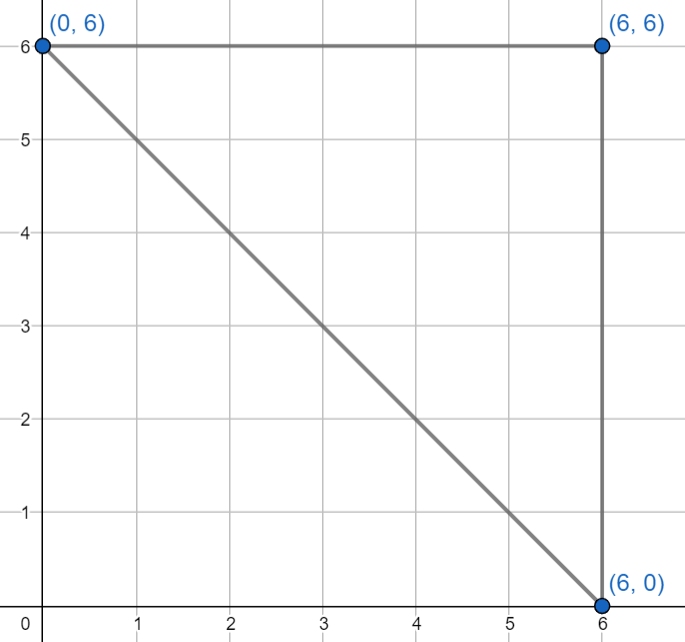
The obtained triangle is a right-angle triangle.
For a right-angle triangle, the circumcentre lies at the midpoint of the hypotenuse itself, as that is where the perpendicular bisectors meet.
Thus, for the given triangle, the circumcentre is at the midpoint point of the hypotenuse respectively.
Using the ratio formula, the coordinates of the midpoint of the hypotenuse are:
$\left( { \dfrac{{0 + 6}}{2}, \dfrac{{6 + 0}}{2}} \right) = (3,3)$
Hence, the coordinates of the circumcentre of the given triangle are (3,3) respectively.
Now, we’ll calculate the distance between the centroid and the circumcentre using the distance formula.
The distance between (4,4) and (3,3) is calculated as:
$\sqrt {{{(4 - 3)}^2} + {{(4 - 3)}^2}} = \sqrt 2 $
Hence, the distance between the centroid and the circumcentre of the given triangle is $\sqrt 2 $ units respectively.
Therefore, the correct option is B.
Note: Consider a right-angle triangle and a circle circumscribing at. As the hypotenuse subtends a right angle at the circumference of the circle circumscribing the triangle, this makes the hypotenuse a diameter of the circumcircle. Now, the center of this circle is the midpoint of its diameter, that is, the hypotenuse. Hence, the circumcentre of a right-angle triangle is at the center of its hypotenuse.
Formula used:
1. The distance between the two points \[\left( {{x_1},{y_1}} \right)\]and \[\left( {{x_2},{y_2}} \right)\] is given by the distance formula.
\[d=\sqrt{(\mathrm{(x_2-x_1)}^2)+(\mathrm{(y_2-y_1)}^2)}\]
2. We know that the coordinates of the centroid of a triangle having the vertices as $\left( {{x_1},{y_1}} \right),\left( {{x_2},{y_2}} \right),\left( {{x_3},{y_3}} \right)$ are:
$\left( { \dfrac{{{x_1} + {x_2} + {x_3}}}{3}, \dfrac{{{y_1} + {y_2} + {y_3}}}{3}} \right)$
Complete step by step Solution:
We know that the coordinates of the centroid of a triangle having the vertices as $\left( {{x_1},{y_1}} \right),\left( {{x_2},{y_2}} \right),\left( {{x_3},{y_3}} \right)$ are:
$\left( { \dfrac{{{x_1} + {x_2} + {x_3}}}{3}, \dfrac{{{y_1} + {y_2} + {y_3}}}{3}} \right)$
Hence, for a triangle with vertices (6,0), (0,6), and (6,6), the coordinates of its centroid are:
$\left( { \dfrac{{6 + 0 + 6}}{3}, \dfrac{{0 + 6 + 6}}{3}} \right) = \left( {4,4} \right)$
Therefore, the coordinates of the centroid are (4,4) respectively. … (1)
Plotting the given coordinates on the coordinate plane to obtain the triangle,
The obtained triangle is a right-angle triangle.
For a right-angle triangle, the circumcentre lies at the midpoint of the hypotenuse itself, as that is where the perpendicular bisectors meet.
Thus, for the given triangle, the circumcentre is at the midpoint point of the hypotenuse respectively.
Using the ratio formula, the coordinates of the midpoint of the hypotenuse are:
$\left( { \dfrac{{0 + 6}}{2}, \dfrac{{6 + 0}}{2}} \right) = (3,3)$
Hence, the coordinates of the circumcentre of the given triangle are (3,3) respectively.
Now, we’ll calculate the distance between the centroid and the circumcentre using the distance formula.
The distance between (4,4) and (3,3) is calculated as:
$\sqrt {{{(4 - 3)}^2} + {{(4 - 3)}^2}} = \sqrt 2 $
Hence, the distance between the centroid and the circumcentre of the given triangle is $\sqrt 2 $ units respectively.
Therefore, the correct option is B.
Note: Consider a right-angle triangle and a circle circumscribing at. As the hypotenuse subtends a right angle at the circumference of the circle circumscribing the triangle, this makes the hypotenuse a diameter of the circumcircle. Now, the center of this circle is the midpoint of its diameter, that is, the hypotenuse. Hence, the circumcentre of a right-angle triangle is at the center of its hypotenuse.
Recently Updated Pages
Mutually Exclusive vs Independent Events: Key Differences Explained

Area vs Volume: Key Differences Explained for Students
JEE Main 2026 April 6 Session Shift 1 Question Paper Analysis & Solutions PDF | Free Download
JEE Main 2026 Chemistry Question Paper April 6 Shift 2 with Solutions PDF
JEE Main 2026 April 6 Shift 2 Physics Question Paper with Solutions PDF
JEE Main 2026 Maths Question Paper April 6 Shift 2 with Answers PDF
Trending doubts
JEE Main 2026 Session 2 Registration (Reopened): Apply Now
BITSAT 2026 Registration Open: Check Last Date, Exam Dates & Correction Window
Understanding Newton’s Laws of Motion
Understanding Motion in a Vertical Circle
Molarity and Molality Explained for JEE and Class 11 Chemistry
Understanding Sign Convention for Lenses and Mirrors
Other Pages
NCERT Solutions For Class 10 Maths Chapter 11 Areas Related To Circles - 2025-26
NCERT Solutions For Class 10 Maths Chapter 14 Probability - 2025-26
CBSE Class 10 Maths 2025 Set 1 Question Paper (Standard)
CBSE Class 10 Maths Question Paper Set 1 (30/1/1) 2025: PDF, Solutions & Analysis
Pregnancy Conception Calculator: Estimate Your Conception and Fertility Window
CBSE Class 10 Maths Question Paper Set 3 2025 (Standard) – PDF, Solutions & Pattern