




Colour of CuO is
A. Black
B. Blue
C. Green
D. Red
Answer
 Verified
270.9k+ views
Hint: In order to answer the question , we need to have a detailed idea about the structure of CuO. We should also be familiar with the physical and chemical properties of CuO.
Complete step-by-step answer:
Let us have a look into the structure of CuO.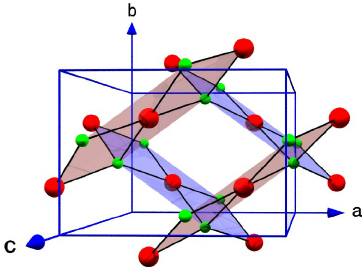
The red structures are the Copper atoms and the green structures are the oxygen atoms.
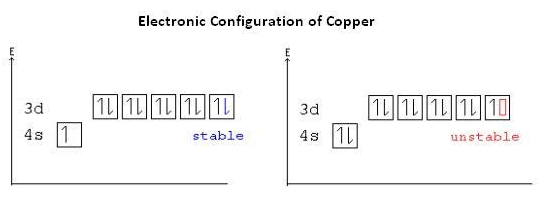
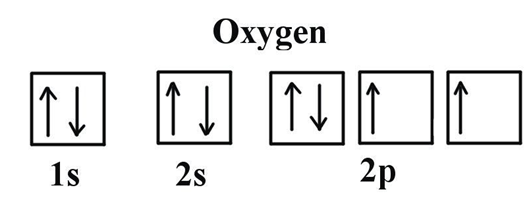
The atomic number of copper is 29. And that of oxygen is 8.
So the electronic configurations of both the elements are given below:
The main factor to occur the colour of the compounds of d block, is having the d orbitals with an incomplete electron filling in the middle atom.
There is an inequality of energy, among those d orbitals. Therefore d-d electrons exchange among those orbitals by absorbing energy. The amount of energy consumption causes the colour of the compound. Here, different amounts of energy need to exchange different numbers of electrons. Thereby the wavelengths absorbed in the process changes, and consequently different colours occur.
The colour of CuO is known to be Black. So the correct option is Option A.
Note: We should be knowing the few uses of CuO. So here are some uses of CuO listed below:
Used in the welding process along with various copper alloys.
Used as a precursor in various copper containing products like wood preservatives and ceramics.
Some properties of CuO are:
Super Thermal Conductivity.
CuO shows photovoltaic properties.
It has high stability and high antimicrobial activity.
Complete step-by-step answer:
Let us have a look into the structure of CuO.
The red structures are the Copper atoms and the green structures are the oxygen atoms.
The atomic number of copper is 29. And that of oxygen is 8.
So the electronic configurations of both the elements are given below:
The main factor to occur the colour of the compounds of d block, is having the d orbitals with an incomplete electron filling in the middle atom.
There is an inequality of energy, among those d orbitals. Therefore d-d electrons exchange among those orbitals by absorbing energy. The amount of energy consumption causes the colour of the compound. Here, different amounts of energy need to exchange different numbers of electrons. Thereby the wavelengths absorbed in the process changes, and consequently different colours occur.
The colour of CuO is known to be Black. So the correct option is Option A.
Note: We should be knowing the few uses of CuO. So here are some uses of CuO listed below:
Used in the welding process along with various copper alloys.
Used as a precursor in various copper containing products like wood preservatives and ceramics.
Some properties of CuO are:
Super Thermal Conductivity.
CuO shows photovoltaic properties.
It has high stability and high antimicrobial activity.
Recently Updated Pages
JoSAA Counselling 2026: JoSAA 2026 Mock Seat Allotment LIVE: Round 2 Result Released, Registration, Choice Filling and Ranks

Disproportionation Reaction: Definition, Example & JEE Guide
Hess Law of Constant Heat Summation: Definition, Formula & Applications
JEE General Topics in Chemistry Important Concepts and Tips
JEE Extractive Metallurgy Important Concepts and Tips for Exam Preparation
JEE Atomic Structure and Chemical Bonding important Concepts and Tips
Trending doubts
Understanding Atomic Structure for Beginners
Understanding the Different Types of Solutions in Chemistry
JEE Main Marking Scheme 2026- Paper-Wise Marks Distribution and Negative Marking Details
Electron Gain Enthalpy and Electron Affinity Explained
Understanding Electromagnetic Waves and Their Importance
Understanding Instantaneous Velocity
Other Pages
JEE Main Colleges 2026: Complete List of Participating Institutes
Ideal and Non-Ideal Solutions Explained for Class 12 Chemistry
Understanding the Angle of Deviation in a Prism
Degree of Dissociation: Meaning, Formula, Calculation & Uses
CBSE Notes Class 11 Chemistry Chapter 7 - Redox Reaction - 2026-27
Understanding Displacement and Velocity Time Graphs