




Aniline reacts with which of these to form Schiff’s base?
A. Acetic acid
B. Benzaldehyde
C. Acetone
D. \[N{H_3}\]
Answer
 Verified
296.4k+ views
Hint: Schiff’s base is an organic compound containing \[ - C = N - \], an imine bond. It is produced by the reaction between aromatic or aliphatic amines with a compound containing an aldehyde group.
Complete Step by Step Solution:
In this reaction to form Schiff’s base, firstly nucleophilic addition and then dehydration takes place with the elimination of water. Hence, it is a condensation reaction. As we know the structure of Schiff’s base, so, by comparing the structure of Schiff’s base and aniline, we can find out that benzaldehyde is the one which will react with aniline to give the structure same as Schiff’s base. Benzaldehyde has an aldehyde group and will form Schiff base on a reaction with aniline in an acidic condition.
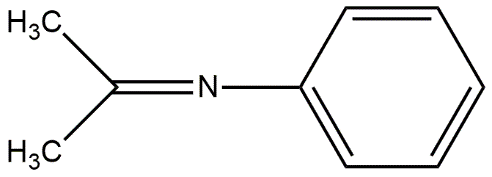
Image: Structure of Schiff’s base

Image:Condensation reaction of aniline and benzaldehyde to form Schiff’s base
Here, hydrogens from aniline and oxygen from benzaldehyde will be eliminated in the form of neutral water to give Schiff’s base and this reaction takes place in acidic conditions where acid acts as a catalyst.
So, option B is correct.
Additional Information: Schiff base is used to distinguish between aldehyde and ketone as it gives reaction selectively with an aldehyde. Schiff bases are used in many reactions as a catalyst. They are also important for reactions in living organisms like decarboxylation and cleavage of carbon-carbon single bonds. These reactions are very necessary for the living system. From the options, acetic acid is an acid. It will not form Schiff’s base; it can help in a reaction as a catalyst.
Note: We use Schiff base mostly for those complexes which are in reaction to forming coordination complexes. Reaction to form Schiff’s base is a selective reaction for aldehyde..
Complete Step by Step Solution:
In this reaction to form Schiff’s base, firstly nucleophilic addition and then dehydration takes place with the elimination of water. Hence, it is a condensation reaction. As we know the structure of Schiff’s base, so, by comparing the structure of Schiff’s base and aniline, we can find out that benzaldehyde is the one which will react with aniline to give the structure same as Schiff’s base. Benzaldehyde has an aldehyde group and will form Schiff base on a reaction with aniline in an acidic condition.
Image: Structure of Schiff’s base
Image:Condensation reaction of aniline and benzaldehyde to form Schiff’s base
Here, hydrogens from aniline and oxygen from benzaldehyde will be eliminated in the form of neutral water to give Schiff’s base and this reaction takes place in acidic conditions where acid acts as a catalyst.
So, option B is correct.
Additional Information: Schiff base is used to distinguish between aldehyde and ketone as it gives reaction selectively with an aldehyde. Schiff bases are used in many reactions as a catalyst. They are also important for reactions in living organisms like decarboxylation and cleavage of carbon-carbon single bonds. These reactions are very necessary for the living system. From the options, acetic acid is an acid. It will not form Schiff’s base; it can help in a reaction as a catalyst.
Note: We use Schiff base mostly for those complexes which are in reaction to forming coordination complexes. Reaction to form Schiff’s base is a selective reaction for aldehyde..
Recently Updated Pages
JEE Main 2025-26 Mock Test: Organic Compounds Containing Oxygen

Purification and Characterisation of Organic Compounds JEE Main 2025-26 Mock Test
JEE Main 2025-26 P Block Elements Mock test-2 Free Online Practice
JEE Main 2025-26 Mock Test: Organic Compounds Containing Oxygen
JEE Main Equilibrium Mock test-2 (2025-26) – Free Practice
JEE Main 2025-26 Equilibrium Mock Test: Free Practice Online
Trending doubts
JEE Main 2026: Exam Dates, Session 2 Updates, City Slip, Admit Card & Latest News
Understanding the Electric Field of a Uniformly Charged Ring
Understanding Atomic Structure for Beginners
Derivation of Equation of Trajectory Explained for Students
Electron Gain Enthalpy and Electron Affinity Explained
How to Convert a Galvanometer into an Ammeter or Voltmeter
Other Pages
NCERT Solutions For Class 12 Chemistry Chapter 2 Electrochemistry - 2026-27 Free PDF Download (Sign-in Required)
NCERT Solutions For Class 12 Chemistry Chapter 1 Solutions - 2026-27 Free PDF Download (Sign-in Required)
NCERT Solutions For Class 12 Chemistry Chapter 3 Chemical Kinetics - 2026-27 Free PDF Download (Login Required)
CBSE Notes Class 12 Chemistry Chapter 1 - Solutions - 2026-27 PDF Download (Login Required)
NCERT Solutions for Class 12 Chemistry Chapter 6 Haloalkanes and Haloarenes - 2026-27 Free PDF Download (Sign-In Required)
NCERT Solutions For Class 12 Chemistry Chapter 7 Alcohol Phenol And Ether - 2026-27 Free PDF Download (Login Required)
NCERT Solutions For Class 12 Chemistry Chapter 2 Electrochemistry - 2026-27 Free PDF Download (Sign-in Required)
NCERT Solutions For Class 12 Chemistry Chapter 1 Solutions - 2026-27 Free PDF Download (Sign-in Required)
NCERT Solutions For Class 12 Chemistry Chapter 3 Chemical Kinetics - 2026-27 Free PDF Download (Login Required)